IGF-1 LR3 Side Effects and Benefits: Research Data
What IGF-1 LR3 is, what cell and animal studies found, why its human side effects are unknown, and what the IGF-1 drug label warns about.
Research summary
IGF-1 LR3 is an engineered cell-culture analogue, and the article's dated ClinicalTrials.gov search found no registered human trial under its listed names.[1]
- Reported biological effects and potential harms come from laboratory and animal research; effects in people are not established.[3]
- Mecasermin is a different, approved IGF-1 medicine, so its label risks cannot be assigned directly to IGF-1 LR3.[8]
IGF-1 LR3 is not an approved medicine. Remy Research material is for in-vitro laboratory research only.
Summary revised November 1, 2026. This editorial update does not constitute a new literature review.
Update History ▾
Research-use-only framing applied throughout in line with Remy editorial standards.
What Is IGF-1 LR3? A Synthetic Analog of Insulin-Like Growth Factor
IGF-1 LR3 (Long R3 IGF-I, also written LR3IGF-I) is a recombinant analogue of human insulin-like growth factor 1 (IGF-1). It carries two changes: an arginine substitution for glutamic acid at position 3, and a 13-amino-acid extension added to the N-terminus.[10] It was first produced in the early 1990s as one of several fusion protein analogues designed to study why IGF-1 variants differ in potency.[4]
Its main commercial use is in the laboratory. Its maker describes LONG R3 IGF-I as engineered to enhance cell culture performance, as a growth factor supplement for serum-free or low-serum media, and says it is used by the biopharmaceutical industry to support the cellular growth of recombinant cell lines.[2] It is not a medicine and not the same molecule as mecasermin, the approved form of human IGF-1.[8]
Evidence and context
IGF-1 LR3 side effects in humans are unknown, because IGF-1 LR3 has never been tested in a registered human clinical trial.[1] It is an engineered analogue of insulin-like growth factor 1 made as a cell culture reagent, and a 2026 review of growth hormone axis peptides notes it was never approved for human use and has no human studies.[2][3]
What is known comes from cells and animals: stronger effects on protein synthesis and nitrogen retention than natural IGF-1, marked gut growth, and a deeper and longer fall in blood sugar.[4][5][6][7] The approved IGF-1 drug mecasermin, a different molecule, carries label warnings for low blood sugar, raised pressure in the skull and cancers.[8] WADA bans IGF-1 and its analogues in sport.[9] Remy Research supplies IGF-1 LR3 for in-vitro laboratory research only.
How IGF-1 LR3 Works: IGF Binding Proteins and the IGF-1 Receptor
IGF binding proteins hold IGF-1 and can reduce its biological activity.[6] IGF-1 LR3 binds these binding proteins poorly. In rat L6 muscle cells, which secrete binding proteins, the long analogues were more potent than IGF-1 at stimulating protein and DNA synthesis and at reducing protein breakdown. In chicken embryo cells that secrete no detectable binding proteins, Long R3 IGF-I was less potent than IGF-1, showing that the gain comes from escaping the binding proteins rather than from stronger receptor activation.[4]
In fact, IGF-1 LR3 binds the type 1 IGF-1 receptor about 3-fold less well than IGF-1, yet it was about 2.5-fold more potent in rats.[5] In hepatoma cells acting through the insulin receptor, the analogues kept a potency similar to IGF-1.[4] In cultured L6 muscle cells, the weak association with binding proteins gave IGF-1 LR3 a 5- to 10-fold greater biological potency than IGF-1.[11]
IGF-1 LR3 Benefits: What Studies Reported on Muscle and Body Composition
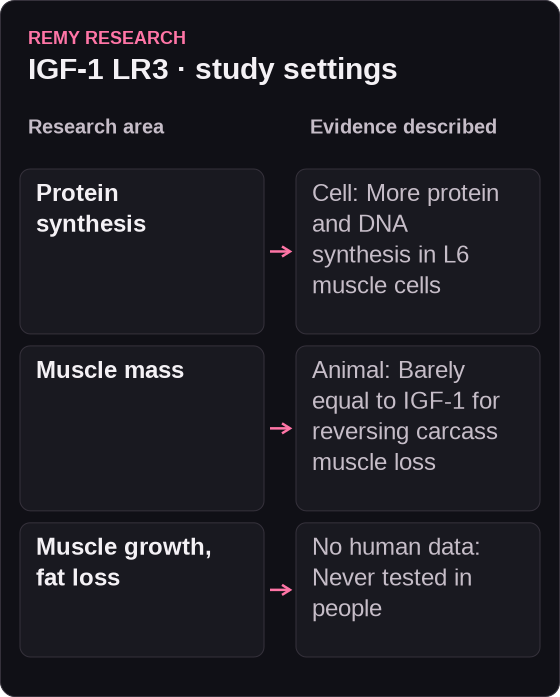
| Claimed benefit | What was reported | Evidence type |
|---|---|---|
| Protein synthesis | More protein and DNA synthesis in L6 muscle cells | Cell |
| Nitrogen retention | Body weight and nitrogen retention up in catabolic rats | Animal |
| Gut growth | Gut weight up, several-fold more potent than IGF-1 | Animal |
| Muscle mass | Barely equal to IGF-1 for reversing carcass muscle loss | Animal |
| Blood sugar | Deeper, longer drop in glucose than IGF-1 | Animal |
| Muscle growth, fat loss | Never tested in people | No human data |
Protein Synthesis and Cell Proliferation in Muscle Cells
The cell evidence is the strongest part of the record. In L6 rat myoblasts, IGF-1 LR3 and the related long analogues stimulated protein synthesis and DNA synthesis and reduced protein breakdown more potently than IGF-1.[4] That is the basis for claims that IGF-1 LR3 promotes protein synthesis, cell proliferation, muscle growth and muscle hypertrophy. It is a result in muscle cells grown in a dish, not a measurement of skeletal muscle, muscle development or lean muscle mass in a living body. No study has measured muscle growth, muscle repair or body composition in the human body.
Nitrogen Retention, Muscle Loss and Anabolic Effects in Rats
In rats made catabolic with dexamethasone, IGF-1, des(1-3)IGF-I and IGF-1 LR3 all produced dose-dependent anabolic effects on body weight and nitrogen retention, with the two analogues about 2.5-fold more potent than IGF-1.[5] Part of the effect was in the gut, which grew by up to 45%.[5] In a later rat study, IGF-1 LR3 stayed more potent than IGF-1 for several effects when given once daily, but it was barely equipotent with IGF-1 for reversing carcass muscle loss.[12] So the muscle tissue effect, the core of muscle building and muscle hypertrophy claims, was the weakest finding. In normal female rats given the peptides for 14 days, IGF-1 LR3 produced marked increases in body weight, nitrogen retention and food conversion efficiency, and kept the gut, spleen and thymus at the relative size typical of younger animals.[11] These studies report body and organ weights and carcass composition, not muscle fibre size or strength.
Gut Growth
In the same catabolic rat model, IGF-1 increased total gut weight across the stomach, small intestine and colon, and IGF-1 LR3 and des(1-3)IGF-I had similar effects at several-fold higher potency. The authors called the gut one of the most sensitive IGF-1 target tissues.[6] Gut growth is a recognised effect of the analogue in animal models, not a benefit in its own right, and it shows that IGF-1 LR3 acts on the gut and other tissues, not only on skeletal muscle.
Are There IGF-1 LR3 Clinical Trials?
No. A search of ClinicalTrials.gov for IGF-1 LR3 and its other names returns no registered human studies.[1] A 2026 review of performance-enhancing peptides acting on the growth hormone and IGF-1 axis classes IGF-1 LR3 as an unregulated peptide marketed as a research compound, never approved for human use, and stresses the complete absence of human studies.[3]
The only human-relevant studies are analytical. Anti-doping laboratories have developed methods to detect IGF-1 LR3 and its breakdown products in human plasma, because IGF-1 analogues are prohibited in sport.[13][9] No study has tested IGF-1 LR3 on athletic performance.[1]
Extended Half-Life? Fast Clearance, Prolonged Action
An extended half-life is often claimed for IGF-1 LR3. In rats, unchanged Long R3 IGF-I disappeared from the blood within about 4 hours, with breakdown products detectable up to 16 hours, so in rats its half-life in blood is short.[14] An earlier rat study also found IGF-1 LR3 was cleared from the circulation faster than IGF-1 and reached the intestine in about twice the amount.[15] Its prolonged action in animals, such as the longer fall in blood sugar, reflects weak binding-protein interaction rather than slow clearance.[7][14]
IGF-1 LR3 Side Effects: Potential Risks From Animal and Label Data
Because no human trial exists, the side effects below come from animal studies of IGF-1 LR3 itself and from the label of mecasermin, approved recombinant IGF-1, which is a different molecule.
- Low blood sugar (animal data). In pigs and marmoset monkeys, IGF-1 variants that bind poorly to binding proteins, IGF-1 LR3 included, lowered plasma glucose 2- to 3-fold more potently than IGF-1 and for much longer, with about 4- to 8-fold more cumulative hypoglycaemia over four hours. The authors raised such variants as a possible adjunct to insulin in hyperglycaemic conditions.[7]
- Organ and gut growth (animal data). The analogue enlarged the gut and visceral organs in rats.[6][12]
- Slower growth and lower hormone levels in pigs (animal data). In growing pigs, longer-term IGF-1 LR3 reduced growth rates, depressed food intake and lowered blood IGF-1, IGF-2 and IGFBP-3, the opposite of the muscle growth claims made for it.[16]
- IGF-1 class warnings (mecasermin label, a different molecule). Severe hypoglycaemia including seizures, hypersensitivity and anaphylaxis, intracranial hypertension, enlarged tonsils and adenoids, slipped capital femoral epiphysis, progression of scoliosis, and cases of malignant neoplasia in treated children. Malignant neoplasia is a contraindication. Hypoglycaemia was reported by 42% of trial subjects.[8]
- Product identity. One vial bought on the black market contained a His-tagged form of Long R3 IGF-I, a version usually made for biochemical studies, whose effects in humans have never been described.[17] Oxidised, lower-quality forms were common in black market products in a later analysis.[14]
The 2026 review lists mitogenic concerns for IGF-1 analogues as biologically plausible but unproven.[3] No source quantifies cancer risk for IGF-1 LR3 itself.
Is IGF-1 LR3 FDA Approved? Regulatory Status
- FDA approval. No. IGF-1 LR3 has never been approved for human use.[3]
- The approved IGF-1 drug. Mecasermin (Increlex), recombinant human IGF-1, is approved for growth disorders: growth failure in children aged 2 and older with severe primary IGF-1 deficiency or growth hormone gene deletion with neutralising antibodies.[8] That approval does not cover IGF-1 LR3.
- Sport. WADA’s 2027 Prohibited List names insulin-like growth factor 1 (IGF-1, mecasermin) and its analogues under S2; IGF-1 LR3 is an analogue of IGF-1.[9][10]
- UAE. Remy Research sells IGF-1 LR3 for in-vitro laboratory research only, not for human or veterinary use.
IGF-1 LR3 vs IGF-1 and Growth Hormone Peptides
IGF-1 is the hormone; IGF-1 LR3 is an engineered version that escapes IGF binding proteins and binds the IGF-1 receptor slightly less well.[4][5] Des(1-3)IGF-I, another variant often compared with LR3, was about as potent as IGF-1 LR3 in catabolic rats.[5] Growth hormone secretagogues work further up the axis, by releasing growth hormone. For those, see ipamorelin benefits and side effects, CJC-1295 and ipamorelin and the GHRH peptides comparison.
What IGF-1 LR3 Research Does Not Yet Show: No Proven Clinical Benefits
- Any human effect. No registered human trial exists.[1]
- Muscle growth in a living body. Carcass muscle results in rats were no better than IGF-1, and growing pigs grew more slowly.[12][16]
- Fat loss, tissue repair, exercise recovery or athletic performance. None of the primary studies above measured these.[4][5][12]
- Long-term safety. The animal studies lasted days to weeks.[5][12]
IGF-1 LR3 for Laboratory Research
Remy Research supplies IGF-1 LR3 for in-vitro, laboratory research use only, as the Genovare IGF-1 LR3 1,500mcg AQ pen, for research settings such as cell culture work on cellular growth. The product page carries its batch testing details.
Our Research Standards
This article prioritizes primary literature, trial registries, the FDA label of the related approved drug and regulator records, and keeps cell, animal and human evidence apart. Label data for mecasermin are marked as belonging to a different molecule. No therapeutic, dosing or administration guidance is given. Read our editorial policy →
IGF-1 LR3 Side Effects and Benefits FAQ
What are the side effects of IGF-1 LR3?
What is IGF-1 LR3?
What are the benefits of IGF-1 LR3?
Is IGF-1 LR3 FDA approved?
Is IGF-1 LR3 safe?
What is the half-life of IGF-1 LR3?
Does IGF-1 LR3 cause fat loss or enhanced recovery?
Does IGF-1 LR3 build muscle?
Is IGF-1 LR3 banned in sport?
Yes. WADA’s 2027 List prohibits IGF-1 and its analogues under S2.[9]
Sources
- ClinicalTrials.gov API v2 intervention search for “IGF-1 LR3”, “LR3-IGF-1”, “Long R3 IGF” and “LR3IGF-I”, run October 28, 2026 (0 registered studies). clinicaltrials.gov ↩
- Repligen. LONG R3 IGF-I Cell Culture Supplement: product page describing a recombinant analog of human IGF-I engineered to enhance cell culture performance in serum-free or low-serum systems, checked October 28, 2026. repligen.com ↩
- Dominikowski A, Rękoś Z, Olejarz M, et al. The emerging landscape of performance-enhancing peptides modulating GH-IGF1 axis: bridging the gap between clinical evidence and patient self-administration. Front Endocrinol (Lausanne). 2026;17:1822475. doi: 10.3389/fendo.2026.1822475 · PMID: 42395176 ↩
- Francis GL, Ross M, Ballard FJ, et al. Novel recombinant fusion protein analogues of insulin-like growth factor (IGF)-I indicate the relative importance of IGF-binding protein and receptor binding for enhanced biological potency. J Mol Endocrinol. 1992;8(3):213-223. doi: 10.1677/jme.0.0080213 · PMID: 1378742 ↩
- Tomas FM, Knowles SE, Owens PC, et al. Insulin-like growth factor-I (IGF-I) and especially IGF-I variants are anabolic in dexamethasone-treated rats. Biochem J. 1992;282(Pt 1):91-97. doi: 10.1042/bj2820091 · PMID: 1371669 ↩
- Read LC, Tomas FM, Howarth GS, et al. Insulin-like growth factor-I and its N-terminal modified analogues induce marked gut growth in dexamethasone-treated rats. J Endocrinol. 1992;133(3):421-431. doi: 10.1677/joe.0.1330421 · PMID: 1613443 ↩
- Tomas FM, Walton PE, Dunshea FR, et al. IGF-I variants which bind poorly to IGF-binding proteins show more potent and prolonged hypoglycaemic action than native IGF-I in pigs and marmoset monkeys. J Endocrinol. 1997;155(2):377-386. doi: 10.1677/joe.0.1550377 · PMID: 9415072 ↩
- INCRELEX (mecasermin) injection, US prescribing information (Ipsen Biopharmaceuticals; label effective August 5, 2025; set id a8b27a1b-a611-4f91-ad22-76d4b390c3ae), via openFDA, checked October 28, 2026. Mecasermin is recombinant human IGF-1, a different molecule from IGF-1 LR3. api.fda.gov ↩
- World Anti-Doping Agency. The 2027 Prohibited List (in force January 1, 2027); S2 names insulin-like growth factor 1 (IGF-1, mecasermin) and its analogues. wada-ama.org ↩
- Laajoki LG, et al. Solution structure and backbone dynamics of long-[Arg(3)]insulin-like growth factor-I. J Biol Chem. 2000;275(14):10009-10015. doi: 10.1074/jbc.275.14.10009 · PMID: 10744677 ↩
- Ballard FJ, Walton PE, Bastian S, et al. Effects of interactions between IGFBPs and IGFs on the plasma clearance and in vivo biological activities of IGFs and IGF analogs. Growth Regul. 1993;3(1):40-44. PMID: 7683526 ↩
- Tomas FM, Lemmey AB, Read LC, et al. Superior potency of infused IGF-I analogues which bind poorly to IGF-binding proteins is maintained when administered by injection. J Endocrinol. 1996;150(1):77-84. doi: 10.1677/joe.0.1500077 · PMID: 8708565 ↩
- Thomas A, Walpurgis K, Delahaut P, et al. Determination of LongR3-IGF-I, R3-IGF-I, Des1-3 IGF-I and their metabolites in human plasma samples by means of LC-MS. Growth Horm IGF Res. 2017;35:33-39. doi: 10.1016/j.ghir.2017.06.002 · PMID: 28668757 ↩
- Mongongu C, Coudoré F, Domergue V, et al. Detection of LongR3-IGF-I, Des(1-3)-IGF-I, and R3-IGF-I using immunopurification and high resolution mass spectrometry for antidoping purposes. Drug Test Anal. 2021;13(7):1256-1269. doi: 10.1002/dta.3016 · PMID: 33587816 ↩
- Shoubridge CA, Read LC. Preferential intestinal delivery of long[Arg3] insulin-like growth factor (LR3IGF-I) over IGF-I in preweaning and adult rats. Endocrinology. 2003;144(5):1887-1893. doi: 10.1210/en.2002-220643 · PMID: 12697696 ↩
- Walton PE, Dunshea FR, Ballard FJ. In vivo actions of IGF analogues with poor affinities for IGFBPs: metabolic and growth effects in pigs of different ages and GH responsiveness. Prog Growth Factor Res. 1995;6(2-4):385-395. PMID: 8817682 ↩
- Kohler M, Thomas A, Walpurgis K, et al. Detection of His-tagged Long-R3-IGF-I in a black market product. Growth Horm IGF Res. 2010;20(5):386-390. doi: 10.1016/j.ghir.2010.07.001 · PMID: 20675162 ↩
For catalog details, see the Genovare IGF-1 LR3 1,500mcg AQ pen. For editorial standards, continue to the editorial policy.