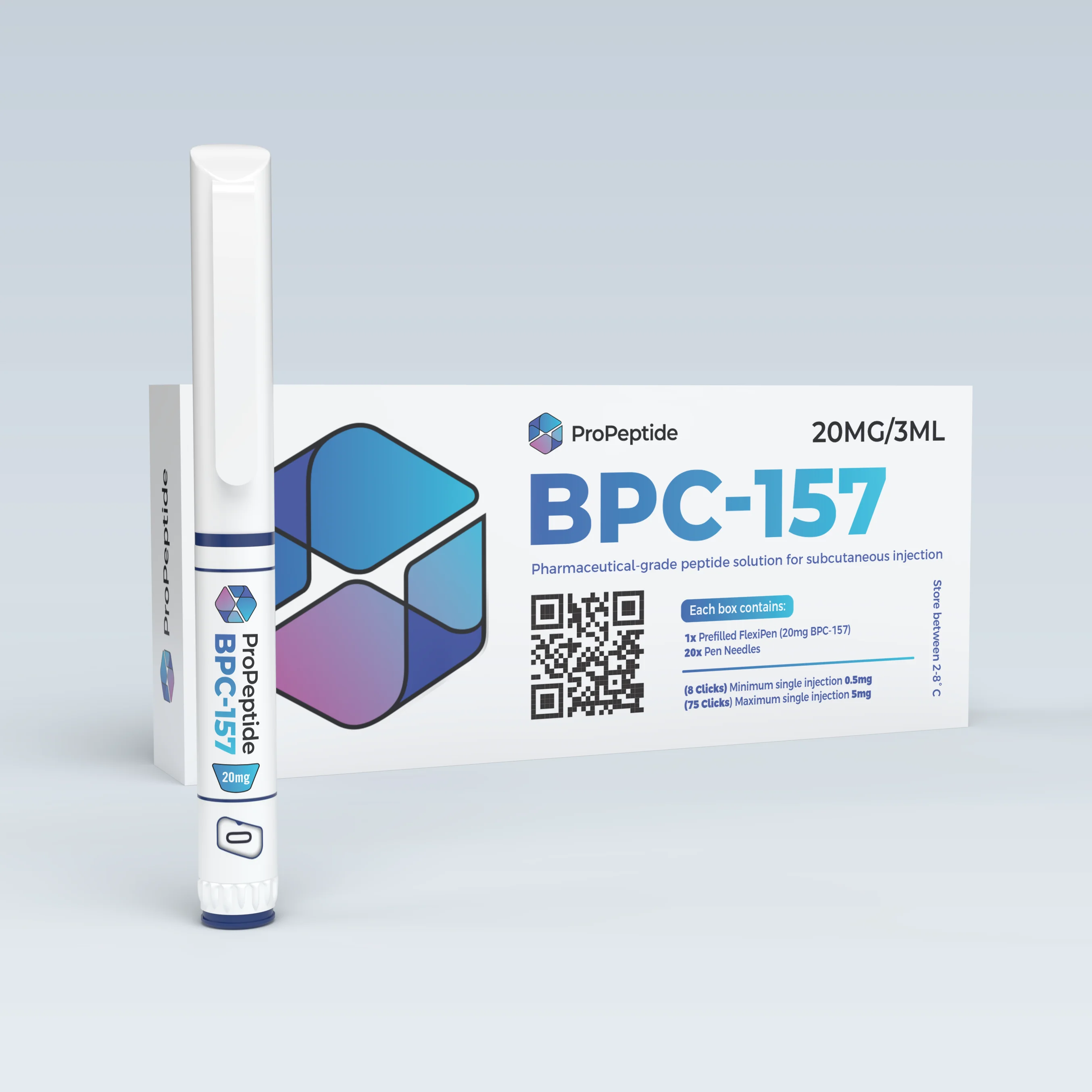
ProPeptide Pre-Filled Pen Premixed Aqueous
SpecsBuy BPC-157 20mg Pen in Dubai
Studied for muscle, ligament and bone repair
AED 400 / pen
- Quantity
- 20mg per pen (20mg / 3mL)
- Format
- Pre-filled FlexiPen device
- Purity
- 99%+
Choose your bundle
Add AED 600 more for free UAE delivery
- OrderBefore 4 PM for Dubai
- PackedCold-chain, 2–8°C
- DeliveredSame day in Dubai, next day elsewhere in the UAE
Order before 4 PM for same-day Dubai delivery.
UAE delivery: AED 50 below AED 1,000; free from AED 1,000
Pay byCash on delivery (Dubai)Card payment linkUSDT
99%+ purityIn-house tested
Specified ≥99% ProPeptide Brand Standard
- Sold by
- Remy Research
- Brand
- ProPeptide
- Manufacturer
- ProPeptide
- Tested by
- 99%+ line standard
- 99%+ purityLine standard
- Same-day DubaiOrder before 4 PM for same-day delivery
- FormatPre-filled FlexiPen device
- Cold-chain packed2–8°C
What the research shows about BPC 157
- 11 of 12 reported knee pain improvement
- Studied for tendon healing
- Studied for stomach ulcer healing
Published study results for the compound, not results from this product. For research use only.
The BPC-157 20mg pen is a pre-filled FlexiPen device containing 20mg of BPC-157 in 3mL solution, specified at 99%+ purity and supplied by Remy Research for research use only. For laboratory scientists and professional researchers in the UAE/GCC running in-vitro peptide work, this product block gives the details that matter up front: pen format, batch-standard purity, cold-chain packing at 2–8°C, and same-day Dubai or next-day UAE delivery.
BPC-157 is being studied in preclinical work for muscle, ligament, tendon, bone, and gut tissue repair, so a ready-to-use 20mg pen (identity and purity still to be verified by your own lab) can help labs source material quickly and keep research moving without extra reconstitution steps. Below, you can review the available bundle options, storage and shipping conditions, published testing references, and key supplier and regulatory details relevant to researchers comparing this format with other peptide options.
The ProPeptide BPC-157 20mg pen holds the 15-residue BPC-157 peptide as a pre-mixed aqueous solution (20mg in 3mL) inside a sealed pen device, which Remy Research ships from Dubai to laboratories. For research use only. Not for human or veterinary use.
- ≥99% Purity
- ProPeptide Brand Standard
- Same-Day Delivery
- Dubai
- Pre-Filled Pen
- Premixed Aqueous
- Storage Guidance
- Follow Package Label
- 1x Pre-filled FlexiPen device (20mg BPC-157)
- 20x Sterile pen needles
- 1x ProPeptide outer carton
- Cold-chain insulated packaging
Other formats of BPC-157
Ships from Dubai
BPC-157 in a pre-filled pen: what this listing is
This listing is the liquid, pre-filled version of BPC-157 in the ProPeptide range, designed as the pen-format alternative to the vial. Where the vial format arrives as freeze-dried powder, the pen arrives already in solution for added convenience: 20mg of peptide in a 3mL aqueous fill, sealed inside a pen-style device at the point of manufacture.
The molecule itself is the same in both formats. BPC-157 is a synthetic chain of 15 amino acids, GEPPPGKPADDAGLV, modelled on a fragment of a larger protein that a Zagreb group reported from human gastric juice in 1993. Most of the published work still comes from that laboratory.
What the published work mostly contains is rat and cell data. FDA's July 2026 briefing on BPC-157 counted only five human studies: two placebo-controlled enema studies from 2002 to 2005 that were reported only as conference abstracts, and three uncontrolled pilot reports from a single Florida physician. None of them has shown efficacy, and no country has approved BPC-157 as a medicine.
In human-use discussions, BPC-157 is commonly described as administered subcutaneously into fatty tissue, with minimal side effects often cited alongside reports of dizziness and injection-site reactions at the site. None of this has been established in controlled trials.
Delivery devices also require careful handling to avoid excessive dosage.
This pen is supplied to laboratories as a reference material and nothing more. For research use only. Not for human or veterinary use.
Pen or vial: how the two BPC-157 formats differ
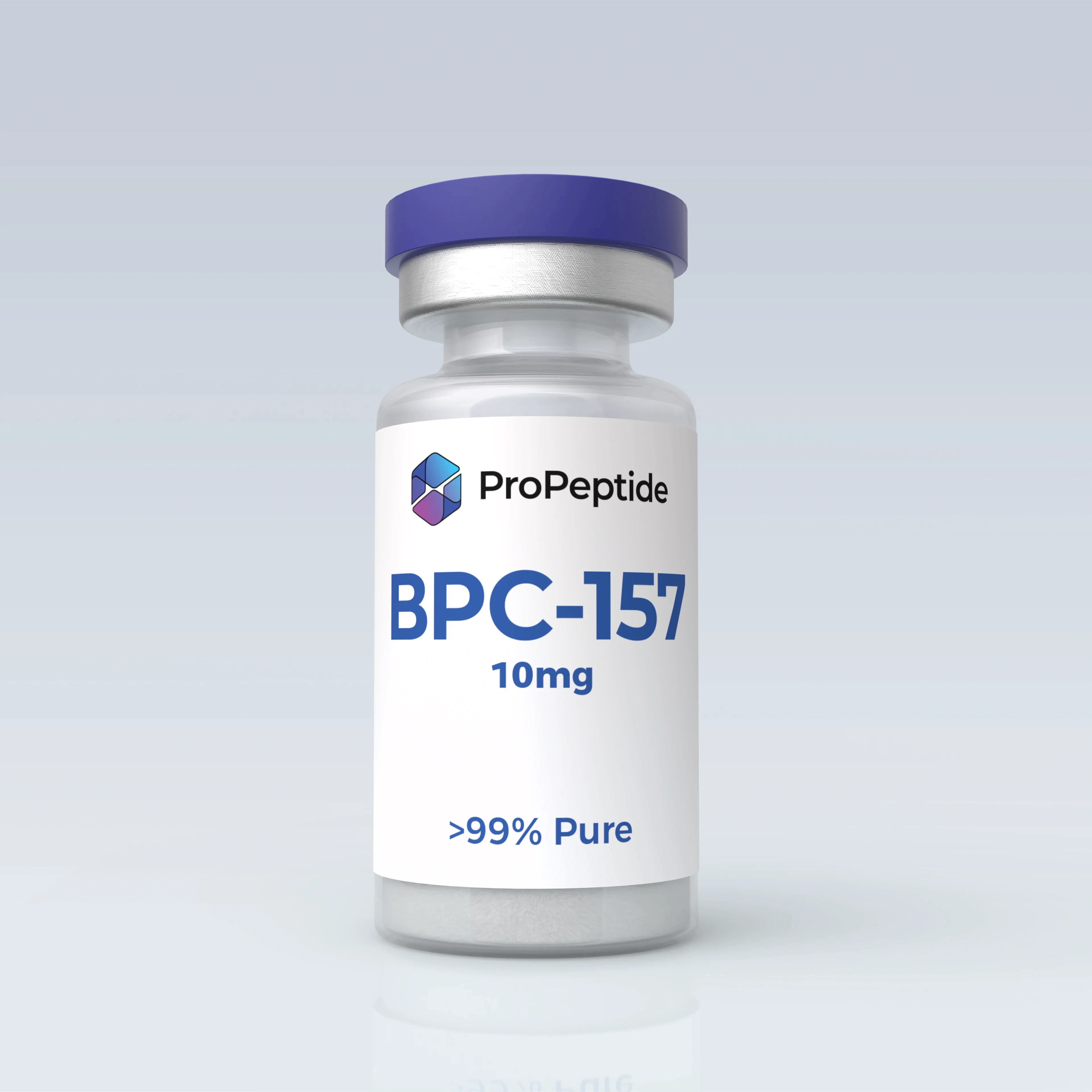
Remy Research carries ProPeptide BPC-157 in two formats. The sequence is identical; the physical form and fill are not.
Already in solution
The pen is filled as an aqueous solution before it is sealed, which ensures there is no powder-handling stage in your lab and no diluent to source. The trade-off is that the solvent, concentration and fill volume are fixed by the manufacturer rather than chosen by the researcher in this pen format.
Twice the peptide of the vial
Each pen carries a nominal 20mg of BPC-157, double the 10mg in the freeze-dried vial. Bear in mind that a label mass usually counts the whole fill of peptide salt and residual water, not net peptide alone.
Stability is the vial's strength
Peptides generally keep longer as dry powder than in liquid. If a project needs long storage, or needs to control its own solvent and concentration, the lyophilised vial is usually the better fit. For storage, the pen should be kept refrigerated at 2 to 8°C. The reasons are set out in our peptide stability and storage guide.
What is, and is not, documented
ProPeptide specifies its BPC-157 products at ≥99% purity by HPLC. That is a line specification, not a batch result: no third-party lab report for any BPC-157 pen batch is public so far.
Cold-chain delivery
We deliver to all seven emirates, and the pen stays between 2 and 8°C in cold-chain packaging throughout. Inside Dubai, anything ordered ahead of 4 PM reaches you with fast same-day delivery. Ordering cut-offs for the other emirates, and charges, are listed on the delivery page.
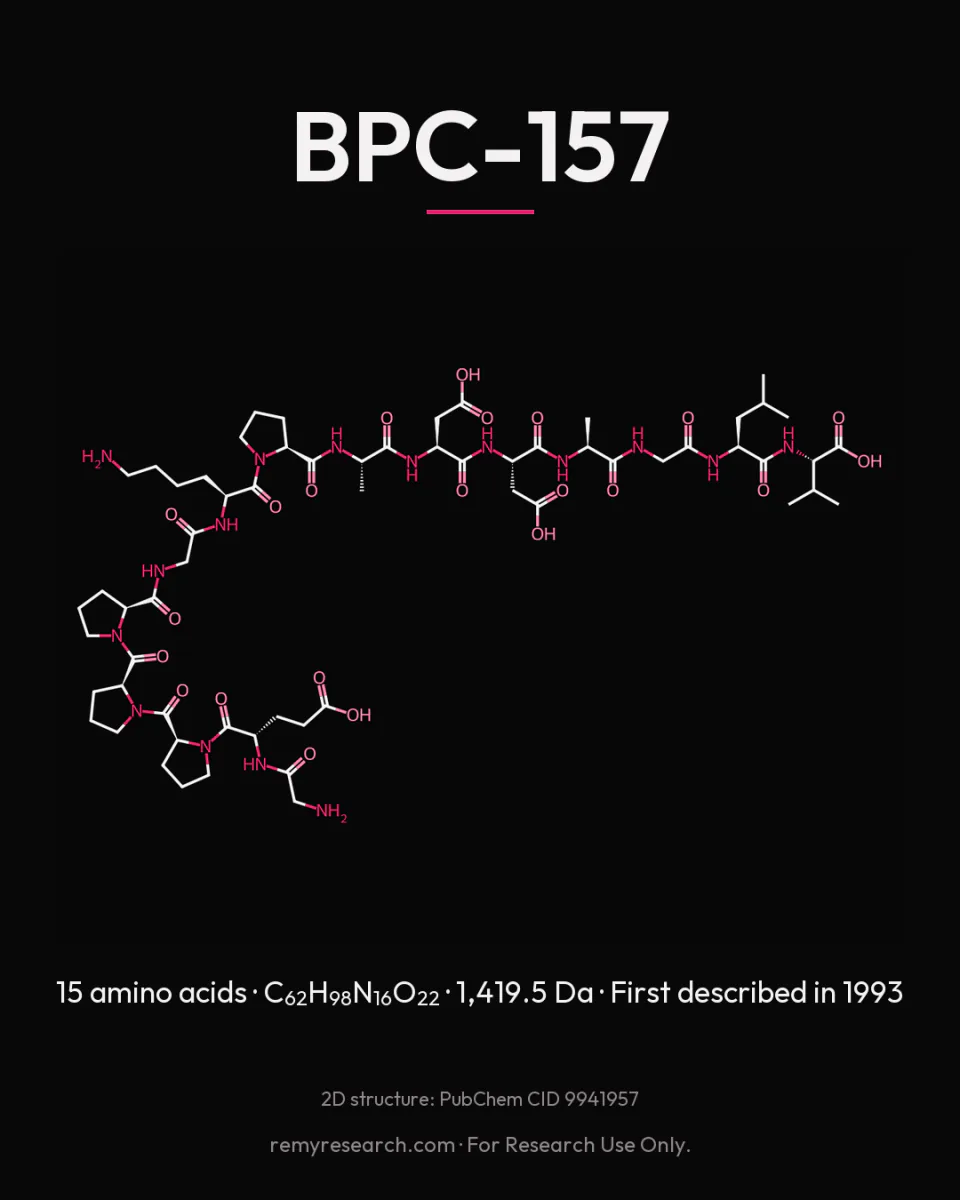
Chemistry · Reference dataBPC-157 chemistry & specifications
Identity
Synthetic pentadecapeptide
Body Protection Compound 157
Also known asBPC 157, BPC157, Bepecin, PL-14736
- CAS
- 137525-51-0
Molecule
- Formula
- C62
H98 N16 O22 - Molecular weight
- 1,419.5 g/mol Registry value for the peptide without counter-ions; not measured for this batch.
- Sequence
- Gly-Glu-Pro-Pro-Pro-Gly-Lys-Pro-Ala-Asp-Asp-Ala-Gly-Leu-Val
This product
- Manufacturer
- ProPeptide
- Quantity
- 20mg per pen (20mg / 3mL)
- Format
- Pre-filled FlexiPen device
- Purity
- Specified ≥99%
- Pen needles included
- 20x sterile
- Storage
- +2 to +8°C; maintain cold chain; no freezing; protect from light
2D structure
Batch documentation
99%+ line standard
Every report we have published is listed in the lab results library.
Reference data for laboratory checks. Registry values describe the compound, not measurements of this batch. For research use only.
Proposed mechanisms of tissue repair in the preclinical literature
Researchers have not pinned BPC-157 to a single receptor. The literature instead describes several overlapping pathways, nearly all of them observed in rodents or cultured cells. Treat each one below as a working hypothesis rather than an established effect in people.
VEGFR2 and new capillaries
In endothelial cell experiments published in 2017, BPC-157 raised the expression and activation of VEGFR2, a receptor that drives capillary growth and angiogenesis, meaning blood vessel growth, and blood flow returned sooner in rodent ischaemia models.
Nitric oxide balance
Work from the Zagreb group reports that BPC-157 counters experimentally disturbed nitric oxide signalling in rodents, including the effects of blocking nitric oxide synthase. In those rat models the authors propose this as one route by which the peptide may reduce inflammation. The inflammation link is a preclinical hypothesis; these studies do not establish effects from this pen in people.
Tendon fibroblasts
In a 2003 rat study, a surgically divided Achilles tendon healed faster in animals given BPC-157, and preclinical literature has also examined ligaments. Cell work in 2011 tied the peptide to better survival and outgrowth of tendon fibroblasts, linked to phosphorylation of focal adhesion kinase and paxillin, with preclinical discussions also linking it to collagen synthesis. These findings are often cited in discussions of how it may accelerate tissue repair and support recovery after injury in these rat and cell models. Adjacent literature discusses TB-500 in relation to cell migration and tissue regeneration. BPC-157 and TB-500 are also widely discussed in combination as the wolverine stack, including in comparison pieces on BPC-157 vs. TB-500, without establishing efficacy in humans. Some preclinical or promotional materials further claim faster recovery, joint recovery, and that the pair, when combined, may accelerate healing by 30-50%; no controlled study we know of has measured that figure.
Stomach and gut lining
The earliest experiments, which gave the compound its name, reported fewer stomach and duodenal lesions in rats exposed to alcohol and other irritants, linking those findings to gut-lining regeneration in rat models.
What this does not show
The one randomised efficacy study, an ulcerative colitis enema trial, was judged by FDA in 2026 to be too thinly reported to support effectiveness. A sham-controlled US trial is planned to start in 2027. Until controlled human data exist, these mechanisms describe animal and cell findings only, not a treatment in people, and are not enough to consider BPC-157 effective. The BPC-157 research review gives full citations, and BPC-157 vs TB-500 compares it with a peptide often studied alongside it.
For research purposes only. Not for human consumption.
Frequently Asked Questions
Where can I buy BPC-157 in Dubai?
From Remy Research, which sends this ProPeptide pen out of Dubai for research use only. If you are in Dubai and order before 4 PM, it comes the same day. Across the rest of the UAE, orders received by 12 PM (noon) land the next day; afternoon orders take up to two days. Saturday orders bound for the other emirates reach you on Monday, since no Sunday deliveries run outside Dubai. The pen is kept at 2–8°C in cold-chain packaging all the way. Charges are listed on the delivery page.
How is the pen different from the BPC-157 10mg vial?
Both hold the same 15-residue peptide. The pen contains 20mg already in a 3mL aqueous solution, sealed in a pen device; the 10mg vial contains freeze-dried powder, which generally keeps longer in storage and lets a lab choose its own solvent. Neither has a published batch-specific report yet.
Has BPC-157 been studied in people?
Only in a handful of small studies. FDA's July 2026 briefing lists five: two placebo-controlled enema studies from 2002–2005 reported only as conference abstracts, and three uncontrolled pilot reports by one Florida physician. No controlled trial has shown efficacy, so the animal findings say nothing reliable about effects in people.
Is BPC-157 an approved medicine?
No. FDA reports no approved BPC-157 product in any country. In July 2026 an FDA advisory committee voted to recommend allowing US compounding pharmacies to use it for ulcerative colitis; that vote is non-binding, and no final FDA action had followed by 12 October 2026. The BPC-157 Dubai guide sets out the wider status.
How should the pen be stored?
In a fridge at 2–8°C, out of the light and never frozen, starting the moment the cold-chain box is opened. Peptide in solution is less forgiving of warm storage than dry powder.
Can this pen be used by people or animals?
No. The pen is a reference material for in-vitro laboratory studies only. For research use only. Not for human or veterinary use.
What are the chemical identifiers of BPC-157?
BPC-157, also called Body Protection Compound 157, has CAS number 137525-51-0, molecular formula C62H98N16O22, molecular weight 1,419.5 g/mol, PubChem CID 9941957. These are registry values for the compound, not measurements of a batch.
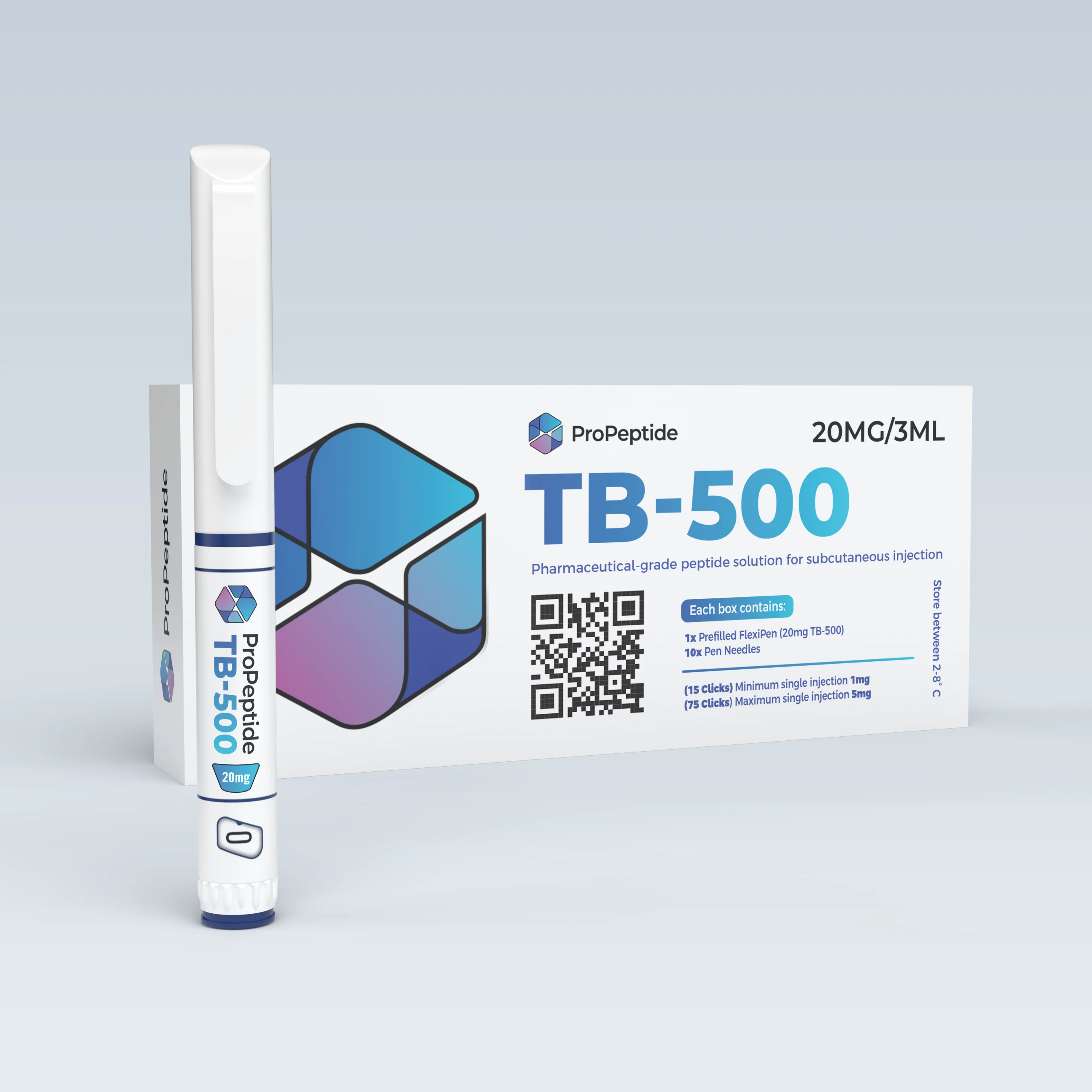
Can I buy the ProPeptide BPC-157 20mg pen together with TB-500?
The ProPeptide BPC-157 20mg pen (20mg in 3mL) costs AED 400 and holds BPC-157 on its own. A ProPeptide TB-500 20mg pen in the same format is listed too. They are two separate products. The BPC-157 vs TB-500 article linked on the page compares both compounds. Research use only.
Can I buy the ProPeptide BPC-157 20mg pen online in the UAE?
Yes. The ProPeptide BPC-157 20mg pen is a pre-filled FlexiPen with 20mg in 3mL, priced from AED 400 for one. Purchase happens at the website checkout, and the AED 400 minimum order is covered by a single pen. Delivery is cold-chain at 2 to 8°C. Research use only.
Is there a shop that sells the ProPeptide BPC-157 20mg pen near me in Dubai?
Nowhere in person: the ProPeptide BPC-157 20mg pen (AED 400) is sold through the website, since there is no walk-in store or pickup point. A cold-chain courier delivers it. Same-day arrival applies to Dubai orders placed ahead of 4 PM. The pen is supplied for research use only.