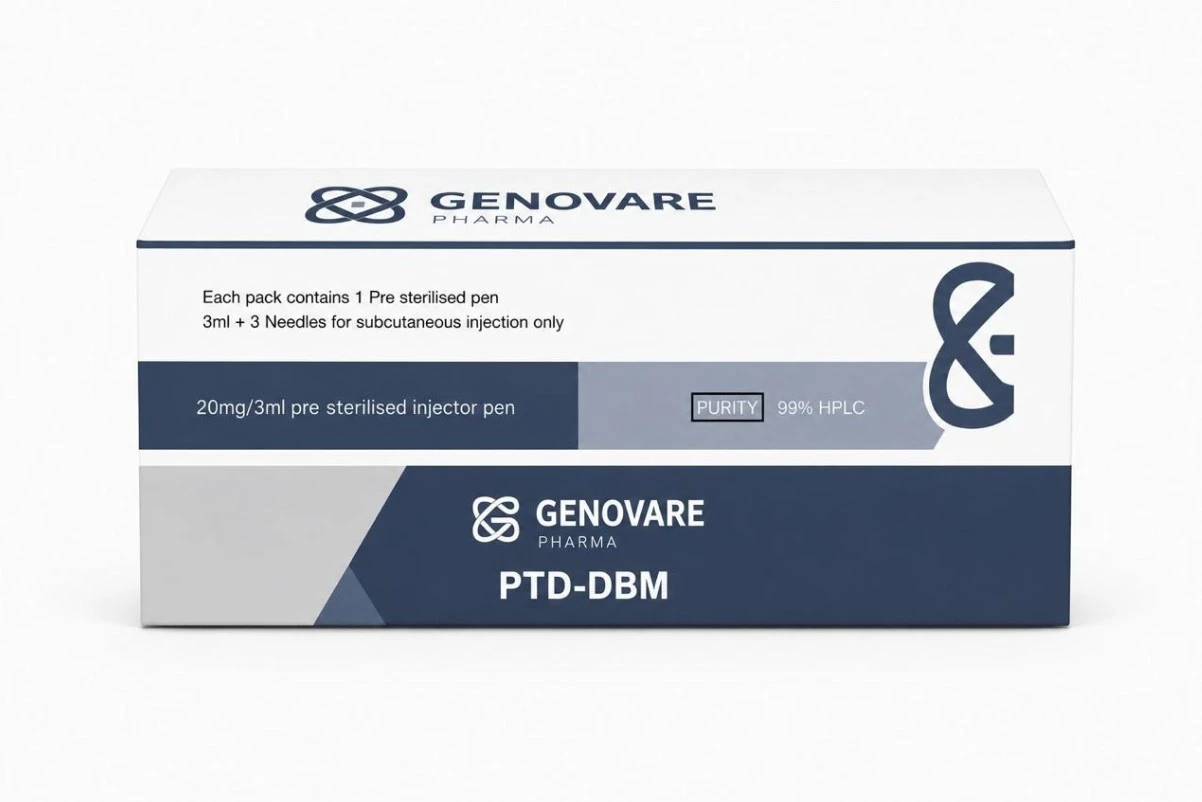
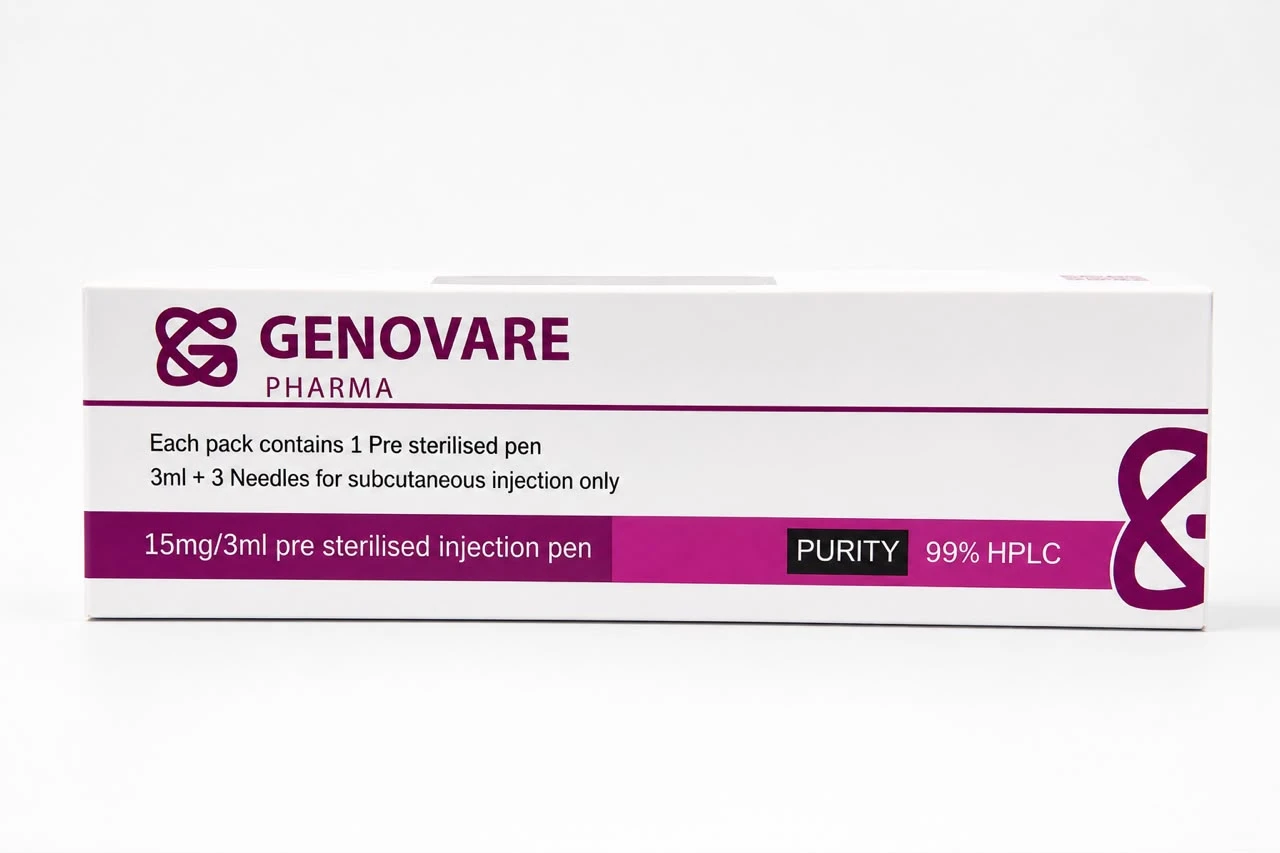
Genovare Pre-Filled Pen Premixed Aqueous
SpecsBuy PTD-DBM Peptide 20mg Pen in Dubai
Studied for hair regrowth via Wnt signaling
AED 1,300 / pen
- Catalogue strength
- 20 mg
- Format
- Aqueous pre-filled pen
- Pack size
- 3mL
- Purity
- 99%+
Choose your bundle
Free UAE delivery on this order
- OrderBefore 4 PM for Dubai
- PackedCold-chain, 2–8°C
- DeliveredSame day in Dubai, next day elsewhere in the UAE
Order before 4 PM for same-day Dubai delivery.
UAE delivery: AED 50 below AED 1,000; free from AED 1,000
Pay byCard payment linkUSDT
99%+ purityIn-house tested
- Sold by
- Remy Research
- Brand
- Genovare
- Manufacturer
- Genovare
- Tested by
- 99%+ line standard
- 99%+ purityLine standard
- Same-day DubaiOrder before 4 PM for same-day delivery
- FormatAqueous pre-filled pen
- Cold-chain packed2–8°C
PTD-DBM peptide: what the research shows
- Studied for new hair follicle formation
- Studied for skin wound healing
- Studied for androgen-linked hair loss
Published study results for the compound, not results from this product. For research use only.
The Genovare PTD-DBM peptide pen is a 3mL premixed aqueous pen labelled 20mg, for laboratory researchers in the UAE who study Wnt signalling in hair follicle and skin wound models. PTD-DBM matters to that work because it blocks CXXC5, a protein that holds the Wnt/beta-catenin pathway back. It has been used in published mouse studies of hair regrowth and new follicle formation. Remy Research sells the pen from Dubai for research use only. It is not for human or veterinary use.
PTD-DBM is a cell-penetrating competitor peptide built to break up the CXXC5-Dishevelled interaction in experimental models of Wnt/beta-catenin signalling. The Genovare pen holds 3mL and is labelled 20mg, but the label gives no peptide sequence and does not say which molecular form is inside.
The name stands for protein transduction domain-fused Dishevelled-binding motif. CXXC5 is a protein that acts as a negative feedback regulator of the Wnt/beta-catenin pathway. It binds the Dishevelled (Dvl) protein through a short Dvl-binding motif at its C-terminal end. The synthetic peptide described in 2015 had three parts: a protein transduction domain to carry it into cells, a flexible linker and the Dvl-binding motif. Because the peptide competes with CXXC5 for Dishevelled, it blocks this negative feedback and keeps Wnt/beta-catenin signalling active (Lee and colleagues, Journal of Experimental Medicine, 2015).
Most PTD-DBM research comes from Kang-Yell Choi's group at Yonsei University in Seoul, South Korea. Their 2015 paper found that the peptide sped up cutaneous wound healing in mice, alone and with valproic acid. Their 2017 paper reported faster hair regrowth and more wound-induced hair neogenesis in mice. It also found raised CXXC5 in miniaturised hair follicles from human balding scalps. A 2023 paper linked CXXC5 to hair loss driven by prostaglandin D2 (PGD2) and dihydrotestosterone (DHT).
These findings come from mice, cultured cells and human tissue samples. ClinicalTrials.gov lists no human trial of PTD-DBM, and no medicine containing it has been approved. The 2015 and 2023 mouse studies applied the peptide to the skin. This product is a premixed aqueous pen, so their results cannot be read across to it.
- Pack Size
- 3mL
- Product details
- Genovare Catalogue
- Pre-Filled Pen
- Premixed Aqueous
- Storage Guidance
- Follow Package Label
- 1 pre-filled Genovare research pen
- 3 pen needles
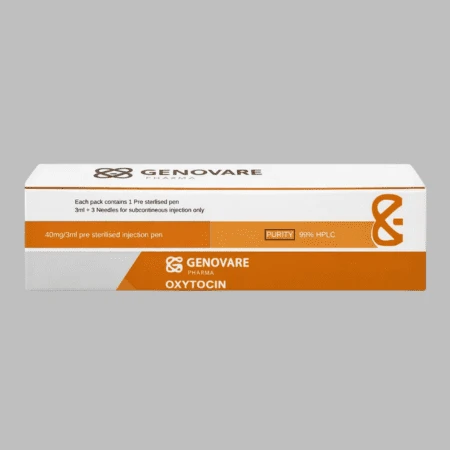
- Genovare retail packaging
Ships from Dubai
Chemistry · Reference dataPTD-DBM chemistry & specifications
Molecule
- Formula
- C124
H225 N61 O28 S2 - Molecular weight
- 3,082.6 g/mol Registry value for the peptide without counter-ions; not measured for this batch.
- Sequence
This product
- Manufacturer
- Genovare
- Catalogue strength
- 20 mg
- Fill volume
- 3mL
- Format
- Aqueous pre-filled pen
- Pack size
- 1 pen with 3 needles
Batch documentation
99%+ line standard
Every report we have published is listed in the lab results library.
Reference data for laboratory checks. Registry values describe the compound, not measurements of this batch. For research use only.
Frequently Asked Questions: PTD-DBM peptide
What is the PTD-DBM price in Dubai?
One PTD-DBM 20mg pen costs AED 1,300. The price per pen stays the same in the 2-pen and 5-pen bundles, and it is the same in every emirate. Delivery is free on orders of AED 1,000 or more, so a single pen ships free. The minimum order is AED 400.
What is PTD-DBM peptide?
PTD-DBM is a synthetic peptide made to switch on Wnt/beta-catenin signalling in laboratory models. The name stands for protein transduction domain-fused Dishevelled-binding motif. The protein transduction domain helps the peptide get into cells. The Dishevelled-binding motif lets it compete with CXXC5, a protein that binds Dishevelled and holds the Wnt pathway back. Kang-Yell Choi's group at Yonsei University first described the peptide in 2015. PubChem lists it as CID 176453931. This Genovare pen holds a premixed aqueous solution labelled 20mg in 3mL and is intended for laboratory research only.
How does PTD-DBM act on the Wnt pathway?
Wnt/beta-catenin signalling takes part in tissue regeneration. It is also involved in hair follicle development and in hair regeneration in adults. When the pathway is switched on, it also raises CXXC5, which binds the Dvl protein and damps the signal down again. The 2015 paper describes CXXC5 as a negative feedback regulator for this reason. PTD-DBM works by inhibiting that binding step. In cultured human dermal fibroblasts it raised the expression of beta-catenin, alpha-smooth muscle actin and collagen I, which are linked to myofibroblast differentiation and collagen production. It also moved more beta-catenin into the cell nucleus. In the same paper, mice lacking CXXC5 healed skin wounds faster, with more keratin 14 and collagen synthesis.
What does PTD-DBM hair growth research show?
Hair follicles pass through a growth stage (the anagen phase), a regression stage (catagen) and a resting stage (telogen). In hair loss the anagen phase shortens and follicles shrink. The Yonsei group reports that CXXC5 rises late in anagen and helps push follicles into catagen. In their 2017 study, CXXC5 was raised in miniaturised follicles and arrector pili muscles from human balding scalps. In human dermal papilla cells it lowered alkaline phosphatase activity and cell proliferation. The paper calls CXXC5 a negative regulator of the Wnt/beta-catenin pathway in hair regrowth. Mice lacking CXXC5 regrew hair faster. In mice, blocking CXXC5 with the competitor peptide sped up hair regrowth and increased wound-induced hair follicle neogenesis. These are animal and cell results. They do not show that PTD-DBM can grow hair in people.
What is wound-induced hair neogenesis?
It is a mouse model in which skin wounds grow new hair follicles as they heal. Ito and colleagues showed in Nature in 2007 that adult mice form these follicles from scratch after wounding. The new follicles produced hair shafts and passed through every stage of normal follicle growth. Blocking Wnt signalling after wound closure stopped this new follicle formation. Extra Wnt ligand in the skin increased the number of follicles. The model therefore tests hair follicle neogenesis, as opposed to regrowth from existing ones. PTD-DBM increased hair follicle neogenesis in this model (Lee and colleagues, 2017).
What are the reported PTD-DBM peptide benefits?
All of the reported findings come from animal, cell and tissue studies. In mice, PTD-DBM sped up hair regrowth and increased wound-induced hair neogenesis (2017). It sped up cutaneous wound healing, alone and with valproic acid (2015), and a patch loaded with both reduced scarring (2023). It restored hair growth that prostaglandin D2 had suppressed in mice (2023). In cultured human fibroblasts it raised beta-catenin and collagen I (2015). None of these results has been shown in people, and none is a claim about this pen.
Is PTD-DBM for hair loss proven in people?
No. ClinicalTrials.gov lists no registered trial of PTD-DBM (search on 22 October 2026). The human evidence is limited to tissue and cells: balding scalp samples with raised CXXC5 and cultured human dermal papilla cells. That evidence does not support any hair loss claim in people. Remy Research makes no hair loss claim for this pen, which is sold for laboratory research only.
How is PTD-DBM linked to DHT and androgenetic alopecia?
Androgenetic alopecia affects men and women who are genetically sensitive to androgens. In this condition, 5-alpha-reductase, an enzyme that converts testosterone to dihydrotestosterone (DHT), is raised, and the extra DHT drives hair loss. The 2023 Yonsei study in Cells found that DHT raised CXXC5 by way of prostaglandin D2 (PGD2). PTD-DBM restored hair growth that PGD2 had suppressed in mice. Against DHT itself, PTD-DBM alone and valproic acid alone did not fully restore beta-catenin. KY19382, a small molecule that blocks both CXXC5 and GSK-3beta, did. The authors note that mice are not an ideal model for human hair loss.
What did the wound healing and valproic acid studies show?
Valproic acid (VPA) is a GSK-3beta inhibitor that also switches on Wnt/beta-catenin signalling, by a different route from PTD-DBM. In the 2015 study, PTD-DBM and VPA each sped up cutaneous wound healing in mice about as well as epidermal growth factor, the comparison treatment. Combining PTD-DBM with VPA worked faster than epidermal growth factor alone, and the wounds given both were fully re-epithelialised. In the 2017 hair study, VPA added further hair regrowth in mice lacking CXXC5. A 2023 study loaded PTD-DBM and VPA into an adhesive hydrogel patch. The patch reduced scar formation in mice and raised collagen III. The authors present CXXC5 as a possible target for future wound-healing therapies. No such therapy has been tested in people.
What is the difference between PTD-DBM and KY19382?
Both come from the same Yonsei research programme, and both target the CXXC5-Dishevelled step. PTD-DBM is a peptide. KY19382 is a small molecule, an analogue of indirubin-3'-monoxime that activates Wnt signalling by inhibiting the CXXC5-Dvl interaction. In a 2021 mouse study it promoted hair regrowth and new follicle formation. The 2023 Cells paper describes KY19382 as blocking both CXXC5 and GSK-3beta. In its DHT experiments, KY19382 fully restored beta-catenin and the growth of whisker hairs in cultured follicles, where PTD-DBM alone did not. Remy Research does not sell KY19382.
PTD-DBM vs minoxidil: how do they differ?
They act on different targets and have very different evidence. Minoxidil is an approved medicine. Minoxidil 5% topical solution is sold over the counter in the United States as a hair regrowth treatment for men, for use on the top of the scalp. In the FDA's drug labelling data, its drug class is arteriolar vasodilator. A 2004 review found that its action on hair follicles was poorly understood. In animal studies, topical minoxidil shortened the resting phase so that follicles entered the anagen phase early. The review says it may also work by opening potassium channels through its sulphated metabolite, but this had not been proven. A 2025 review in the Journal of Medicinal Chemistry notes that minoxidil and finasteride are the only FDA-approved drugs for androgenetic alopecia. PTD-DBM acts on the CXXC5-Dishevelled step of the Wnt pathway and is not an approved medicine. PubMed lists no study that tests the two against each other (search on 22 October 2026).
PTD-DBM vs AHK-Cu: what is the difference?
They are unrelated molecules. AHK-Cu is a copper tripeptide: alanine-histidine-lysine bound to copper(II). PubMed lists one hair study of AHK-Cu, a 2007 laboratory study (search on 22 October 2026). In it, AHK-Cu lengthened human hair follicles held in culture and made dermal papilla cells multiply. PTD-DBM is a longer engineered peptide that targets the CXXC5-Dishevelled step of the Wnt pathway, with mouse and cell studies from 2015 onward. PubMed lists no study that compares them or tests them together (search on 22 October 2026), so the evidence cannot say which is better for hair growth. Remy Research also lists the Genovare AHK-Cu 100mg pen. For the related copper peptide GHK-Cu, see GHK-Cu skin research.
Was PTD-DBM topical in the published studies?
In the papers whose methods we checked, yes. The 2015 wound study used topical application to skin wounds on mice. In the 2023 Cells study, it was a topical treatment on depilated back skin and on wounds. The 2023 patch study loaded it into an adhesive hydrogel patch. The 2015 paper lists PTD conjugation among the ways to help a topical agent penetrate skin. This Genovare product is a premixed aqueous pen, a different format from the study preparations, and this page gives no instructions for using it. Cosmetic PTD-DBM hair serums are consumer products in a separate category. Remy Research does not sell them.
Is PTD-DBM approved, and are there human clinical trials?
No to both. Drugs@FDA lists no product with PTD-DBM as an active ingredient (openFDA search, 22 October 2026). ClinicalTrials.gov lists no registered trial (search on the same day). The research so far is preclinical: mouse models, cultured human cells and human tissue samples. This pen is sold for laboratory research only.
What are the limits of the PTD-DBM evidence?
Safety in people has not been studied, and PubMed lists no long-term safety study of PTD-DBM (search on 22 October 2026). Wnt signalling drives most adult tissue stem cells, and mutated Wnt pathway components can cause cancer (Nusse and Clevers, Cell, 2017). Whether keeping the pathway switched on with PTD-DBM carries that risk has not been studied. Most papers come from one research group. In the 2023 Cells paper, the group's leader declares that he is chief executive of CK Regeon, which holds a licence to develop the Wnt/beta-catenin activator the paper describes. The 2023 authors also state that mouse models are not ideal for studying human hair loss, because the two systems differ. The published work used research preparations applied to skin, so it does not describe this pen. The pen's label gives no sequence or molecular form.
Which papers make up the core PTD-DBM research?
Three papers from the Yonsei University group in Seoul, South Korea, form the core record. Lee SH, Kim MY, Kim HY, Lee YM, Kim H, Nam KA and colleagues introduced the peptide in a 2015 wound healing study in the Journal of Experimental Medicine. Lee SH, Seo SH, Lee DH, Pi LQ, Lee WS and Choi KY reported the hair regrowth work in the Journal of Investigative Dermatology in 2017. Ryu YC, Park J, Kim YR, Choi S and colleagues linked CXXC5 to DHT-driven hair loss in Cells in 2023.
Where can I buy PTD-DBM peptide in the UAE?
Remy Research sells this Genovare PTD-DBM 20mg pen from Dubai for laboratory research only. Dubai orders placed before 4 PM arrive the same day. Orders for the other emirates placed before 12 PM (noon) arrive the next day, and later orders arrive within two days. Saturday orders outside Dubai arrive on Monday. Every parcel is cold-chain packed at 2–8°C and gets a live tracking link once it is dispatched. You can pay by card payment link or in USDT. Cut-off times are on the delivery page.
Does this PTD-DBM pen have a certificate of analysis?
A useful report would show an HPLC trace for purity and a mass spectrum for identity. For PTD-DBM a sequence check also matters, because the label gives no sequence. The report should name the lab, the test date and a batch code that matches the pen. Every report Remy Research has published is in the lab results library. The Peptide COA Guide in the research links above explains how to read one.
How is the PTD-DBM pen shipped and stored?
It travels in cold-chain packaging that holds 2–8°C. On arrival, store it as the Genovare package label directs. Remy Research gives no separate storage instructions. Peptides in solution break down far faster than the same peptides in powder form, as the peptide storage guide explains.
What are the chemical identifiers of PTD-DBM?
PTD-DBM has molecular formula C124H225N61O28S2, molecular weight 3,082.6 g/mol, PubChem CID 176453931. These are registry values for the compound, not measurements of a batch.
Can I buy PTD-DBM online in the UAE?
Yes. Remy Research, a Dubai-based research peptide supplier, lists the Genovare PTD-DBM 20mg AQ Pen at AED 1,300. It is a 3mL aqueous pre-filled pen sold for in-vitro laboratory research only, supplied to the 99%+ line standard. Order on the website. Delivery covers all seven emirates, and the minimum order is AED 400.