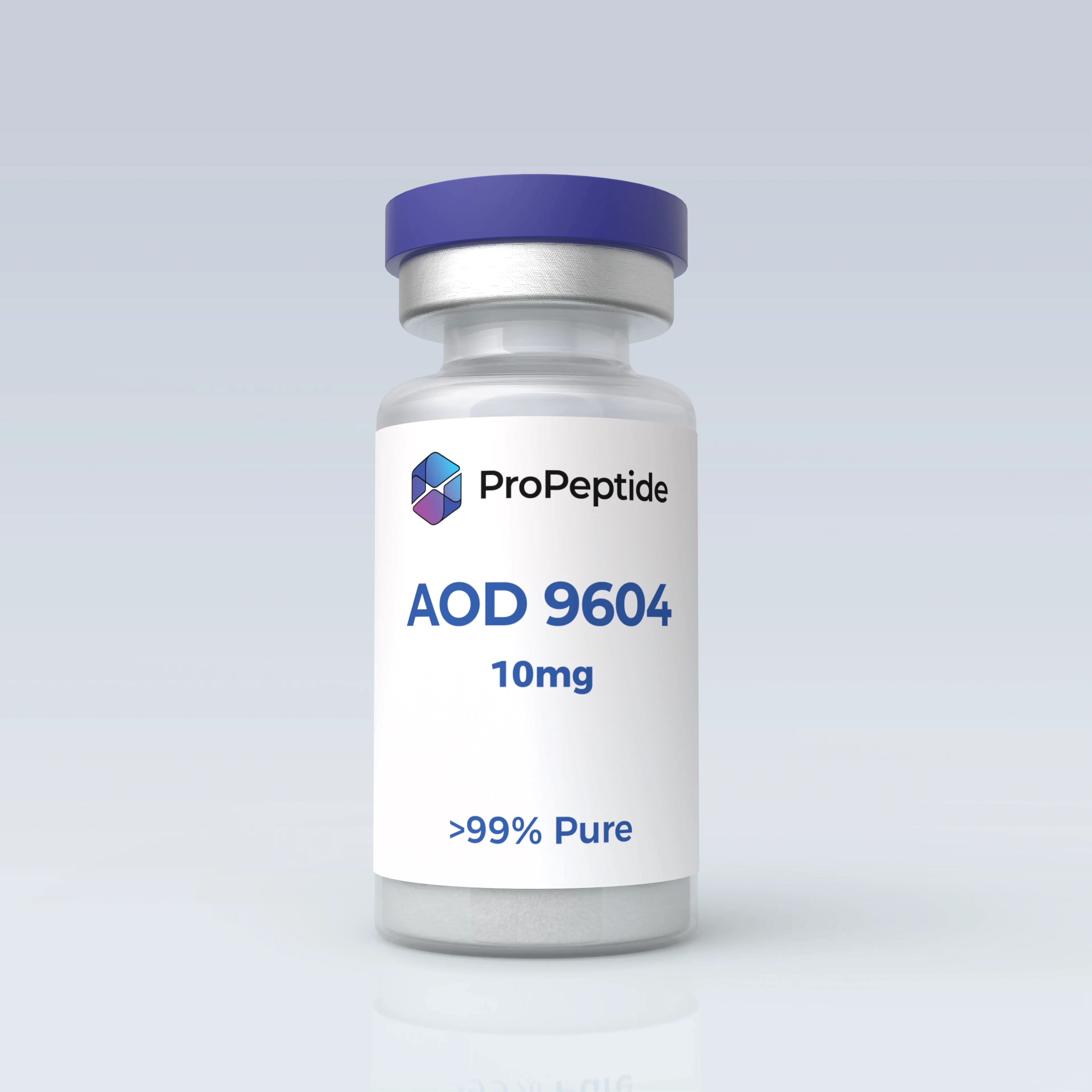
ProPeptide Lyophilized Vial Research Format
SpecsBuy AOD 9604 Peptide Vial: ProPeptide AOD-9604 10mg in Dubai
4.9Modified hGH fragment with placebo-like safety in trials
AED 400 / vial
- Quantity
- 10mg per vial
- Format
- Lyophilized powder, sealed glass vial
- Purity
- Specified ≥99%
Choose your bundle
Add AED 600 more for free UAE delivery
- OrderBefore 4 PM for Dubai
- PackedCold-chain, 2–8°C
- DeliveredSame day in Dubai, next day elsewhere in the UAE
Order before 4 PM for same-day Dubai delivery.
UAE delivery: AED 50 below AED 1,000; free from AED 1,000
Pay byCash on delivery (Dubai)Card payment linkUSDT
99%+ purityIn-house tested
Specified ≥99% ProPeptide Brand Standard
- Sold by
- Remy Research
- Brand
- ProPeptide
- Manufacturer
- ProPeptide
- Tested by
- 99%+ line standard
- 99%+ purityLine standard
- Same-day DubaiOrder before 4 PM for same-day delivery
- FormatLyophilized powder, sealed glass vial
- Cold-chain packed2–8°C
Buy AOD 9604 Peptide Vial: What the Research Shows About Fat Metabolism
- No IGF-1 rise in human trials
- Studied for fat burning in obese mice
- Studied for cartilage repair in rabbits
Published study results for the compound, not results from this product. For research use only.
If you want to buy an AOD-9604 peptide vial in the UAE, Remy Research supplies the ProPeptide AOD-9604 10mg research vial as a lyophilized powder with specified ≥99% purity. Delivery is same-day in Dubai and next-day across the UAE, and every vial ships cold-chain at +2 to +8°C. Published study results below describe the compound, not this product, and the material is for research use only.
The AOD-9604 10mg research vial from Remy Research holds a tyrosine-modified analog of the hGH 177-191 tail in a sealed glass vial. It is made for laboratory scientists, academic teams, and commercial biotech researchers in the UAE and GCC whose in-vitro peptide work requires verified, high-purity, traceable materials. This page covers the peptide’s chemistry and core specifications first. Then come the published research findings, such as fat-burning studies in obese mice, cartilage-repair work in rabbits, and the lack of an IGF-1 rise in human trials. It also covers research on fat metabolism, lipolysis, body composition, weight management, obesity, and cartilage repair, alongside the limits of current human studies, plus the practical details researchers check before ordering: storage requirements, vial format, purity standard, delivery logistics, and research-use-only status. It is not for human or veterinary use. Buyers who need a high-purity peptide get clear handling parameters here, realistic limits around current human data, and a verified UAE supply option for laboratory work.
AOD-9604 is a 16-amino-acid peptide fragment derived from the C-terminal region of human growth hormone. It was developed at Monash University in the late 1990s, with human trials running from 2001 to 2007, and was designed to isolate the lipolytic domain of human growth hormone while limiting IGF-1 pathway activity. In simple terms, researchers studied whether this research peptide could isolate growth-hormone-related effects on fat metabolism and lipolysis, meaning fat breakdown, without activating the wider GH–IGF-1 pathway. Human studies generally did not establish consistent, clinically meaningful weight loss, and obesity-drug development stopped after Phase 2b, so the compound is not an FDA-approved active treatment. Published research also discussed reduced fat storage and support fat metabolism as the intended mechanism, but human benefit remained unproven. In the published human literature, the compound appeared tolerated, did not affect blood sugar levels, and reported side effects such as injection-site irritation or mild headaches remained limited. AOD-9604 was synthesized via solid-phase peptide synthesis and is prohibited in competitive sports by the World Anti-Doping Agency.
- ≥99% Purity
- ProPeptide Brand Standard
- Same-Day Delivery
- Dubai
- Lyophilized Vial
- Research Format
- Cold-Chain Shipped
- +2 to +8°C
- 1x ProPeptide research vial (lyophilized powder)
- Cold-chain insulated packaging
What customers say
“A smooth experience overall. The AOD-9604 10mg Vial label matched the order details and the packaging felt carefully prepared.”
“Quick delivery and good communication. The AOD-9604 10mg Vial was secure in the box and the label was clear.”
“Order: AOD-9604 10mg Vial
Packaging: vial was sealed and protected inside the box.
Communication: clear and timely.
Overall: no issues.”
“Support took a little while to reply, but the answer was clear. The AOD-9604 10mg Vial arrived safely and the presentation was good.”
“Another easy order. AOD-9604 10mg Vial arrived as described, and the team kept me updated without needing a follow-up.”
“Clear product information, responsive support, and careful packaging. I would order AOD-9604 10mg Vial again.”
Swipe to read all 6 reviews →
Customer reviews supplied to Remy Research. Feedback covers service, packaging and delivery, not research results. For research use only.
Other formats of AOD-9604
Ships from Dubai
AOD-9604 in Brief: A Modified Human Growth Hormone Fragment
AOD-9604 is a synthetic peptide fragment derived from human growth hormone. Its 16 amino acids come from the far C-terminal end of human growth hormone (hGH). It corresponds to the human growth hormone 176-191 region, specifically hGH residues 177–191 with an additional tyrosine attached at the N-terminus, which is why some primary papers write it as Tyr-hGH 177-191. It is a separate, defined molecule, not intact growth hormone.
In simple terms, AOD-9604 is a synthetic fragment and synthetic peptide derived from the C-terminal region of human growth hormone, created to support fat metabolism rather than act like full-length growth hormone. Available research suggests it does not bind to the growth hormone receptor, and the exact molecular target remains unidentified. Its proposed action is that it stimulates lipolysis, promoting fat breakdown by helping release stored fat into free fatty acids while suppressing lipogenesis to reduce new fat storage. These findings are research-based, and they have not established consistent changes in body composition, glucose, or growth hormone signaling in humans.
The idea behind it was to isolate the fat-metabolizing properties of human growth hormone while leaving out the hormone's wider endocrine effects, including its broader growth promoting activity. That concept led to laboratory studies, then laboratory research on lipid metabolism and fat breakdown, and later a human development programme for obesity.
The evidence is uneven. The clearest mechanistic papers are rodent studies. Advisory committee briefing documents published in December 2024 summarise the later human programme: a 24-week, 536-adult Phase IIb trial run by Metabolic Pharmaceuticals failed to show statistically significant weight loss, and obesity development was stopped in 2007. Clinical trials failed to show statistically significant weight loss benefits for AOD-9604. AOD-9604 is not FDA-approved for therapeutic use. It was also evaluated for food-related use and has self-affirmed GRAS status, not an FDA approval or FDA GRAS determination, so it does not indicate medical approval.
Remy Research supplies this 10mg vial strictly for laboratory research use only. It is not intended for dietary use or human or animal consumption. Our AOD-9604 evidence review covers the full source set.
About This Vial: Format, Documentation and Delivery
What arrives with the ProPeptide-labelled AOD-9604 10mg vial, and what documentation stands behind it.
When reviewed research and sourcing details matter, rely on scientific sources and the product documentation provided with the order. Purchasing AOD-9604 vials can involve regulatory and quality-control risks, especially outside approved therapeutic channels.
AOD-9604 is a research peptide, and reliable sourcing decisions should be grounded in scientific references rather than marketing claims. As of June 2026, it is not FDA-approved for therapeutic use and appears on the World Anti-Doping Agency prohibited list.
- Format: Lyophilized powder in a sealed glass vial
- Material state: Stable dry peptide prior to mixing
- Documentation: Batch and supplier records should be reviewed before purchase
- Shipping: Packed for secure transit and storage integrity
Freeze-dried solid in a glass vial
The peptide is supplied as a lyophilised powder in a crimp-sealed glass vial for stability and, while sealed, should be stored refrigerated in a dry, dark place. A dry, sealed solid is the standard way to keep a short peptide stable on the laboratory shelf, with the vial kept protected from light until laboratory use. For laboratory handling, the 10mg vial is commonly reconstituted with 3 mL of bacteriostatic water. For longer-term storage, the lyophilized material can be kept at -20°C. Keep the vial protected from light, ideally in its original packaging.
A stated ≥99% HPLC standard for high purity peptide
The ProPeptide line is specified to ≥99% purity by HPLC. HPLC measures how clean a sample is; mass spectrometry confirms that the molecule is the one on the label. HPLC testing should confirm that stated ≥99% purity standard. For purity verification, AOD 9604 should come with independent third-party testing plus a Certificate of Analysis to verify identity and purity, and research vials should pass rigorous quality controls before release. As part of release testing and analysis, that Certificate of Analysis should include batch-specific quality-control data and, alongside mass spectrometry, confirm molecular mass and composition. Our COA and HPLC purity guide explains how to read both.
Batch reports
Remy Research keeps batch-specific reports in the lab results library. Check the library for current coverage before you order.
Chilled delivery across all seven emirates
Shipments travel in cold-chain packaging held at 2–8°C. In Dubai, orders placed before 4 PM arrive the same day. Elsewhere in the UAE, orders placed before 12 PM (noon) arrive the next day. Full timings and charges are on the delivery page.
Evidence first, no promises
Most online vendors sell AOD-9604 intended strictly for research and laboratory use, and so do we. On this page we report what the published studies found and where they stop. In the human clinical literature, the safety data showed a favorable safety profile, while efficacy was weak. Nothing here is medical advice, and nothing suggests a personal, clinical or body-composition benefit. AOD-9604 appears on the World Anti-Doping Agency Prohibited List.
Chemistry · Reference dataAOD-9604 chemistry & specifications
Identity
Modified growth-hormone fragment
AOD-9604 (Tyr-hGH 177–191)
It comes from the 176-191 region of hGH: residues 177–191 with an added N-terminal tyrosine.
Also known asAOD9604, AOD 9604
- CAS
- 221231-10-3
Molecule
- Formula
- C78
H123 N23 O23 S2 - Molecular weight
- 1,815.1 g/mol Registry value for the peptide without counter-ions; not measured for this batch.
- Sequence
- Tyr-Leu-Arg-Ile-Val-Gln-Cys-Arg-Ser-Val-Glu-Gly-Ser-Cys-Gly-Phe
- Note
- AOD-9604 is typically produced by solid-phase peptide synthesis (SPPS), with amino acids assembled sequentially during synthesis.
- Note
- It also shows good aqueous solubility in laboratory buffers.
This product
- Manufacturer
- ProPeptide
- Quantity
- 10mg per vial
- Format
- Lyophilized powder, sealed glass vial
- Purity
- Specified ≥99%
- Storage
- +2 to +8°C lyophilized.
Batch documentation
99%+ line standard
Every report we have published is listed in the lab results library.
Reference data for laboratory checks. Registry values describe the compound, not measurements of this batch. On a batch report, HPLC measures purity and mass spectrometry (LC-MS) confirms identity by molecular weight. For research use only.
What the Laboratory Research Reports About Body Composition, Fat Metabolism, and Where It Stops
Two early animal papers and one set of official briefing documents make up most of the useful evidence on AOD-9604.
Obese Zucker rats (Ng et al., 2000)
In Hormone Research, Ng and colleagues reported that obese Zucker rats given AOD-9604 for 19 days gained less weight and showed higher lipolytic activity in adipose tissue. The authors read this as a lipolytic effect, meaning higher lipolysis. That rodent fat breakdown signal is consistent with activation of hormone-sensitive lipase in fat cells, acting on stored fat and breaking stored triglycerides down into free fatty acids the body can use as fuel. Unlike intact hGH in the same model, the animal signal suggested this pathway remained more active without the insulin-level or blood sugar effects associated with full growth hormone, and longer-term exposure did not appear to worsen insulin sensitivity on clamp measurements. The compound has since been studied in fat loss research because it may stimulate lipolysis and inhibit lipogenesis without affecting IGF-1 levels. This is a rodent signal, not evidence of an effect in people.
Obese mice and beta-3 knockouts (Heffernan et al., 2001)
In Endocrinology, Heffernan and colleagues reported lower body weight and body fat in obese mice, along with increased expression of β3-adrenergic receptor RNA in fat tissue. The authors discussed these findings in terms of lipid metabolism, fat oxidation in fat tissue and energy regulation at the molecular level. In this animal work, the response also appeared linked to effects in fat cells, including enzymatic breakdown (lipolysis) and beta oxidation. In a short experiment in beta-3 knockout mice, AOD-9604 raised energy expenditure and fat oxidation (the beta oxidation of stored fatty acids), and the Ng work above linked it to less formation of new fat. Inhibition of lipogenesis would mean less new fat made inside existing fat cells, not fewer new fat cells; neither paper measured fat-cell number, and the Ng abstract reports lipolytic activity rather than lipogenesis. These observations were framed as possible support for fat loss and metabolic efficiency in animal models only. The response changed in beta-3 receptor knockout mice, which the authors read as a pathway effect more complex than direct beta-3 agonism.
An unsettled mechanism
The 2024 FDA review materials state that the peptide's mechanism of action remains uncertain (see the AOD-9604 mechanism evidence), and the molecular target behind the reported effects remains unknown in the material reviewed. Available work points to distinctions involving lipid metabolism and growth hormone signaling, but it does not establish a definitive pathway. Online summaries often describe a clean "fat-burning fragment"; the sources do not support that level of certainty.
The human programme
The larger 24-week trial did not separate from placebo on weight, and AOD-9604 remains associated with limited evidence for clinical efficacy and safety. While some published human studies described a favorable safety profile, the developer judged the results not commercially viable in 2007. It is not FDA-approved for weight loss or clinical treatment. For a researcher, AOD-9604 is best treated as a historical metabolic peptide with a modest preclinical signal and weak translational support.
For research purposes only. As of June 2026, AOD-9604 is not FDA-approved for therapeutic use. Some reports also discuss where the evidence stops: available data do not establish reliable clinical outcomes, even though trial and preclinical discussions have mentioned visceral fat reduction and no clear effect on blood sugar or hormone balance.
For research purposes only. Not for human consumption.
Frequently Asked Questions
Where can I buy AOD-9604 in Dubai?
Remy Research supplies this ProPeptide AOD-9604 10mg vial from Dubai as research-use-only material. Dubai orders placed before 4 PM are delivered the same day. Across the other six emirates, orders placed before 12 PM (noon) arrive the next day and later orders within two days; Saturday orders outside Dubai arrive on Monday, and there is no Sunday delivery outside Dubai. Every shipment uses cold-chain packaging at 2–8°C. Charges are listed on the delivery page.
What is AOD-9604?
AOD-9604 is a synthetic 16-amino-acid fragment from the C-terminal end of human growth hormone: residues 177–191 with an additional tyrosine at the N-terminus, which is why some papers write it as Tyr-hGH 177-191. It is a separate, defined molecule, not intact growth hormone. This vial is sold for research use only, not for human or veterinary use.
Is AOD-9604 the same as hGH fragment 176-191?
Not exactly. "Fragment 176-191" names a region of the growth hormone molecule. AOD-9604 is a specific modified peptide from that region: hGH 177-191 with an added N-terminal tyrosine. Our AOD-9604 vs hGH fragment 176-191 explainer sets out the terms.
Is AOD-9604 a form of growth hormone?
No. It is a 16-residue synthetic analog derived from the hormone's C-terminal tail. It is not intact hGH and should not be described as equivalent to it.
What did the research on AOD-9604 find?
Rodent studies from 2000 and 2001 reported less weight gain, more adipose lipolytic activity and changes in beta-3 adrenergic receptor expression. A later 24-week human study of 536 adults did not show significant weight loss versus placebo, and obesity development ended in 2007. The mechanism is still described as uncertain. Reliable information should come from scientific sources. Published human studies did not establish consistent weight loss benefits, and AOD-9604 is also on the World Anti-Doping Agency prohibited list.
How does AOD-9604 differ from tesamorelin?
They belong to different classes. Tesamorelin is a GHRH analog that acts on the release side of the growth hormone axis, while AOD-9604 is derived from the hormone molecule itself. Findings for one do not transfer to the other. The tesamorelin 10mg vial is listed separately.
How should the sealed vial be stored?
Keep the lyophilised vial refrigerated at 2–8°C and protected from light until it is used in the laboratory.
Is AOD-9604 intended for human use?
No. Remy Research supplies it for in-vitro laboratory research only. It is not an approved medicine and is not for human or veterinary use.
What are the chemical identifiers of AOD-9604?
AOD-9604 (Tyr-hGH 177–191) has CAS number 221231-10-3, molecular formula C78H123N23O23S2, molecular weight 1,815.1 g/mol, PubChem CID 71300630. These are registry values for the compound, not measurements of a batch.
Can I buy the ProPeptide AOD-9604 10mg vial online in the UAE?
The ProPeptide AOD-9604 10mg vial is a freeze-dried powder in a sealed glass vial, and one vial costs AED 400. Yes, it can be ordered online through the website checkout. The AED 400 minimum order is met by a single vial. It ships cold-chain at 2 to 8°C for research use only.
Do you sell the ProPeptide AOD-9604 10mg vial as a tablet, oral or troche form?
No tablets, oral forms or troches are listed. The ProPeptide AOD-9604 10mg vial at AED 400 is a freeze-dried powder in a sealed glass vial. A Genovare 25mg AQ pen with premixed aqueous solution is the other AOD-9604 format. Neither product is intended for people or animals. For research use only.
What strengths of AOD-9604 come with the ProPeptide 10mg vial listing?
Strength here is fixed: each ProPeptide vial holds 10mg of freeze-dried AOD-9604, at AED 400 for one. A Genovare 25mg AQ pen sits on its own page as a different format. Nothing at 5mg is listed on this page. All items are for research use only.