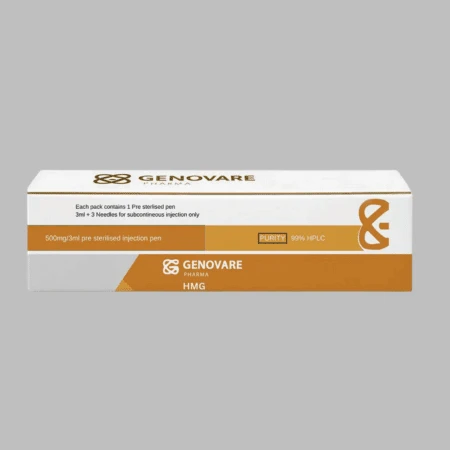
Genovare Pre-Filled Pen Premixed Aqueous
SpecsBuy HMG Pen 500mg (Menotropins) in Dubai
4.9Gonadotropin used clinically in IVF
AED 600 / pen
- Catalogue strength
- 500 mg
- Format
- Aqueous pre-filled pen
- Pack size
- 3mL
Choose your bundle
Add AED 400 more for free UAE delivery
- OrderBefore 4 PM for Dubai
- PackedCold-chain, 2–8°C
- DeliveredSame day in Dubai, next day elsewhere in the UAE
Order before 4 PM for same-day Dubai delivery.
UAE delivery: AED 50 below AED 1,000; free from AED 1,000
Pay byCard payment linkUSDT
- Sold by
- Remy Research
- Brand
- Genovare
- Manufacturer
- Genovare
- Tested by
- 99%+ line standard
HMG peptide: what the systematic review research shows
- Combines FSH and LH activity
- Drives ovarian follicle growth and maturation
- Clinical pregnancy in 26% after one cycle
Published study results for the compound, not results from this product. For research use only.
Human menopausal gonadotropin (HMG), or menotropins, is normally characterised by FSH and LH biological activity in IU rather than by total mass. This 3mL pen states only 500mg, with no FSH/LH activity, ratio or source, so the strength cannot be interpreted as menotropin potency or converted to IU.
- Pack Size
- 3mL
- Product details
- Genovare Catalogue
- Pre-Filled Pen
- Premixed Aqueous
- Storage Guidance
- Follow Package Label
- 1 pre-filled Genovare research pen
- 3 pen needles
- Genovare retail packaging
What customers say
“The HMG 500mg AQ Pen arrived in secure, tidy packaging. The label was easy to read and the delivery updates were clear.”
“Really easy order. The HMG 500mg AQ Pen came well packed, and support replied quickly when I asked about delivery.”
“Order: HMG 500mg AQ Pen
Packaging: pen was held securely in the packaging.
Communication: clear and timely.
Overall: no issues.”
“The outer carton had a small scuff from transit, but the HMG 500mg AQ Pen inside was intact and well protected. Otherwise, a smooth order.”
“This was my second order of HMG 500mg AQ Pen. Checkout was straightforward again and the presentation was consistent.”
“I found the product details and supporting documentation without difficulty. The HMG 500mg AQ Pen itself was securely packaged.”
Swipe to read all 6 reviews →
Customer reviews supplied to Remy Research. Feedback covers service, packaging and delivery, not research results. For research use only.
Ships from Dubai
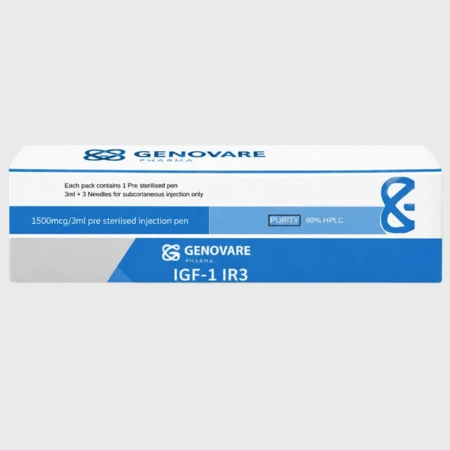
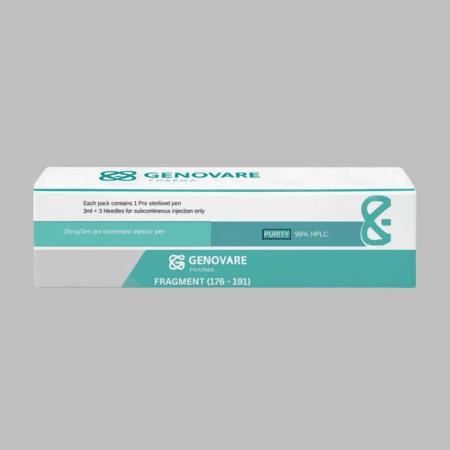
Chemistry · Reference dataHMG chemistry & specifications
Identity
Mixture of FSH and LH
Human menopausal gonadotropin (menotropins)
Also known asMenotropins
- CAS
- 61489-71-2
Registry note
A mixture of two glycoprotein hormones, so there is no single molecular formula.
This product
- Manufacturer
- Genovare
- Catalogue strength
- 500 mg
- Fill volume
- 3mL
- Format
- Aqueous pre-filled pen
- Pack size
- 1 pen with 3 needles
- Specification status
- Unresolved. This pen states only 500 mg, with no FSH/LH activity, ratio or source, so the strength cannot be interpreted as menotropin potency or converted to IU, and the formulation remains unresolved.
Batch documentation
99%+ line standard
Every report we have published is listed in the lab results library.
Reference data for laboratory checks. Registry values describe the compound, not measurements of this batch. For research use only.
Frequently Asked Questions about HMG peptide
What is HMG peptide?
HMG peptide is the name research suppliers use for human menopausal gonadotropin (HMG), also called menotropins. It is a purified preparation of two hormones, follicle-stimulating hormone (FSH) and luteinizing hormone (LH), extracted from the urine of postmenopausal women. Both hormones are glycoproteins. The U.S. menotropins label (Menopur) gives 1975 as the first U.S. approval. This Genovare pen is a research catalogue item and is not that medicine.
What is human menopausal gonadotropin (HMG) used for?
Clinically, HMG is a fertility medicine used under strict medical guidance as part of infertility treatment. In medicine, menotropins are prescription fertility drugs. The U.S. label lists one indication: the development of multiple follicles and pregnancy in ovulatory women as part of assisted reproductive technology (ART). It says menotropins produce ovarian follicle growth and maturation in women who do not have primary ovarian failure. It also says only physicians experienced in infertility treatment should use the product. In laboratories, HMG is bought as a research material for work on combined FSH and LH activity. This Genovare pen has no approved medical use and is sold for in-vitro laboratory research only.
What do follicle stimulating hormone (FSH) and luteinizing hormone (LH) do?
FSH supports follicle growth, while LH helps trigger ovulation and supports hormone production. Together, they play central roles in reproductive function. Both are released by the pituitary gland, on the underside of the brain. In women, FSH stimulates the ovaries to produce eggs, and a surge in LH causes the release of an egg (ovulation). In men, FSH stimulates sperm production. Blood levels of both hormones are higher after menopause, according to MedlinePlus, the U.S. National Library of Medicine's health encyclopedia. HMG supplies FSH and LH activity together.
Is menotropin the same as FSH?
No. Menotropins contain both FSH and LH activity, while FSH-only products contain follicle stimulating hormone without the same LH component. Menotropins carry both FSH and LH activity, while recombinant FSH (rFSH, follitropin) contains FSH alone. The menotropins label measures each activity with its own animal bioassay: ovarian weight gain in female rats for FSH, and seminal vesicle weight gain in male rats for LH. Both assays are standardised against a World Health Organization international standard, and the results are given in international units (IU). The label also states that human chorionic gonadotropin (hCG) is detected in the product.
HMG peptide vs hCG: what is the difference?
HMG provides both FSH and LH activity, while hCG mainly mimics LH activity in the body. They are used differently depending on clinical goals. The main HMG vs hCG difference is FSH. HMG carries FSH and LH activity, while hCG acts mainly through the LH receptor. Human chorionic gonadotropin (hCG) is made mainly by placental cells called syncytiotrophoblasts, and its structure is very close to that of luteinizing hormone. It belongs to the same glycoprotein hormone family as LH, FSH and TSH, and its beta subunit is 80–85% homologous to the LH beta subunit. That likeness lets hCG bind the LH/choriogonadotropin receptor (LHCGR), according to a 2017 review in the International Journal of Molecular Sciences. Remy Research lists hCG separately as the Genovare HCG pen. The HCG vs gonadorelin vs kisspeptin article in the research links above explains where hCG sits on the hormone axis.
Have human chorionic gonadotropin (hCG) and HMG been studied together?
Yes. Some clinical research has evaluated their combined use in fertility-related studies, especially in male infertility settings. They have been studied together in two settings. The menotropins label describes two steps in its approved fertility use: menotropins drive follicle development and maturation, and hCG is the hormone that then induces ovulation. In men with a low sperm count (oligospermia), two placebo-controlled trials tested hCG and HMG together. In the first (Knuth and colleagues, J Clin Endocrinol Metab, 1987), 39 men took part. Two pregnancies followed in the hCG–HMG group and none in the placebo group, but sperm concentrations, sperm motility and normal forms stayed similar in both groups. In the second (Zhao and colleagues, Andrologia, 2019), the patients were sorted into three groups by inhibin B level, and combined gonadotropin therapy was compared with placebo treatment for three months. Sperm concentration, sperm motility, normal sperm morphology and the spontaneous pregnancy rate improved in the medium and higher inhibin B groups. In the lower inhibin B group, semen measures showed no significant changes. A 2025 review of both trials records febrile illness as an adverse event in two men in the first trial and no adverse events in the second.
What did a trial of HMG in male infertility find?
Some published studies reported improvements in semen parameters in selected men, although results vary depending on the population studied and the study design used. A randomised clinical trial (Amirzargar and colleagues, Iran J Reprod Med, 2012) compared hCG, HMG and recombinant FSH (rhFSH) in 113 infertile men after surgery for varicocele (varicocelectomy). The authors note that varicocele is the most frequent physical finding in infertile men and that oxidative stress is one way it can affect seminal parameters. The patients were divided into four groups, and one group had no medical treatment after surgery. After three months, HMG treatment improved sperm motility and sperm morphology, and the HMG group had a 57% pregnancy rate. With rhFSH, every sperm parameter measured improved and the pregnancy rate was 62.5%. Only rhFSH raised sperm concentrations above 20 million per mL. hCG treatment improved sperm morphology, with a 32% pregnancy rate. In the untreated group, sperm morphology also improved, but no pregnancies occurred. Comparing the treatment groups, the authors judged rhFSH more effective than the other drugs.
What does a systematic review say about hCG for male infertility?
A 2025 systematic review in Cureus (Shoaib and colleagues) included seven randomised controlled trials with 926 men. The trials tested hCG alone or with other treatments such as HMG, clomiphene and recombinant FSH. In men with varicocele treated for three months after varicocelectomy, hCG showed statistically significant differences in sperm morphology and pregnancy rate. hCG combined with HMG was associated with increased pregnancy rates in men with oligospermia. A combination given to men with severe testiculopathy showed no statistically significant differences. Where statistical analysis was not possible, the authors reported results narratively. Few trials reported live births or adverse events. The authors concluded that current evidence to support the use of hCG is limited, that the case for hCG-combined treatment is not compelling, and that more research is needed.
How does HMG compare with recombinant follicle stimulating hormone?
They are different gonadotropin options. HMG provides LH activity in addition to FSH activity, while recombinant FSH is more targeted to FSH alone. A 2026 Cochrane systematic review (Berkhout, Kostova and van Wely) compared recombinant follicle stimulating hormone (rFSH) with urinary gonadotropins for ovarian stimulation in IVF and ICSI, two forms of assisted reproductive technology. It included 59 randomised controlled trials with 18,119 women and pooled the results in a meta-analysis. Against HMG or highly purified HMG, rFSH probably led to fewer live births and clinical pregnancies and probably to more ovarian hyperstimulation syndrome (OHSS), on moderate-certainty evidence. The 2011 edition brought all randomised studies under common inclusion criteria, because earlier reviews had used different inclusion and exclusion criteria and reached conflicting results. It included 42 trials. In the 28 trials that reported live births, it found no evidence of a statistically significant difference between rFSH and the urinary gonadotropins as a group. It said the choice should depend on availability, convenience and costs. The 2026 update has replaced that edition. In the menotropins label's own IVF trial, 373 patients received Menopur. Of these, 98 (26%) had a clinical pregnancy, the figure in the research summary above, and the continuing pregnancy rate of 23% was non-inferior to recombinant FSH.
What side effects does the menotropins label list?
In two IVF trials with 434 women given Menopur, the label lists these reactions at 2% or more: abdominal pain (6.7%), headache (6.2%), ovarian hyperstimulation syndrome (6.2%), pain or another reaction where the medicine was given (3.9%), abdominal cramps (3.0%), an enlarged abdomen (2.3%) and inflammation at that site (2.3%). Its warnings also cover abnormal ovarian enlargement, OHSS with or without lung and blood vessel complications, ovarian torsion and multi-fetal pregnancy. The label says multi-fetal pregnancy has been reported with all gonadotropin therapy. In its IVF trial, ultrasound found multiple pregnancies in 30 of 85 pregnancies (35.3%). The label calls ultrasound monitoring of the ovarian response important for lowering these risks. These are label facts about the approved medicine. This pen is for laboratory research only and is not for human use.
What contraindications does the menotropins label list?
Label-listed contraindications can include hypersensitivity, certain endocrine or reproductive conditions, and use in pregnancy. Clinical use also depends on the presence of conditions that make gonadotropin therapy inappropriate. The label says menotropins must not be used in women with any of these: prior hypersensitivity to menotropins or one of the excipients, high FSH levels that point to primary ovarian failure, pregnancy, uncontrolled thyroid, adrenal or pituitary disorders, sex hormone dependent tumours of the reproductive tract, tumours of the pituitary gland or hypothalamus, abnormal uterine bleeding of unknown cause, and ovarian cysts or enlargement of unknown cause that are not due to polycystic ovary syndrome. These are label facts about the approved medicine and do not describe this research pen.
Why is this HMG peptide pen labelled in mg and not IU?
This product is presented according to the manufacturer's labelling format, which may differ from pharmacy gonadotropins commonly expressed in IU. Genovare gives only a weight. For approved menotropins, strength means biological activity: FSH and LH activity are each set by bioassay and stated in international units (IU). A weight in milligrams does not show how much of the material is active FSH or LH. Genovare labels this pen 500 mg and gives no activity figures. For that reason this page makes no conversion from mg to IU and treats 500 mg as a catalogue figure only.
Is the Genovare HMG pen the same as pharmacy menotropins?
No. Pharmacy HMG is a prescription product and cannot be obtained without a prescription. Pharmacy menotropins such as Menopur are prescription medicines used in fertility treatments, and the U.S. carton is marked Rx only. Ferring Pharmaceuticals is the company named on the U.S. label, and Menopur is supplied as a sterile lyophilized powder in vials. The Genovare HMG peptide pen holds a premixed aqueous solution in a 3mL pen. It is a research catalogue item with no approved use, and Remy Research sells it for in-vitro laboratory research only. Product characteristics such as labelling, formulation, and intended use are not the same.
How should the HMG pen be stored?
Follow the storage directions on the Genovare package label. Remy Research packs orders cold-chain at 2–8°C for delivery. The storage rules on the Menopur label cover its lyophilized powder, which may be kept refrigerated or at room temperature (3–25°C) and protected from light. They do not carry over to this Genovare pen, which is already in solution. Follow the storage directions on the product label and packaging for this specific item.
Is there a COA for this HMG peptide pen?
The pen is supplied to the 99%+ line standard. A certificate ties a batch code to identity and purity results. For a gonadotropin mixture like HMG, potency is normally stated as FSH and LH activity, and no published record gives those figures for this pen. Every report we have published is listed in the lab results library. The peptide COA guide in the research links above explains how to read one. If a certificate of analysis is available from the seller or manufacturer, it should outline the product's tested composition and batch information.
How much does HMG peptide cost in the UAE?
Remy Research lists one HMG peptide for sale: the Genovare 500 mg pen at AED 600 per pen. The 2-pen and 5-pen bundles keep the same per-pen price. UAE delivery costs AED 50 below AED 1,000 and is free from AED 1,000, and the minimum order is AED 400. Dubai orders placed before 4 PM arrive the same day. Elsewhere in the UAE, orders placed before 12 PM (noon) arrive the next day. Parcels are cold-chain packed at 2–8°C. You can pay by card payment link or in USDT.
What are the chemical identifiers of HMG?
HMG, also called Human menopausal gonadotropin (menotropins), has CAS number 61489-71-2. These are registry values for the compound, not measurements of a batch. HMG is a gonadotropin preparation containing follicle stimulating and luteinizing activity rather than a single small-molecule compound with one simple identifier.
Where can I buy HMG in the UAE?
Remy Research, a Dubai-based research peptide supplier, lists the Genovare HMG 500mg AQ Pen at AED 600. The 3mL pen is labelled 500 mg with no FSH or LH activity in IU, so the strength cannot be read as menotropin potency. It is sold for in-vitro laboratory research only. Delivery covers all seven emirates, and the minimum order is AED 400. If you want to buy the Genovare HMG pen in the UAE, check current availability through the product page or supplier listing. For pharmacy menotropins used in fertility care, availability depends on prescription status, local regulation, and whether there is clinical evidence supporting use for the intended case.