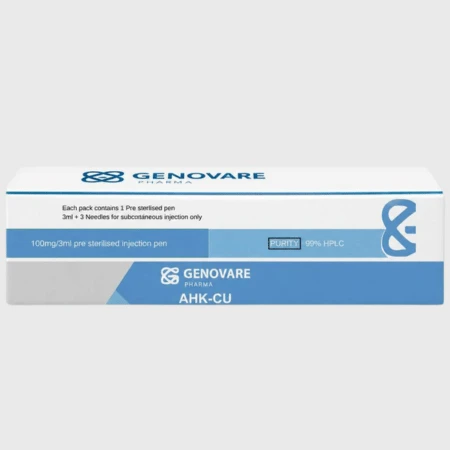
Genovare Pre-Filled Pen Premixed Aqueous
SpecsBuy AHK-Cu Peptide 100mg Pen in Dubai
Studied for hair growth in lab tests
AED 650 / pen
- Catalogue strength
- 100 mg
- Format
- Aqueous pre-filled pen
- Pack size
- 3mL
- Purity
- 99%+
Choose your bundle
Add AED 350 more for free UAE delivery
- OrderBefore 4 PM for Dubai
- PackedCold-chain, 2–8°C
- DeliveredSame day in Dubai, next day elsewhere in the UAE
Order before 4 PM for same-day Dubai delivery.
UAE delivery: AED 50 below AED 1,000; free from AED 1,000
Pay byCard payment linkUSDT
99%+ purityIn-house tested
- Sold by
- Remy Research
- Brand
- Genovare
- Manufacturer
- Genovare
- Tested by
- 99%+ line standard
- 99%+ purityLine standard
- Same-day DubaiOrder before 4 PM for same-day delivery
- FormatAqueous pre-filled pen
- Cold-chain packed2–8°C
AHK-Cu peptide: what the research shows
- Studied for hair follicle elongation
- Studied for dermal papilla cell growth
- Studied for hair-root cell survival
Published study results for the compound, not results from this product. For research use only.
The Genovare AHK-Cu peptide pen holds 3mL of premixed aqueous solution labelled 100mg. Remy Research sells it from Dubai to laboratories across the UAE for research use only. It is not for human or veterinary use. The pen is aimed at laboratory researchers who study copper peptides in hair follicle and skin cell models. AHK-Cu matters to that work because its one published study used human hair follicles.
AHK-Cu is a copper(II) complex built on the tripeptide Ala-His-Lys, and it is a different molecule from GHK-Cu. Researchers have tested it on human hair follicles kept alive ex vivo and on dermal papilla cells grown in culture. The pen label gives 100mg in 3mL. It does not state the peptide sequence, the copper stoichiometry or the form of the complex.
Published AHK-Cu research centres on hair. Pyo and colleagues at Seoul National University evaluated the compound on human hair follicles and on dermal papilla cells, the specialised fibroblasts that are important in hair follicle formation and growth (Archives of Pharmacal Research, 2007). AHK-Cu lengthened the follicles and made the papilla cells multiply. It also raised the Bcl-2/Bax ratio and lowered cleaved caspase-3 and PARP, markers linked to programmed cell death. The fall in the number of dying cells did not reach statistical significance. The authors' proposed mechanism is that AHK-Cu supports follicle growth by spurring papilla cells to divide and by holding back their death. These are laboratory results on tissue and cells, not results in people.
This pen holds the AHK-Cu copper tripeptide already in aqueous solution. That sets it apart from freeze-dried AHK-Cu powder sold in vials. It also sets it apart from cosmetic serums and creams, where copper peptides are sold for skincare and hair care. Remy Research does not sell AHK-Cu as a powder or as a serum. The Peptide Pens vs Vials guide in the research links below compares the two research formats.
Some effects claimed for AHK-Cu online have no published study behind them. PubMed lists no study that measured its effect on blood flow to the scalp or hair follicles, on inflammation or on oxidative stress (search on 23 October 2026). The 2007 paper's abstract mentions vascular endothelial growth factor only in its background on earlier copper-tripeptide work in dermal fibroblasts. It did not measure blood flow.
- Pack Size
- 3mL
- Product details
- Genovare Catalogue
- Pre-Filled Pen
- Premixed Aqueous
- Storage Guidance
- Follow Package Label
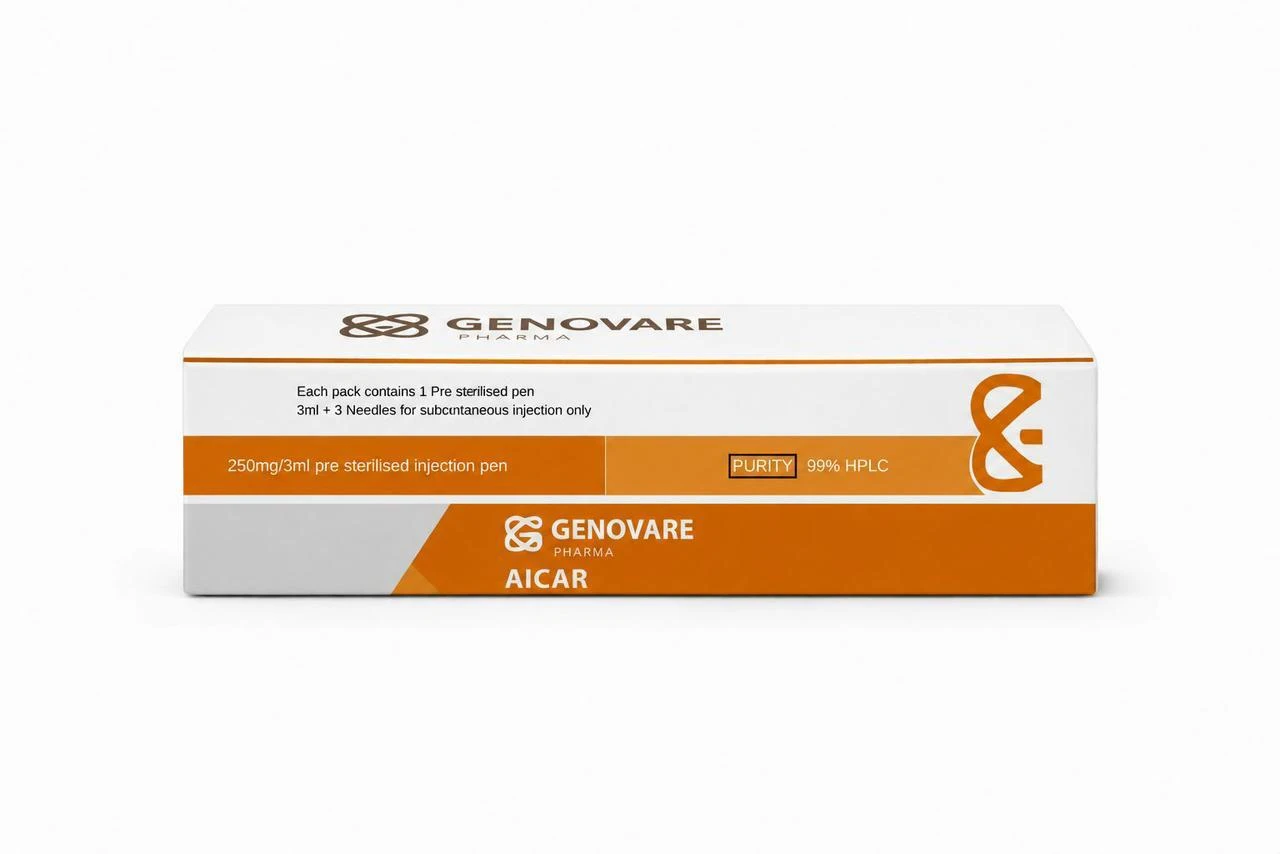
- 1 pre-filled Genovare research pen
- 3 pen needles
- Genovare retail packaging
Ships from Dubai
Chemistry · Reference dataAHK-Cu chemistry & specifications
Identity
Copper complex of the tripeptide Ala-His-Lys
AHK-Cu (copper tripeptide Ala-His-Lys)
Molecule
- Sequence
- Ala-His-Lys, copper complex
- Note
- PubChem’s AHK-Cu record (CID 168431292) describes a hydrochloride copper complex, and the free tripeptide Ala-His-Lys is CID 7408502; the pen does not state its form or copper stoichiometry, so no formula or weight is given.
This product
- Manufacturer
- Genovare
- Catalogue strength
- 100 mg
- Fill volume
- 3mL
- Format
- Aqueous pre-filled pen
- Pack size
- 1 pen with 3 needles
Batch documentation
99%+ line standard
Every report we have published is listed in the lab results library.
Reference data for laboratory checks. Registry values describe the compound, not measurements of this batch. For research use only.
Frequently Asked Questions: AHK-Cu peptide
What is the AHK-Cu peptide?
AHK-Cu is the tripeptide alanine-histidine-lysine (Ala-His-Lys) bound to a copper(II) ion. Each letter names one amino acid: A for alanine, H for histidine and K for lysine. It is one of the copper tripeptides, alongside the better-known GHK-Cu. One chemical supplier lists it as copper tripeptide-3 and as soluble in water. In PubMed, its published research is a single 2007 laboratory study of hair growth, run on human hair follicles and dermal papilla cells (search on 22 October 2026). This Genovare pen holds AHK-Cu as a premixed aqueous solution, labelled 100mg in 3mL, and is intended for laboratory research only.
What is the difference between AHK-Cu and GHK-Cu?
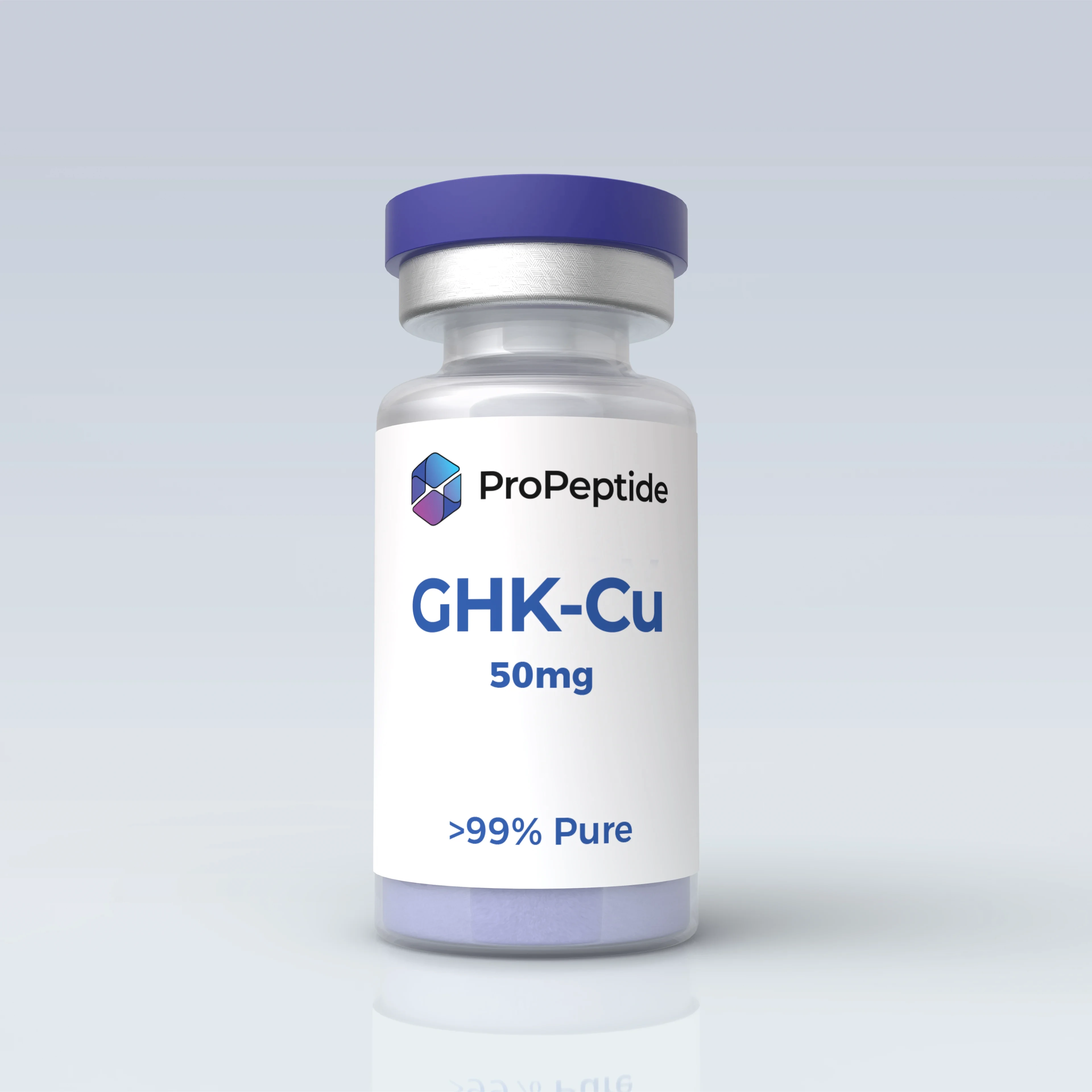
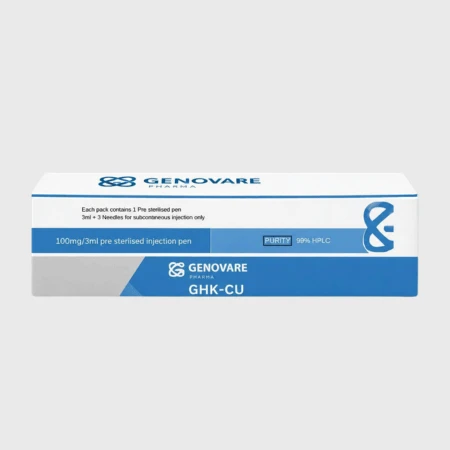
Both are copper tripeptides with histidine and lysine in the second and third positions. They differ in the first amino acid: AHK-Cu starts with alanine and GHK-Cu starts with glycine. Alanine is one carbon larger than glycine, so the two differ slightly in molecular weight. Their research records differ far more. GHK was isolated from human plasma and has decades of skin, collagen and wound healing studies behind it. PubMed lists no report of AHK-Cu occurring as a free peptide in the body (search on 23 October 2026). AHK-Cu has one indexed hair-follicle study. PubMed lists no study that compares the two directly or tests them together, so the evidence cannot say which of the two copper peptides is better for hair growth. Remy Research also lists the Genovare GHK-Cu 100mg pen and the ProPeptide GHK-Cu 50mg vial.
Is AHK-Cu combined with GHK-Cu or other peptides?
In one registered study, yes. NCT07888595, first posted on 22 October 2026, includes a mix of AHK-Cu, GHK-Cu and three other peptides among the agents it tests. It had posted no results when checked on 23 October 2026. PubMed lists no study that tests AHK-Cu and GHK-Cu together (search on 23 October 2026), so there is no published evidence that the pair does more than either peptide alone. This Genovare pen is research material, not a cosmetic, and is not for human consumption.
Is AHK-Cu good for hair growth?
In laboratory models the evidence points that way, but it is thin. In 2007, Pyo and colleagues found that the AHK-Cu copper tripeptide lengthened human hair follicles held in ex vivo culture and increased the proliferation of dermal papilla cells. No other study in PubMed has repeated the work (search on 22 October 2026). A longer follicle in a culture dish does not show that AHK-Cu grows hair on a person.
Has AHK-Cu been tested for hair loss in people?
No. PubMed lists no human study of AHK-Cu (search on 23 October 2026). ClinicalTrials.gov now lists one registered study that includes it: NCT07888595, first posted on 22 October 2026. It is an early phase 1 study of ageing markers in skin and blood that tests several agents, including metformin, ivermectin and a mix of five peptides that contains AHK-Cu. It is not a hair loss trial, and it had posted no results when checked on 23 October 2026. Every published AHK-Cu hair growth result comes from isolated follicles and cultured cells. Remy Research makes no hair loss claim for this pen, which is sold for laboratory research only.
Is AHK-Cu safe?
Its safety in people has not been established. The published record holds one laboratory study on tissue and cells. No clinical study that includes AHK-Cu has published results. Side effects in people, such as skin redness or mild irritation, are therefore unknown. Drugs@FDA lists no medicine with AHK-Cu as an active ingredient (openFDA search, 22 October 2026), so there is no FDA-approved label with safety data either. This pen is for laboratory research only and is not for human or veterinary use.
Is AHK-Cu studied for skin, collagen or wound healing?
Not directly. That research belongs mainly to GHK-Cu, a naturally occurring tripeptide in human plasma that has been studied since its discovery in 1973 (Pickart and Margolina, 2018 review). Maquart and colleagues found that GHK-Cu raised collagen production by fibroblasts in culture (FEBS Letters, 1988). Pickart's 2008 review covers its wound healing and tissue-remodelling studies, including controlled studies on aged skin. The 2018 review adds that GHK increases collagen, elastin and glycosaminoglycan synthesis and supports the function of dermal fibroblasts. The AHK-Cu paper opens with background on earlier copper-tripeptide work. Its abstract does not say which tripeptide that work used. It calls the tripeptide-copper complex a growth factor for several kinds of differentiated cells. It notes that the complex makes dermal fibroblasts multiply and raises their output of vascular endothelial growth factor. It also notes lower secretion of transforming growth factor-beta1 (TGF-β1) by the same cells. The paper's own experiments were on hair follicles and papilla cells. GHK-Cu findings should not be read across to AHK-Cu without testing.
Does AHK-Cu work topically?
No published study has tested that. PubMed lists no study of AHK-Cu applied to skin or scalp (search on 22 October 2026). One registered study, NCT07888595, includes AHK-Cu in a mix of five peptides. It tests the mix rather than AHK-Cu alone and had posted no results when checked on 23 October 2026. The 2007 study used isolated follicles and cultured cells. Copper tripeptide serums, creams and other topical formulations sold as cosmetics are a separate product category. This research pen holds an aqueous solution for laboratory work, and this page gives no instructions for using it on the body. The GHK-Cu vs Copper Peptide Serum article in the research links above sets out the line between research material and cosmetics.
What is the molecular weight of AHK-Cu?
It depends on the form. The free tripeptide Ala-His-Lys has the formula C15H26N6O4 and a molecular weight of 354.41 g/mol (PubChem CID 7408502). PubChem's AHK-Cu record (CID 168431292) is a hydrochloride copper complex at 451.39 g/mol, and one chemical supplier lists a 1:1 copper complex at 415.93 g/mol. For comparison, free Gly-His-Lys (GHK) is 340.38 g/mol (PubChem CID 73587). The Genovare label does not say which form the pen holds, so no single weight applies to it.
How much is the AHK-Cu 100mg pen in Dubai?
One AHK-Cu 100mg pen costs AED 650. The price per pen is consistent across the 2-pen and 5-pen bundles, and it is the same in every emirate. UAE delivery costs AED 50 on orders below AED 1,000 and is free from AED 1,000, so an order of two pens ships free. The minimum order is AED 400.
Does Remy Research deliver AHK-Cu across the UAE?
Yes. AHK-Cu UAE orders ship from Dubai to all seven emirates. Outside Dubai, orders placed before 12 PM (noon) arrive the next day, and later orders arrive within two days. Saturday orders outside Dubai arrive on Monday, because there is no Sunday delivery outside Dubai. Every parcel is cold-chain packed at 2–8°C and gets a live tracking link once it is dispatched. You can pay by card payment link or in USDT. Cut-off times are on the delivery page.
Does this AHK-Cu pen have a certificate of analysis?
No. For AHK-Cu, a useful report would include an HPLC trace for purity and a mass spectrum for identity. The label does not give the form of the copper complex, so a copper measurement would also help settle the copper-to-peptide ratio. The report should name the lab, the test date and a batch code that matches the pen. Every report Remy Research has published is in the lab results library. The Peptide COA Guide in the research links above explains how to read one.
How is the AHK-Cu pen shipped and stored?
It travels in cold-chain packaging that holds 2–8°C. On arrival, store it as the Genovare package label directs. Remy Research gives no separate storage instructions. The peptide storage guide in the research links above explains why peptides in solution need more care than freeze-dried powder.
Where can I buy AHK-Cu in Dubai?
Remy Research sells the Genovare AHK-Cu 100mg AQ pen from Dubai for research use only. One pen is AED 650. Dubai orders placed before 4 PM are delivered the same day, and orders for the other emirates placed before 12 PM (noon) arrive the next day. Delivery is AED 50 below AED 1,000 and free from AED 1,000.
Is AHK-Cu sold as a powder, serum or topical?
Remy Research sells AHK-Cu only as this Genovare pen, a premixed aqueous solution labelled 100mg in 3mL. It does not sell AHK-Cu as a freeze-dried powder, a serum or a topical product. AHK-Cu is the copper complex of the Ala-His-Lys tripeptide and is chemically distinct from GHK-Cu. The pen is supplied for research use only.