What the research shows
- Average muscle ATP-output rise: 27% vs 12% placebo
- Studied for exercise tolerance in aging
- Studied for heart function in aging
Published study results for the compound, not results from this product. For research use only.
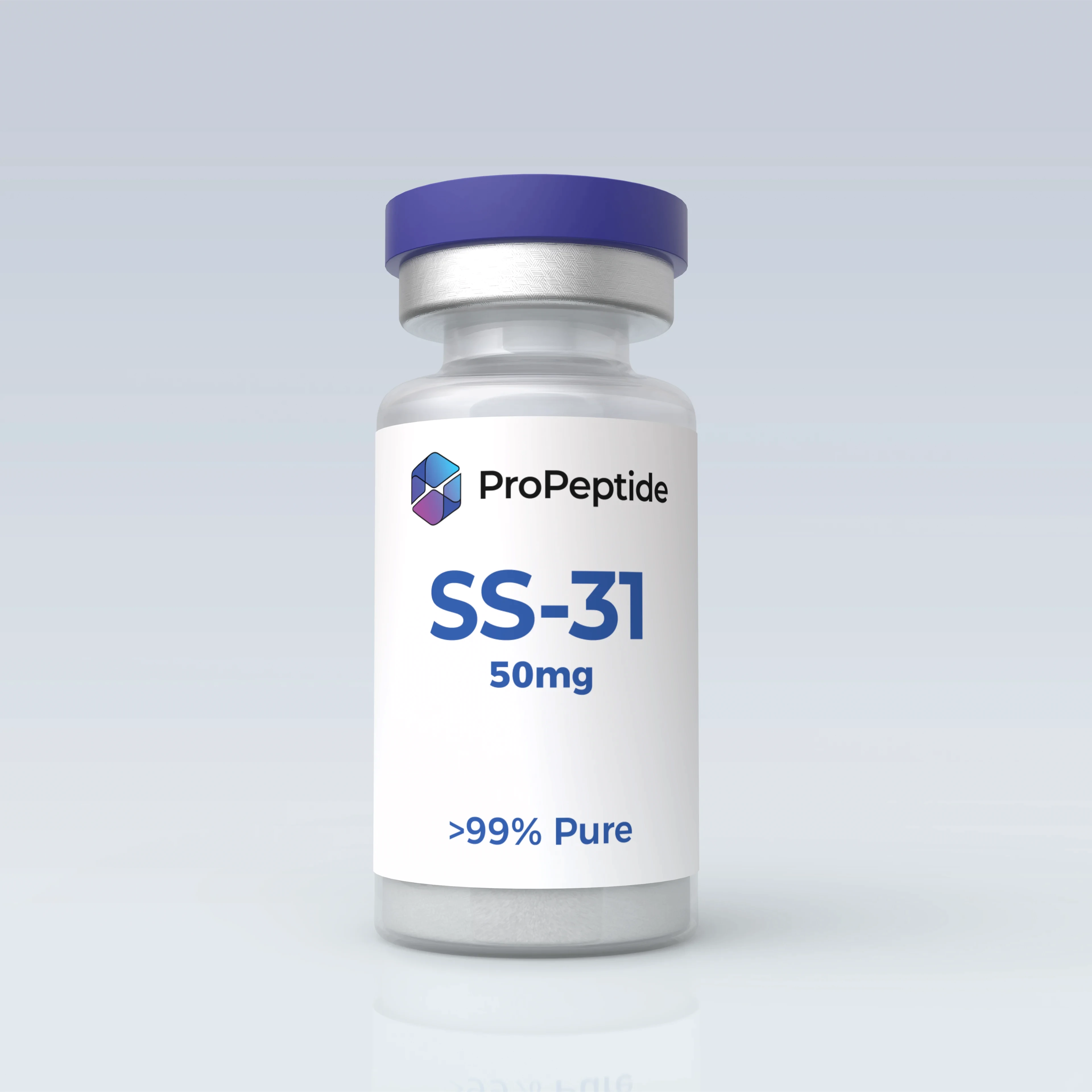
SS-31 (elamipretide) research vial from Remy Research: a synthetic four-residue peptide that binds cardiolipin in the inner mitochondrial membrane. Lyophilised, >99% HPLC line standard. For research use only. Not for human or veterinary use.
- ≥99% Purity
- ProPeptide Brand Standard
- Same-Day Delivery
- Dubai
- Lyophilized Vial
- Research Grade
- Cold-Chain Shipped
- +2 to +8°C
ProPeptide Lyophilized Vial Research Grade
SpecsSS-31 50mg Vial
Studied for mitochondrial energy in aging
AED 600 / vial
Strength
Choose your bundle
Minimum order is AED 400
25% off orders of AED 700+ with code KV25 at checkout
Order before 4 PM for same-day Dubai delivery.
UAE delivery: AED 50 below AED 1,000; free from AED 1,000
Extended-study format
5x the peptide content at a lower per-mg cost. Best for laboratories running extended mitochondrial studies from a single reconstituted stock.
Specified ≥99% ProPeptide Brand Standard
- Sold by
- Remy Research
- Brand
- ProPeptide
- Manufacturer
- ProPeptide
- Tested by
- Line standard — no independent report
Ships from Dubai
SS-31 at a Glance: A Cardiolipin-Binding Tetrapeptide
SS-31 takes its name from Hazel Szeto and Peter Schiller, the Cornell pharmacologists who designed the Szeto-Schiller family of cell-penetrating peptides. It is a short synthetic chain of four residues, D-Arg-Dmt-Lys-Phe-NH₂, in which Dmt is 2′,6′-dimethyltyrosine. The free peptide has the formula C₃₂H₄₉N₉O₅ and a molecular weight close to 639.8 g/mol. In the literature you will also meet it as elamipretide, its clinical development name, and under the older labels Bendavia and MTP-131. All four names describe one molecule.
Its alternating positive and aromatic residues let it settle at the inner mitochondrial membrane rather than drift in the cell's fluid. Cell studies report concentrations there roughly 100 times higher than in the cytosol. That targeting is why SS-31 is studied differently from general antioxidants: the questions are about membrane structure and energy output, not bulk free-radical clearance.
Elamipretide has a regulatory history of its own. Forzinity (elamipretide HCl) received FDA accelerated approval for Barth syndrome on September 19, 2025. That approval covers a specific medicine in a defined patient group. It does not apply to this vial, which Remy Research supplies as lyophilised material for in-vitro laboratory research. For research use only. Not for human or veterinary use. The full literature review sits in our SS-31 research profile.
What Comes with This Research Vial
A plain summary of the format, paperwork and handling behind the ProPeptide-labelled SS-31 vial sold by Remy Research.
Freeze-dried peptide in a sealed glass vial
The material arrives as a lyophilised solid under a crimp seal, the standard way short peptides are kept stable for laboratory storage.
Identity you can check
A vial sold as SS-31 should match one exact sequence, not a loose family of compounds. Compare the name, sequence and mass on any certificate against the specifications below before the material enters an experiment.
Stated purity standard
The line is supplied to a >99% HPLC standard. HPLC measures how clean a sample is; mass spectrometry confirms that the molecule is the right one. A complete certificate reports both.
Batch evidence without guesswork
Batch-specific reports are published in the Remy Research lab results library. Check there for current SS-31 coverage before ordering; we do not claim a report for a batch that has not been tested.
Cold-chain delivery across the UAE
Shipments travel in cold-chain packaging held between 2–8°C. Dubai orders in by 4 PM go out the same day, with most arriving within about four hours, and the other six emirates receive next-day delivery on orders placed before noon.
Mechanism: What the Published Research Describes
Most mechanistic data come from cell cultures, isolated mitochondria and animal models. Four themes recur, and each should be read as a research finding rather than an established effect in people.
Two-point grip on cardiolipin
Cardiolipin is a phospholipid found almost only in the inner mitochondrial membrane, where it holds the curved folds called cristae in shape. Birk and colleagues (J Am Soc Nephrol, 2013) used NMR and fluorescence methods to show SS-31 attaching in two ways: its positive D-Arg and Lys residues pair with cardiolipin's negative headgroups, while the Dmt and Phe rings tuck into the lipid tails.
Keeping the electron transport chain organised
The respiratory complexes and ATP synthase sit on a cardiolipin scaffold. In isolated mitochondria put under oxidative stress, SS-31 was reported to preserve complex activity and membrane potential closer to unstressed controls, which researchers link to protection of that scaffold.
Oxidative stress at the membrane surface
Cardiolipin is easily oxidised, and oxidised cardiolipin weakens cristae structure, which in turn can raise reactive oxygen species output. The Dmt residue can scavenge radicals, so SS-31 is studied as an antioxidant placed at the membrane itself rather than in the mitochondrial matrix.
Clinical-development signals, read cautiously
A small 2021 crossover study in older adults (Roshanravan et al., PLOS ONE) reported higher muscle ATP production after one elamipretide treatment. The TAZPOWER trial in Barth syndrome missed both primary endpoints in its blinded crossover phase, then reported a walking-distance improvement in its open-label extension. These are early, small human datasets from a regulated drug programme.
Technical Specifications
| Manufacturer | ProPeptide |
|---|---|
| Compound | SS-31 (Elamipretide / MTP-131) |
| CAS Number | 736992-21-5 |
| Molecular Weight | 639.8 Da |
| Sequence | D-Arg-Dmt-Lys-Phe-NH₂ (synthetic tetrapeptide) |
| Format | Lyophilized powder, sealed glass vial |
| Available sizes | 10mg, 50mg |
| Purity | Specified ≥99% |
| Storage | +2 to +8°C, protect from light, do not freeze |
For research purposes only. Not for human consumption.
Frequently Asked Questions
Where can I buy SS-31 in Dubai?
Remy Research lists this ProPeptide SS-31 vial for laboratory research, alongside a separate SS-31 40mg pen. Dubai orders placed before 4 PM are delivered the same day, and most arrive within 4 hours. For the other emirates, orders in before 12 PM (noon) arrive the next day and later orders within two days; Saturday orders outside Dubai arrive on Monday, and there is no Sunday delivery outside Dubai. Every shipment uses cold-chain packaging held at 2–8°C. See delivery details for current charges. Supplied for research use only, not for human or veterinary use.
Are SS-31, elamipretide, Bendavia and MTP-131 different compounds?
No. They are four names for one synthetic tetrapeptide, D-Arg-Dmt-Lys-Phe-NH₂. SS-31 is the Szeto-Schiller lab code, elamipretide the clinical development name, and Bendavia and MTP-131 are earlier investigational labels.
What makes SS-31 different from a general antioxidant?
Location. SS-31 gathers at the inner mitochondrial membrane and binds cardiolipin, so research focuses on cristae structure, electron transport and ATP output. Compounds such as MitoQ instead rely on membrane potential to build up in the mitochondrial matrix.
Does the 2025 Forzinity approval apply to this vial?
No. Forzinity (elamipretide HCl) received FDA accelerated approval for Barth syndrome on September 19, 2025. That decision concerns a specific medicine for a defined patient group. This vial is research-grade material for in-vitro laboratory work, not that medicine.
How does SS-31 compare with MOTS-c?
They answer different questions. SS-31 is studied for membrane structure and cardiolipin binding, while MOTS-c, a 16-residue peptide encoded in mitochondrial DNA, is studied for AMPK signalling and glucose handling. Read our MOTS-c vs SS-31 comparison or see the MOTS-c 10mg vial.
Is there a batch certificate for this vial?
The line is supplied to a >99% HPLC standard. Published batch-specific reports are kept in our lab results library; check there for current SS-31 coverage before ordering.
How should the sealed vial be stored?
Keep the lyophilised vial refrigerated at 2–8°C and away from light, and do not freeze it. Move it into the refrigerator as soon as the cold-chain package arrives.
Is SS-31 intended for human use?
No. Remy Research supplies SS-31 for in-vitro and animal-model laboratory research only. It is not a medicine and is not for human or veterinary use, diagnosis or treatment.