GLP1 Muscle Loss & Body Composition Data
DEXA-measured body composition data from semaglutide, tirzepatide, and retatrutide clinical trials—how much lean mass is lost, why it happens, and what the research says about preserving it.
Update History ▾
October 12, 2026: Replaced the claim that SARM and GLP-1 combinations rest on “early preclinical data” with the sponsor-reported Phase 2b QUALITY trial (enobosarm plus semaglutide: 71% less lean-mass loss than semaglutide plus placebo at 16 weeks), and added the September 2026 Drugs meta-analysis of 60 studies (lean-mass decrease, low certainty, largely tied to weight loss; no bone or joint effect). Pointed a mechanism link to the GLP-1/GIP/glucagon mechanism page.
October 11, 2026: Added a 2026 review of 35 RCTs, a 2026 meta-analysis of 20 RCTs, the phase 2 EMBRAZE trial and a medRxiv preprint (not peer reviewed). Qualified the tirzepatide-versus-semaglutide lean-share claim. The stat cards and three FAQ answers now use sourced figures (SURMOUNT-1: about 25% lean), replacing an 88% resistance-training figure and an Obesity Reviews (2023) citation that could not be traced. A second source check rebuilt the body-composition table from the STEP 1 and SURMOUNT-1 DXA reports, removed STEP 3 lean-mass figures (STEP 3 had no DXA scans) and softened two unsupported superlatives. A further check against the STEP 1 supplementary appendix replaced a whole-trial weight-loss figure in the table with the fat-plus-lean loss measured in the DXA substudy (17.3 kg, of which 40% was lean mass). A final check filled the retatrutide row of the table from a phase 2 DXA substudy in type 2 diabetes (Coskun et al., 2025: total fat mass fell 23.2% at 36 weeks on 12 mg, and the authors judged the lean share of weight lost similar to other obesity treatments), labelled the obesity and diabetes trials in that row, and updated the triple-agonist section (dropping an unsourced "most closely watched" claim) and one FAQ answer to match.
October 7, 2026: Freshness update — added retatrutide TRIUMPH-1 Phase 3 result (NEJM, September 29, 2026) and replaced the old "late 2026 or 2027" forecast for DEXA data with the current status.
June 4, 2026: Added a registered RCT protocol (NCT07609160, Acibadem University) testing tirzepatide plus a 24-week home-based resistance-exercise programme versus tirzepatide alone on skeletal-muscle morphology, quality, and physical function.
May 27, 2026: Added BELIEVE Phase 2 combination-therapy data — bimagrumab + semaglutide produced 22.1% weight loss at 72 weeks with only 2.6% lean-mass loss versus 7.9% on semaglutide monotherapy.
May 18, 2026: Added May 2026 research update on the COMPARE-AT deep-phenotyping trial (NCT07589322), which will be the first purpose-built tirzepatide-vs-semaglutide head-to-head with DXA, MRI-PDFF, bone-turnover, AI-ECG and multi-omics endpoints.
May 17, 2026: Added retatrutide TRIUMPH-4 Phase 3 readout (December 11, 2025; 28.7% mean weight loss at 12 mg) as the current efficacy ceiling alongside the existing Phase 2 24.2% reference.
March 6, 2026: Latest data review and formatting update
Initial publication
Research summary
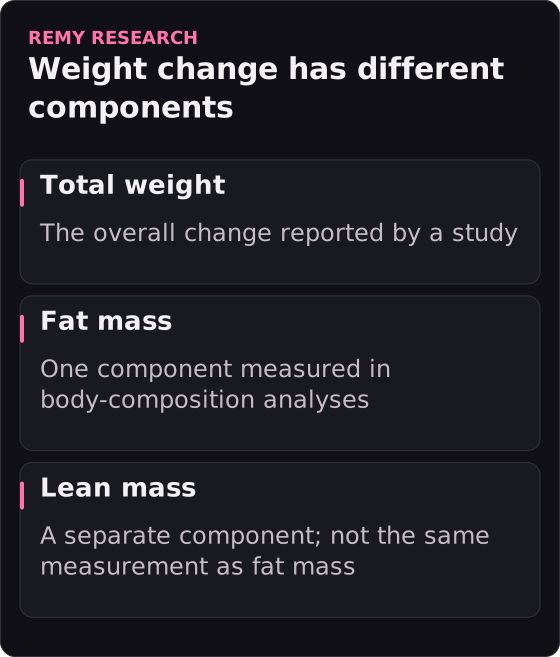
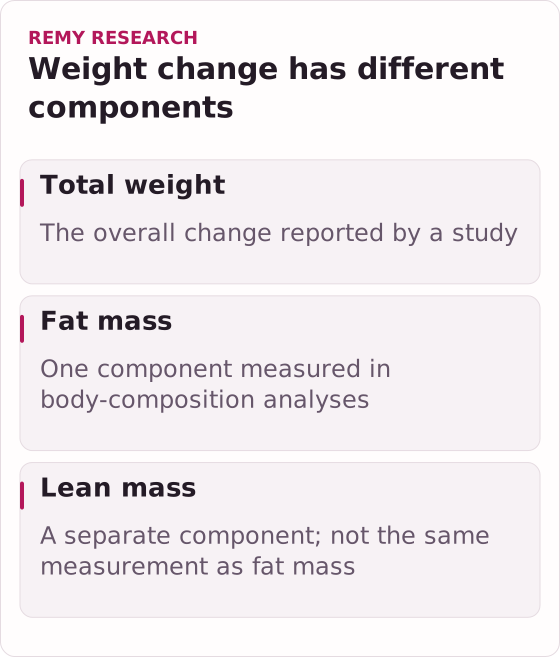
DXA studies and pooled reviews show that weight loss during GLP-1-based treatment can include both fat mass and lean mass. The measured share varies with the study population, method and treatment, so one percentage does not describe every patient.PubMed 1 PubMed 2 PubMed 3
- Most estimates are cross-trial findings, not direct comparisons between medicines.
- Strategies discussed for preserving lean mass are research context, not individual care guidance.
Interpret body-composition findings within each study's measurement method and population.
Summary revised November 1, 2026. This editorial update does not constitute a new literature review.
weight lost (Semaglutide)
weight lost (Tirzepatide)
weight lost (Resistance training)
| Trial | Compound | Total Weight Lost | Fat Mass Lost | Lean Mass Lost |
|---|---|---|---|---|
| STEP 1 | Semaglutide | −17.3 kg (fat + lean) | −10.4 kg (60%) | −6.9 kg (40%) |
| SURMOUNT-1 | Tirzepatide (pooled doses) | −21.3% body weight | −15.9 kg (74%) | −5.6 kg (26%) |
| Phase 2 | Retatrutide 12mg | −24.2% body weight (Phase 2, obesity) | −23.2% fat mass (Phase 2, type 2 diabetes) | Share of weight lost similar to other obesity treatments (Phase 2, type 2 diabetes) |
Why Does Lean Mass Decrease on GLP-1?
How Does Caloric Deficit Drive Muscle Breakdown?
The lean mass loss observed with GLP-1 receptor agonists is primarily a consequence of caloric deficit, not a direct pharmacological effect on skeletal muscle. When the body is in sustained energy deficit—regardless of the cause—it catabolizes both adipose tissue and lean tissue for fuel. This muscle breakdown is a natural metabolic response that concerns many patients who want to lose weight while maintaining muscle mass.
GLP-1 medications create caloric deficits through three mechanisms: reduced appetite via hypothalamic signaling, delayed gastric emptying which prolongs satiety, and decreased food reward signaling. Understanding the multi-receptor agonist pathway helps explain how different compounds produce varying degrees of caloric deficit. Gradual dose titration is one strategy to moderate the rate of weight loss and reduce lean mass impact; for retatrutide-specific protocols, see the retatrutide dosage guide. The magnitude and speed of this deficit determines the lean-to-fat loss ratio. Patients who experience more rapid total weight loss tend to lose proportionally more muscle mass and fat tissue simultaneously. For a complete breakdown of adverse events across these compounds, including GI tolerability data, see our retatrutide side effects profile.
Pooled trial data suggest the lean share on GLP-1 drugs is broadly similar to that of lifestyle-driven weight loss. A 2026 meta-analysis of 20 RCTs (15,782 participants) in Diabetes, Obesity and Metabolism put lean mass at 35.2% of weight lost with semaglutide, 25.4% with tirzepatide and 26.2% with lifestyle intervention, and judged incretin therapy and lifestyle intervention broadly comparable. A 2026 systematic review of 35 RCTs in Annals of Internal Medicine found a median lean share of 28.3% in incretin groups; about two thirds of incretin studies exceeded a benchmark of about 25%, and no study reported objective physical-function outcomes. A third 2026 pooled analysis, a meta-analysis of 60 studies (46 randomised trials) in Drugs, found a consistent decrease in lean or fat-free mass with GLP-1 receptor agonists across 28 studies, driven mainly by liraglutide and semaglutide, but rated the certainty of evidence low and judged the change largely related to weight loss; it found no effect on bone density, fractures or joint outcomes (see GLP-1 and bone density).
A separate meta-analysis in Diabetes, Obesity and Metabolism (published October 19, 2026) pooled handgrip strength in 660 semaglutide-treated adults from 10 studies. The average change was close to zero (−0.16 kgf; 95% CI −1.98 to 1.65), but results varied widely between studies. The authors rated the certainty as very low because the pooled data were before-and-after changes without a control group, and they state that the findings do not establish strength preservation.
Real-world data are mixed. A medRxiv preprint (not peer reviewed) of US health records, including 7,965 people with body-composition measurements before and after starting treatment, found excess lean-mass losses of 1.1% to 2% with tirzepatide compared with semaglutide over 3 to 12 months. It is observational.
What Patient Factors Influence Muscle Mass Loss?
- Rapid weight loss is associated with higher proportions of lean muscle loss regardless of method—patients who lose weight quickly face greater muscle mass reduction
- Greater baseline obesity tends to produce a more favorable fat-to-lean loss ratio, as patients with higher body fat have more fat tissue available for mobilization
- Age and sex influence body composition changes—older patients and males lose proportionally more muscle mass, raising concern about sarcopenia
- Physical activity level during treatment is the strongest modifiable predictor of muscle retention—regular exercise substantially reduces lean muscle loss
- Diabetes status may influence outcomes, as patients with type 2 diabetes often have altered muscle metabolism and insulin signaling that affects how they preserve muscle during active weight loss
Evidence and context
All GLP-1 receptor agonists (glucagon-like peptide-1 drugs) cause some degree of lean mass loss alongside fat loss. DEXA data from clinical trials shows that 25–40% of total weight lost on single-agonist GLP-1 drugs comes from lean body mass. A 2026 review of 35 RCTs found a median of 28.3%; about two thirds of incretin studies exceeded its benchmark of about 25%. Pooled RCTs give 35.2% for semaglutide, 25.4% for tirzepatide and 17.5% for lifestyle plus resistance training (not head to head); a medRxiv preprint (not peer reviewed) found more lean loss on tirzepatide than semaglutide. In a Phase 2 DXA substudy in type 2 diabetes, the share of weight lost as lean mass on Retatrutide was similar to other obesity treatments. Resistance training and high protein intake (1.2–1.6 g/kg) are the most evidence-supported strategies for mitigating lean mass loss during GLP-1 therapy.
Muscle mass loss remains a growing concern for patients taking GLP-1 medications, particularly those with diabetes or low muscle mass at baseline. Research suggests that patients who lose weight too rapidly during active weight loss phases without regular exercise may experience greater lean muscle loss, with potential implications for long-term health, mobility, and metabolic function. Strategies to preserve muscle and prevent muscle loss are now a central focus of obesity pharmacotherapy research. For a deeper look at how peptides are being studied for aesthetic applications, see our guide to peptide research in aesthetics and body composition.
What Is “Ozempic Face”?
“Ozempic face” is a colloquial term describing the gaunt, aged facial appearance that can accompany rapid weight loss on GLP-1 medications. It results from the loss of subcutaneous facial fat pads—particularly the buccal, malar, and periorbital fat compartments—which provide structural volume and a youthful contour. This phenomenon varies in severity across different GLP-1 compounds, as detailed in our Ozempic vs Mounjaro vs Wegovy side effects comparison. For an in-depth analysis of prevalence data, risk factors, and mitigation strategies, see our dedicated article on Ozempic face and GLP-1 facial fat loss.
This phenomenon is not specific to semaglutide or GLP-1 drugs. It occurs with any method of rapid, significant weight loss—including bariatric surgery, very-low-calorie diets, and other pharmacotherapy. The rate of weight loss is the primary determinant: faster loss gives facial skin less time to retract, producing a more pronounced sagging appearance.
Clinical strategies to mitigate facial volume loss include gradual dose titration (slower weight loss trajectory), adequate protein intake to preserve overall lean tissue, and consultation with a dermatologist regarding volume-restoring procedures if cosmetically desired. Resistance training, while primarily targeting skeletal muscle, also supports overall tissue integrity.
Is Muscle Mass Loss a Concern for Patients with Diabetes?
GLP-1 Agonists and Patients with Type 2 Diabetes
For patients with type 2 diabetes, the relationship between glucagon-like peptide-1 medications and muscle mass is particularly complex. Diabetes itself is associated with accelerated muscle mass decline—a condition sometimes called diabetic sarcopenia. Patients with diabetes who take GLP-1 medications may therefore face compounding risk factors for low muscle mass, making it essential to monitor body composition throughout the weight loss journey. HbA1c, fasting glucose, CMP, and lipid baselines are also useful before therapy; see the GLP-1 and peptide blood test checklist.
Clinical data from diabetes-focused trials (SUSTAIN, SURPASS) show that patients taking GLP-1 receptor agonists for diabetes management experience similar lean mass loss ratios as patients without diabetes. However, the health implications differ: patients with diabetes and low muscle mass may face greater risk of impaired mobility, reduced functional capacity, and poor metabolic outcomes. This concern has led researchers to emphasize the importance of physical activity and more protein intake for diabetic patients on GLP-1 therapy. Furthermore, weight regain after stopping GLP-1 medications can compound these body composition challenges.
Blood Sugar Control and Its Effect on Muscle Preservation
Improved blood sugar control from GLP-1 medications may partially offset muscle mass loss in patients with diabetes. Better glycemic regulation reduces protein catabolism driven by insulin resistance, which means patients who achieve tighter blood sugar control may preserve muscle more effectively. Research suggests that the dual benefit of weight loss and improved metabolic health creates a complex picture where total weight loss must be weighed against improvements in overall patient health outcomes, including reduced cardiovascular risk, better mobility, and improved quality of life.
How Does Body Composition Differ Across Single, Dual, and Triple Agonists?
- 35.2% of weight lost is lean mass (2026 meta-analysis)
- No thermogenic pathway activation
- Appetite suppression is primary mechanism
- Higher lean loss ratio in older populations
- Well-established long-term safety data
- GCGR activation drives hepatic thermogenesis
- Energy expenditure pathway independent of lean tissue catabolism
- GIP receptor may support adipocyte lipid mobilization
- Phase 3 TRIUMPH-1: 28.3% weight loss at 80 weeks (12 mg, efficacy estimand)
- Phase 3 DEXA data not yet published
- Lean mass ratio unconfirmed in large-scale trials
The body-composition discussion is about to get a purpose-built dataset: COMPARE-AT (NCT07589322, posted May 15, 2026) is a 120-participant open-label trial that will measure tirzepatide versus semaglutide on DXA fat-to-lean ratio, MRI-PDFF liver fat, regional fat depots, bone-mineral density, and bone-turnover markers, with AI-ECG cardiometabolic scoring and multi-omics (metabolomics, proteomics, microRNA, RNA-seq, methylation) layered on top. The Tri-Service General Hospital (Taipei) trial enrolled adults aged 20–65 with BMI ≥27 and metabolic syndrome but without diabetes, with 6- and 12-month phenotyping windows. Primary completion is targeted for September 2028. Until this reads out, “lean-mass preservation” comparisons between the two leading incretins remain inference from non-purpose-built sub-analyses.
How Can You Preserve Muscle and Prevent Muscle Loss During Treatment?
Research identifies several evidence-based interventions that help patients preserve muscle and improve muscle retention during the weight loss journey with GLP-1 pharmacotherapy. These strategies to prevent muscle loss are supported by controlled clinical data and apply to patients across the spectrum—including those with diabetes and those without.
Resistance Training and Regular Exercise
Regular exercise—particularly resistance training—is a well-supported way to preserve muscle mass during active weight loss. In a 2026 meta-analysis of 20 RCTs, lifestyle intervention plus resistance training had the lowest lean share of weight lost of any group (17.5%, against 26.2% for lifestyle intervention); the authors concluded that resistance training, adequate protein intake and body-composition monitoring can significantly preserve muscle mass. For patients with limited mobility or joint concerns, resistance bands and bodyweight exercises provide accessible alternatives that still support muscle retention. Regular exercise of any intensity helps preserve muscle mass and improve overall health outcomes.
A registered randomized controlled-trial protocol (ClinicalTrials.gov NCT07609160, Acibadem University) is designed to test this question prospectively: it compares a GLP-1/GIP dual agonist (tirzepatide) plus a 24-week home-based resistance-exercise programme using elastic bands and bodyweight movements against the dual agonist alone, measuring skeletal-muscle morphology, muscle quality, and physical function. The protocol is registered but not yet recruiting, so it represents a planned test of whether structured resistance training preserves muscle during incretin-based weight loss rather than a completed result.
Protein Intake and Nutritional Strategies to Prevent Muscle Loss
- More protein (1.2–1.6 g/kg/day) — Consuming more protein above 1.2 g per kilogram of body weight is associated with improved nitrogen balance and reduced lean tissue catabolism. Leucine-rich sources (whey, eggs, poultry) provide the strongest muscle protein synthesis stimulus and help patients preserve muscle during their weight loss journey.
- Creatine monohydrate (3–5 g/day) — While not studied specifically in GLP-1 populations, creatine supplementation is among the most well-evidenced interventions for muscle mass preservation during caloric deficit, supported by decades of sports science research and shown to prevent muscle loss in older patients.
What Is the Triple-Agonist Hypothesis?
Retatrutide’s inclusion of a glucagon receptor (GCGR) agonist introduces a mechanistically distinct pathway for weight loss. Unlike single-agonist GLP-1 drugs which rely primarily on appetite suppression and reduced caloric intake, the GCGR component activates hepatic thermogenesis—increasing resting energy expenditure by stimulating fat oxidation in the liver.
This creates a theoretical advantage for body composition: rather than requiring the body to catabolize lean tissue alongside fat for energy, GCGR-mediated thermogenesis provides an alternative energy expenditure pathway that is inherently fat-preferential. Phase 2 data from the Retatrutide trial program showed 24.2% total body weight loss at the highest dose; the December 2025 TRIUMPH-4 Phase 3 readout reported 28.7% at 12 mg over 68 weeks. The pivotal TRIUMPH-1 trial, published in the New England Journal of Medicine on September 29, 2026 (doi:10.1056/NEJMoa2604169), reported up to 28.3% at 80 weeks by the efficacy estimand (up to 25% by the treatment-regimen estimand) — among the highest figures for any compound in the obesity pharmacotherapy landscape. Retatrutide is not approved anywhere. For a direct efficacy comparison, see our Retatrutide vs Tirzepatide vs CagriSema head-to-head analysis.
Whether this translates to a measurably superior lean-to-fat loss ratio remains to be confirmed by Phase 3 DEXA body composition data. In a Lilly-funded phase 2 DXA substudy of 189 adults with type 2 diabetes, published in The Lancet Diabetes & Endocrinology in 2025, total fat mass fell 23.2% from baseline at 36 weeks with retatrutide 12 mg, and the authors judged the lean share of weight lost similar to other obesity treatments. As of October 20, 2026, we have not found published Phase 3 DEXA results for retatrutide; the TRIUMPH-1 NEJM paper and its supplement are the first place to check.
What Are the Bone and Mobility Concerns with Rapid Weight Loss?
Beyond muscle mass loss, rapid weight loss on GLP-1 medications raises concern about bone mineral density (BMD) reduction. Bone health is closely tied to mechanical loading—when patients lose weight quickly, the reduced load on the skeletal system can lead to decreased bone density. Older patients and those with existing bone health concerns face elevated risk of fracture during rapid total weight loss phases.
Research from the STEP trials reported modest reductions in bone mineral density among semaglutide-treated patients, though fracture rates were not significantly elevated. For patients concerned about bone and muscle mass loss, weight-bearing exercise and resistance training serve a dual purpose: they help preserve muscle and maintain bone density simultaneously. Adequate calcium, vitamin D, and protein intake further support bone health during the weight loss journey.
Mobility is another important consideration. Patients who experience significant lean muscle loss alongside fat loss may notice reduced functional strength, affecting daily activities like climbing stairs, carrying objects, and maintaining balance. For these patients, regular exercise and strategies to preserve muscle mass are critical not just for body composition but for maintaining independence and long-term function.
What Does Future Research Suggest About Muscle Mass Preservation?
The combination-therapy avenue moved out of preclinical territory in 2025–2026. The BELIEVE Phase 2 trial, with full data presented at ADA 2025 and summarised in 2026 coverage, paired high-dose bimagrumab (a myostatin-pathway antibody) with semaglutide and reported 22.1% total weight loss at 72 weeks in the combination arm versus 15.7% with semaglutide alone and 10.8% with bimagrumab alone. The body-composition split is the more interesting number: DXA-measured lean mass loss was 2.6% in the combination arm versus 7.9% with high-dose semaglutide monotherapy, and mean waist-circumference reduction in the combo arm was roughly 22 cm. In this phase 2 trial, adding a myostatin-pathway antibody to a GLP-1 drug reduced lean-mass loss while increasing total weight loss. Source: ADA Meeting News, BELIEVE Phase 2 combination-therapy summary.
Another myostatin-pathway antibody has since reported randomized data. In the phase 2 EMBRAZE trial (Nature Medicine, 2026), 102 adults with overweight or obesity received tirzepatide plus either apitegromab, an antibody that selectively inhibits myostatin activation, or placebo. At week 24, the apitegromab group lost 1.9 kg less lean mass than the placebo group, with similar total weight loss. Adverse events were reported by 76% and 71% of participants respectively, and exploratory physical-function tests showed no notable difference. It was a 24-week proof-of-concept trial funded by Scholar Rock. Source: Pratley et al., Nature Medicine 2026 (PubMed: 42260100).
Future research in the GLP-1 muscle loss space is focused on several additional areas. Selective androgen receptor modulators (SARMs) are also being tested alongside GLP-1 drugs. In Veru’s Phase 2b QUALITY trial (sponsor-reported topline, January 2025), participants taking semaglutide plus enobosarm lost 71% less lean mass at 16 weeks than those taking semaglutide plus placebo (−1.2% vs −4.1% of total lean mass). Enobosarm is investigational, and no SARM is approved for this use.
The triple-agonist mechanism of Retatrutide is also under close investigation for its potential to improve body composition ratios. Research suggests that the GCGR component may provide a thermogenic pathway that inherently favors fat oxidation over muscle breakdown, but Phase 3 DEXA data is needed to confirm this hypothesis. Additionally, personalized dosing protocols based on patient biomarkers—including muscle mass, diabetes status, and physical activity levels—may help clinicians tailor treatment to minimize potential side effects on lean tissue while maximizing health benefits. The field of obesity pharmacotherapy is evolving rapidly, and muscle retention is now recognized as a key outcome metric alongside total weight loss. For a ranked comparison of current research compounds and suppliers, see our retatrutide supplier checklist.
Further reading
Our Research Standards
This article cites peer-reviewed studies, FDA filings, and ClinicalTrials.gov data. All claims are cross-referenced against primary sources. We update articles when new trial data or regulatory decisions are published. Read our editorial policy →
- Wilding JPH, et al. Once-weekly semaglutide in adults with overweight or obesity (STEP 1). N Engl J Med. 2021;384:989–1002. PubMed: 33567185
- Wadden TA, et al. Effect of subcutaneous semaglutide vs placebo as adjunct to intensive behavioral therapy (STEP 3). JAMA. 2021;325(14):1403–1413. PubMed: 33625476
- Jastreboff AM, et al. Tirzepatide once weekly for the treatment of obesity (SURMOUNT-1). N Engl J Med. 2022;387:205–216. PubMed: 35658024
- Jastreboff AM, et al. Triple-hormone-receptor agonist retatrutide for obesity (Phase 2). N Engl J Med. 2023;389:514–526. PubMed: 37366315
- Cava E, Yeat NC, Mittendorfer B. Preserving healthy muscle during weight loss. Adv Nutr. 2017;8(3):511–519. PubMed: 28507015
- Heymsfield SB, et al. Mechanisms, pathophysiology, and management of obesity. N Engl J Med. 2017;376(3):254–266. PubMed: 28099824
- Look M, Dunn JP, Kushner RF, et al. Body composition changes during weight reduction with tirzepatide in the SURMOUNT-1 study. Diabetes Obes Metab. 2025. PubMed: 39996356
- COMPARE-AT. Comparative Adipose Tissue and Cardiometabolic System Remodeling by Tirzepatide and Semaglutide (NCT07589322). ClinicalTrials.gov, May 15, 2026. clinicaltrials.gov
- NCT07609160. Effectiveness of Combined GLP-1/GIP Dual Agonist Therapy and Structured Exercise on Skeletal Muscle Morphology, Quality, and Physical Function in Overweight and Obese Individuals. Acibadem University, registered protocol (not yet recruiting). ClinicalTrials.gov, 2026. clinicaltrials.gov
- Eisa N, Barood O. Lean mass changes with incretin therapy versus lifestyle intervention: a systematic review and meta-analysis of randomised controlled trials. Diabetes Obes Metab. 2026;28(6):4818–4827. PubMed: 41877354
- Batsis JA, et al. Effect of incretin-based and nonpharmacologic weight loss on body composition: a systematic review. Ann Intern Med. 2026;179(7):996–1013. PubMed: 41996180
- Pratley RE, et al. Apitegromab for lean mass preservation during tirzepatide-induced weight loss: a randomized, double-blind, placebo-controlled phase 2 trial (EMBRAZE). Nat Med. 2026;32(7):2673–2678. PubMed: 42260100
- Murugadoss K, Venkatakrishnan AJ, Soundararajan V. Greater lean-body-mass decline with tirzepatide than semaglutide in routine care, revealed by body-composition digital phenotyping (doi:10.64898/2026.04.11.26350687). medRxiv preprint, not peer reviewed, April 13, 2026. medrxiv.org
- Coskun T, Wu Q, Schloot NC, et al. Effects of retatrutide on body composition in people with type 2 diabetes: a substudy of a phase 2, double-blind, parallel-group, placebo-controlled, randomised trial. Lancet Diabetes Endocrinol. 2025;13(8):674–684. PubMed: 40609566
- Beaudart C, et al. GLP-1 receptor agonists and musculoskeletal outcomes: a systematic literature review and meta-analysis. Drugs. 2026;86(10):1661–1691. doi:10.1007/s40265-026-02365-3. PubMed: 42730869
- Veru Inc. Positive topline data from Phase 2b QUALITY clinical study: enobosarm preserved lean mass in patients receiving Wegovy (semaglutide). January 2025. ir.verupharma.com
- Machado LG, et al. Changes in muscle strength following semaglutide treatment in adults: a systematic review with meta-analysis of handgrip strength. Diabetes Obes Metab. 2026 Oct 19. doi:10.1111/dom.71432. PubMed: 42897109