Tesamorelin Peptide: GHRH Analog Research Data and Clinical Limits
A data-first tesamorelin peptide review covering the randomized HIV lipodystrophy trials, liver-fat findings in HIV-associated NAFLD, and the narrow regulatory lane in which the compound is actually approved.
Research summary
Tesamorelin is a GHRH analogue with an FDA-approved indication to reduce excess abdominal fat in adults with HIV-associated lipodystrophy. [1]
- The label says tesamorelin is not indicated for weight-loss management. [1]
- Randomized trials in adults with HIV-associated lipodystrophy found reductions in visceral fat; separate research studied liver fat in HIV-associated fatty liver disease. These findings do not establish use for general obesity or anti-aging. [2] [4]
Remy Research tesamorelin material is for in-vitro laboratory research only, not human or veterinary use.
Summary revised November 1, 2026. This editorial update does not constitute a new literature review.
Update History ▾
October 22, 2026: Added a short definition, a mechanism section, side-effect and trial-endpoint tables, the muscle-area, body-weight and HIV NAFLD figures, the 2012 older-adult trial, an FDA status line and six FAQ answers, with four new primary sources (refs 21–24).
October 19, 2026: The Genovare pens on this page now read the 99%+ line standard (owner order, 19 October).
October 12, 2026: Treated EGRIFTA WR and EGRIFTA SV as two current labels (DailyMed lists both; the WR label says they are not substitutable); added the recruiting non-HIV Phase 2 peripheral nerve-injury trial (NCT03150511) and the 2026 placebo-controlled cognition pilot (PMID 42382101); noted that the HIV TRIUMPH trial is unrelated to Lilly's retatrutide TRIUMPH program; pointed the product links to the in-stock tesamorelin vial and listed the Genovare tesamorelin pen.
October 11, 2026: Corrected the trial-activity note: TRIUMPH (NCT06554717) is the active HIV trial and its protocol is now cited; the claim of continuing 2026 non-HIV NAFLD / MASH studies was unsupported (the one earlier non-HIV Phase 2 trial, NCT03375788, completed in January 2025). A recruitment-site listing was replaced with the ClinicalTrials.gov records. Added the July 2026 meta-analysis of four randomized trials in HIV-associated lipodystrophy (PMID 42538058).
October 7, 2026: Cited the March 2025 EGRIFTA WR label as the current FDA label (the February 2024 EGRIFTA SV label is kept as the earlier version) and added the WADA 2027 Prohibited List status.
October 7, 2026: Corrected the regulatory section. Tesamorelin was never on FDA's Category 2 list or the July 2026 PCAC docket, so the May 28 entry below was wrong; it is an FDA-licensed medicine (Egrifta, approved November 10, 2010). A dead Reuters link was replaced with Drugs@FDA, and FDA and company sources were added. Also corrected the journal name to Obesity Research & Clinical Practice, relabelled the six-month VAT table row as the second phase 3 trial, and fixed the source-list numbering.
May 28, 2026: Added FDA April 15–16 2026 regulatory update: tesamorelin removed from the 503A Do-Not-Compound Category 2 list and placed on the July 23–24 2026 PCAC docket for the 503A Bulks List review.
May 23, 2026: Added the 2026 evidence update — PMID 41545261 / Obesity Research & Clinical Practice review (VAT, hepatic fat, lean body mass, IGF-1 outcomes), Egrifta WR (F8) concentrated formulation note, and the active TRIUMPH HIV Phase 2 trial plus continuing non-HIV NAFLD / MASH studies.
May 18, 2026: Added May 2026 research update on the tesamorelin vs GLP-1 HIV-visceral-adiposity case-series in Clinical Infectious Diseases (PMID 42139091).
April 23, 2026: Initial publication built from primary trials, follow-on mechanistic papers, and the February 2024 FDA label.
Research-use-only framing applied throughout in line with Remy editorial standards.
What Is Tesamorelin?
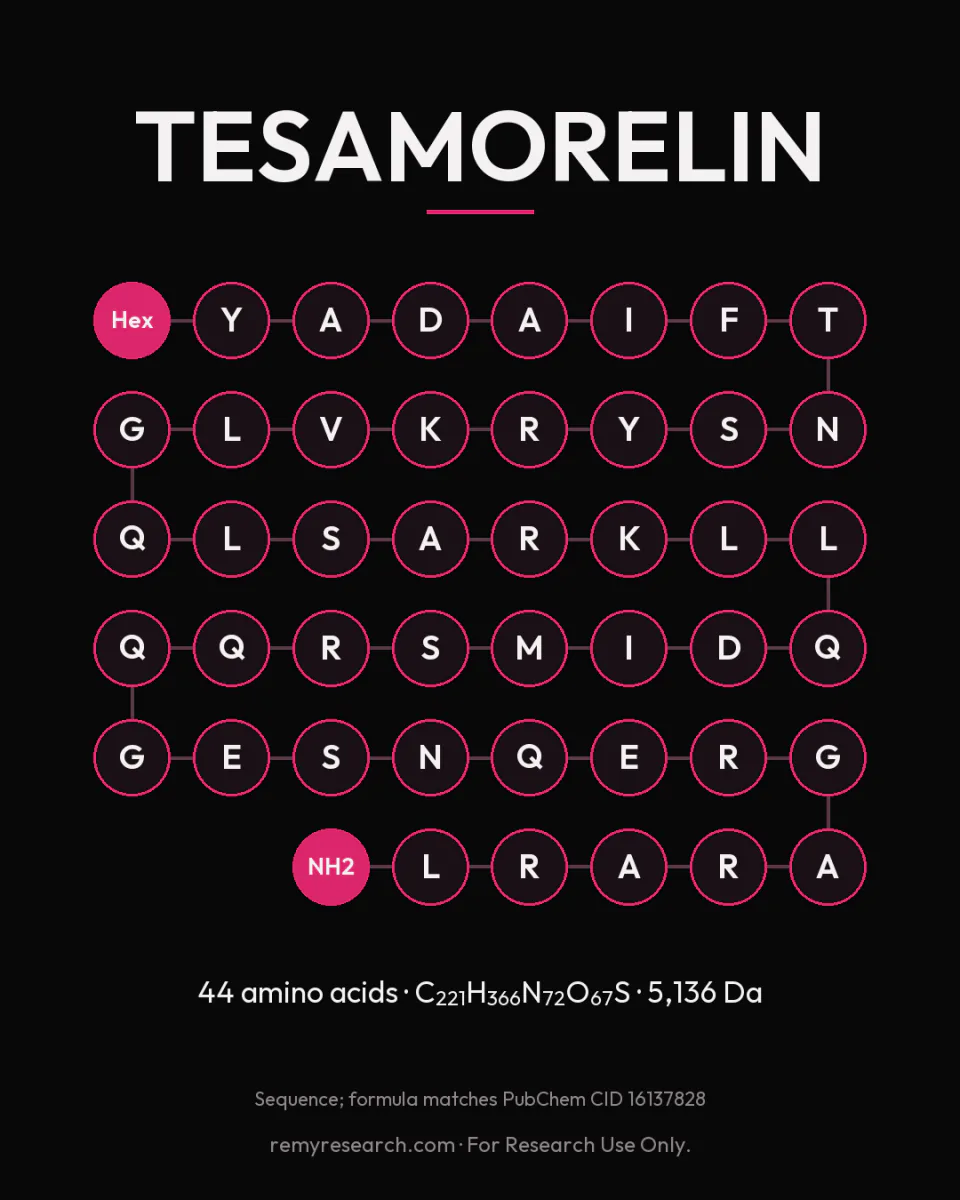
The tesamorelin peptide is a synthetic analog of growth hormone-releasing hormone (GHRH) built on the full 44-amino-acid human sequence. It acts on the pituitary gland, which then releases more of the body's own growth hormone. Its only FDA-approved use, sold as EGRIFTA, is reducing excess abdominal fat in adults with HIV-associated lipodystrophy.[1] This review is written for researchers. It sets out what the trials and the label show and where the data stop.
For a plain summary of what published studies report, see tesamorelin vs sermorelin: benefits, side effects and evidence.
Tesamorelin is a synthetic growth hormone-releasing factor (GHRF) analog. In practical endocrine terms, that means it acts upstream of growth hormone rather than being growth hormone itself. The approved U.S. product label places tesamorelin in a very specific category: a GHRF analog used for reduction of excess abdominal fat in HIV-infected adults with lipodystrophy.[1]
That narrow indication matters because tesamorelin is often discussed online as if it were a broad lifestyle or anti-aging compound. The official label says otherwise. It specifically states that tesamorelin is not indicated for weight-loss management and that long-term cardiovascular safety has not been established.[1]
For researchers, tesamorelin sits in a more evidence-backed position than many gray-market GH-axis peptides because there is a genuine randomized trial literature behind it. At the same time, that literature is population-specific, and responsible interpretation means staying close to the studied populations and endpoints.
How the Tesamorelin Peptide Works as a Growth Hormone-Releasing Hormone Analogue
The tesamorelin mechanism of action runs through the pituitary gland. The molecule keeps the full 44-amino-acid sequence of human GHRH and adds a hexenoyl group, a six-carbon chain, at the N-terminal tyrosine. In laboratory tests it binds and activates human GHRH receptors with about the same potency as the body's own hormone.[1]
GHRH acts on somatotroph cells in the pituitary gland. These cells then make endogenous growth hormone and release it in pulses. GH is both anabolic and lipolytic, so it affects tissue building and fat metabolism, and some of its effects are carried by IGF-1 made in the liver and other tissues. Tesamorelin stimulates GH secretion and raises IGF-1 and IGFBP-3. In the trials, other pituitary hormones (TSH, LH, ACTH and prolactin) showed no clinically significant change.[1]
This is the main difference between a GHRH analog and growth hormone itself. Recombinant GH supplies the end hormone directly. Tesamorelin works one step upstream, so the extra GH still comes from the pituitary and follows its physiologic pattern of pulses. GH secretion is reduced in people with excess visceral fat, which is the rationale for raising it this way. In a 2011 study of 13 healthy men, two weeks of tesamorelin raised mean overnight GH, GH peak area and basal secretion. The authors concluded that it augments basal and pulsatile growth hormone release. Fasting glucose and insulin-stimulated glucose uptake did not change significantly, so insulin sensitivity appeared preserved over that short period.[22] For how the GHRH analog tesamorelin compares with sermorelin, CJC-1295 and ipamorelin, see the GHRH peptides comparison.
Evidence and context
Tesamorelin has a real clinical literature, but its validated lane is narrow. The current FDA label describes tesamorelin as a growth hormone-releasing factor analog indicated only for the reduction of excess abdominal fat in HIV-infected adults with lipodystrophy and explicitly says it is not indicated for weight-loss management.[1] The best primary trial data come from the randomized HIV lipodystrophy program, where Falutz et al. reported significant visceral-fat reduction versus placebo over six months, with benefit maintained in participants who continued treatment.[2][3] Additional randomized work in HIV-associated NAFLD suggests tesamorelin can reduce liver fat and slow fibrosis progression in that specific setting.[4][5] That does not justify turning tesamorelin into a generic anti-aging or obesity shortcut in public-facing content.
The Strongest Evidence: HIV Lipodystrophy Randomized Trials
The core tesamorelin evidence base comes from randomized, placebo-controlled trials in HIV-infected adults with excess abdominal fat. Two phase 3 trials were run. In the second, a 12-month study of 404 patients published by Falutz et al. in 2010, visceral adipose tissue fell by 10.9% at six months on tesamorelin against 0.6% on placebo, with additional improvements in trunk fat, waist circumference, waist-to-hip ratio, and body-image distress.[2]
A useful detail from that paper is what did not change: abdominal subcutaneous fat did not move in a clinically meaningful way, which reinforces that the trial signal was about visceral-fat distribution rather than simple global weight loss.[2]
The extension data are just as important for interpretation. In the same program, participants who continued tesamorelin through 12 months maintained and deepened the visceral-fat response, while those switched from tesamorelin to placebo lost much of the improvement.[2] The separate long-term safety report described a comparable adverse-event pattern through the extension period and confirmed that benefit was not durable after discontinuation.[3]
| Endpoint | Tesamorelin | Placebo | Interpretation |
|---|---|---|---|
| Visceral adipose tissue at 6 months | -10.9% | -0.6% | Second phase 3 trial (2010, n=404) |
| Abdominal subcutaneous fat | No meaningful change | No meaningful change | Not a general weight-loss effect |
| Continuation vs discontinuation | Benefit maintained with continued therapy | Benefit lost after switch to placebo | Effect depends on ongoing exposure in the studied setting |
Tesamorelin and Liver Fat in HIV-Associated NAFLD
Tesamorelin later moved into another clinically relevant HIV-associated metabolic problem: nonalcoholic fatty liver disease. In the randomized multicenter trial by Stanley et al., tesamorelin reduced liver fat and prevented fibrosis progression over one year in HIV-associated NAFLD.[4] Follow-on mechanistic work by Fourman et al. linked those observations to changes in hepatic oxidative-phosphorylation, inflammatory, tissue-repair, and immune-pathway signatures.[5]
The tesamorelin fatty liver trial was small: 61 people were enrolled. Over 12 months, hepatic fat fraction fell by an absolute 4.1 percentage points more than placebo, a 37% relative reduction. At 12 months, 35% of the tesamorelin group and 4% of the placebo group were below the 5% hepatic fat fraction used as the entry threshold. Fasting glucose and HbA1c did not differ between groups. The trial was funded by the US National Institutes of Health and the National Institute of Allergy and Infectious Diseases.[4]
This is a meaningful expansion of the tesamorelin evidence story, but it is still not a license to generalize the compound into every liver-fat context or into every non-HIV population. The data remain condition-specific, and careful readers should keep that boundary intact.
A newer 2024 analysis in people with HIV receiving integrase inhibitors is directionally consistent with the earlier literature, but it remains a smaller follow-on study rather than a new broad indication.[6]
Key Benefits Documented in Tesamorelin Clinical Trials
The tesamorelin benefits that hold up in randomized data are body-composition and liver measures in adults with HIV-associated metabolic disease. All the results below come from placebo-controlled trials in people with HIV. The 52-week row is a change from baseline in people who stayed on tesamorelin.
| Endpoint | Tesamorelin vs placebo | Evidence |
|---|---|---|
| Visceral adipose tissue at 26 weeks | -15.2% vs +5.0% | First phase 3 trial (2007, n=412)[21] |
| Visceral adipose tissue at 52 weeks of continued use | About -18% from baseline | Extension phase[3] |
| Trunk fat | -1.18 kg vs placebo | 2026 meta-analysis of five trials[7] |
| Lean body mass | +1.42 kg vs placebo | Same meta-analysis |
| Waist circumference | -1.61 cm vs placebo | Same meta-analysis |
| Triglycerides at 26 weeks | -50 vs +9 mg/dL | First phase 3 trial |
| Hepatic fat fraction (HIV NAFLD) | -4.1 points absolute, -37% relative | Randomized trial, 61 people[4] |
| Weight and body mass index | No meaningful change | Label and 2026 meta-analysis[1][7] |
The 2026 meta-analyses report significant improvements in visceral fat, waist circumference, trunk fat and lean body mass.[7][18] In the first phase 3 trial, which enrolled 412 HIV-infected patients, IGF-1 rose by 81.0% on tesamorelin and fell by 5.0% in the placebo group. Glucose and insulin levels did not differ significantly between the groups.[21]
Tesamorelin Visceral Fat Results: Belly Fat Rather Than Fat Loss
Visceral adipose tissue is the fat stored inside the abdomen around the internal organs. The trials measured it by CT scan at the L4–L5 level.[1] Visceral fat accumulation during antiretroviral therapy is linked to higher cardiovascular risk, and the first phase 3 trial gives this as its reason for targeting it.[21] Tesamorelin reduced this visceral belly fat. In the 2010 trial, fat under the skin of the abdomen and limbs did not change.[2] The label calls the drug weight neutral.[1] Its trial signal is mainly about reducing visceral fat, and it does not translate into fat loss across the body.
Body Weight and Body Mass Index in the Trials
Weight barely moved. In the two phase 3 studies, mean weight changed by -0.4 kg and +0.5 kg on tesamorelin against 0.0 kg and +0.3 kg on placebo.[1] The 2026 meta-analysis of five randomized trials found no significant reduction in body mass index or in fat under the skin.[7] Taken together, the data describe a shift in overall body composition: less excess visceral fat and a little more lean mass at about the same body weight.
Lean Muscle: Tesamorelin Decreases Muscle Fat and Increases Muscle Area
A 2019 secondary analysis of the two phase 3 trials looked at trunk muscles on the same CT scans. It compared 193 tesamorelin responders, defined as people whose visceral fat fell by at least 8%, with 148 placebo participants over 26 weeks. Muscle density rose more than on placebo in all four trunk muscle groups, which points to less fat inside the muscle. Lean muscle area rose by 0.64 to 1.08 cm² across those groups, and the total muscle area of the rectus and psoas also increased.[23] The label reports lean body mass gains of 1.3 kg and 1.2 kg in the two studies against small losses on placebo.[1]
These are exploratory results. The analysis included responders only, and 87% of participants were men. The CT measures are area and density on one slice, not a direct reading of whole-body lean muscle mass.[23]
What the Official Label Says Researchers Should Not Ignore
The tesamorelin label is useful not only because it states the indication, but because it defines the official caution zone. Both current EGRIFTA labels, EGRIFTA WR (revised March 2025) and EGRIFTA SV (revised February 2024), each still listed on DailyMed, highlight:
- Elevated IGF-1 with monitoring expectations during treatment[1]
- Glucose intolerance or diabetes risk, including periodic glucose evaluation[1]
- Fluid-retention effects such as edema, arthralgia, and related discomfort[1]
- Hypersensitivity and injection-site reactions[1]
- Contraindications that include active malignancy and pregnancy[1]
The WR label also states that the two formulations are not substitutable.[1]
In a research article, these points do not function as consumer instructions. They function as guardrails for interpretation. If a compound needs this much labeling nuance even inside its approved indication, public-facing research content should be especially careful not to overstate its role outside that lane.
Tesamorelin Side Effects Reported in Trials and on the Label
The fullest record of tesamorelin side effects is the pooled 26-week placebo-controlled phase in the EGRIFTA label. It covers 543 people on tesamorelin and 263 on placebo, all HIV-infected adults with lipodystrophy. The table lists reactions that were more common on tesamorelin.[1]
| Reaction | Tesamorelin | Placebo | Interpretation |
|---|---|---|---|
| Injection-site reactions (redness, itching, pain) | 17% | 6% | Largest gap versus placebo |
| Arthralgia (joint pain) | 13% | 11% | Label links it to GH-related fluid retention |
| Myalgia (muscle pain) | 6% | 2% | Musculoskeletal |
| Peripheral edema | 6% | 2% | Edema-related reaction |
| Paresthesia (tingling) | 5% | 2% | Nerve symptom |
| Carpal tunnel syndrome | 1% | 0% | Edema-related reaction |
| HbA1c 6.5% or higher by week 26 | 5% | 1% | Hazard odds ratio 3.3 (CI 1.4–9.6) |
The label ties the swelling, joint pain and carpal tunnel syndrome to fluid retention linked to GH secretion, and says these effects are either transient or resolve when treatment stops. It also reports glucose intolerance (raised blood sugar), hypersensitivity reactions in 4% of treated patients, and IGF-1 above 2 standard deviation scores in 47% of patients after 26 weeks.[1] The 2026 meta-analysis of five randomized trials named the same pattern of arthralgia, myalgia, paresthesia and injection-site erythema, and reported no serious side effects.[7]
Two further label warnings matter when reading GH-axis data. Increased mortality has been reported after pharmacologic amounts of growth hormone in acute critical illness, including acute respiratory failure, and the label applies this warning because tesamorelin stimulates growth hormone production. Tesamorelin is also contraindicated when the hypothalamic-pituitary axis is disrupted, for example by pituitary surgery, hypopituitarism or head irradiation. The label has no information on people over 65.[1]
How Tesamorelin Should Be Framed for Research Use
Tesamorelin can be discussed more confidently than many speculative GH-axis compounds because the compound has randomized human data and an approved-product label. But the compliance-safe framing is still narrow: trial data, label language, observed outcomes, and research handling.
What should be avoided is the fast drift from "published data in a defined HIV population" to "general consumer transformation claims." That is exactly the kind of slippage Remy's research-use-only standard is designed to prevent, because labeling and implied intended use affect the compliance posture of a page. Tesamorelin is supplied strictly for in-vitro research use only.
For format and catalog context, see the in-stock Tesamorelin 10mg lyophilised vial and the Genovare Tesamorelin 25mg AQ pen (99%+ line standard); the ProPeptide Tesamorelin 20mg pen is currently out of stock. Each page keeps its own stock, price, handling, and evidence record. For practical handling questions, use the bacteriostatic water guide, storage guide, and mixing guide. For where tesamorelin sits next to CJC-1295, sermorelin, and ipamorelin across the GHRH axis, see the GHRH peptides side-by-side comparison. For an adjacent endocrine-axis compound studied under similar research-use framing, see the HCG gonadotropin research reference. For the broader compliance context, keep Are Peptides Legal in Dubai? nearby.
A two-case clinical vignette in Clinical Infectious Diseases (May 15, 2026) contrasts reported tesamorelin and GLP-1 receptor agonist use in excess visceral abdominal fat among people living with HIV. The vignette is useful as a descriptive research citation because it separates non-obese visceral-adiposity presentation from higher-BMI presentation, but it should not be read as treatment guidance or as support for consumer-facing claims outside the studied context.
2026 Evidence Update — Body Composition, Hepatic Fat, and the F8 Formulation
A 2026 publication indexed under PMID 41545261 collates body-composition, hepatic-fat, metabolic, and safety outcomes for tesamorelin and confirms the established direction of effect: improvements in visceral adipose tissue (VAT), hepatic fat, and lean body mass, with the expected on-treatment rise in IGF-1, and no signal of serious adverse events in the HIV-associated lipodystrophy population.[7] The same review is published in Obesity Research & Clinical Practice (doi 10.1016/j.orcp.2026.01.002).[8] The data direction is consistent with the prior randomized literature; what is useful in 2026 is the consolidated read across endpoints rather than any single new effect size.
A separate systematic review and meta-analysis of four randomized trials (909 participants), published in July 2026, found that tesamorelin reduced visceral adipose tissue, waist circumference and trunk fat and increased lean body mass compared with placebo; it also reported growth-hormone-related adverse effects and a trend toward more discontinuations that did not reach statistical significance (risk ratio 2.25, 95% CI 0.98–5.17).[18]
On the formulation side, Egrifta WR (F8) — the concentrated tesamorelin formulation — is now in active use. Trial activity through 2025–2026 is concentrated in HIV: the investigator-led TRIUMPH Phase 2 trial of tesamorelin as an adjunct to exercise for physical function in people with HIV (NCT06554717; not related to Lilly's retatrutide TRIUMPH program) is recruiting, and its protocol was published in BMJ Open in July 2026.[9][16] Outside HIV, a small Johns Hopkins Phase 2 trial in peripheral nerve injury (NCT03150511), open since 2018, is listed as recruiting;[19] a Phase 2 trial in adults with obesity and fatty liver disease (NCT03375788) was completed in January 2025; and, apart from one registry record labelled a mock study, no non-HIV NAFLD / MASH trial of tesamorelin was listed as recruiting on ClinicalTrials.gov as of October 12, 2026.[17] A 2026 double-blind pilot in 22 adults with cognition ranging from normal to mild cognitive impairment found no significant change in cognition, body composition, physical performance or glucose tolerance after 10 weeks of low-dose tesamorelin; only exploratory machine-learning analyses suggested regional brain differences.[20] For a research page, the relevant framing is that the evidence base is being deepened inside HIV-associated disease and probed in adjacent metabolic contexts — not that the label has expanded.
The 2026 pilot sits next to an earlier and larger randomized trial. In 2012, a 20-week placebo-controlled study of 152 adults aged 55 to 87, 66 of them with mild cognitive impairment, reported a favorable effect on cognition that was comparable in healthy older adults and those with mild cognitive impairment, with the clearest effect on executive function. IGF-1 rose by 117% and stayed within the physiological range, and percent body fat fell by 7.4%. Adverse events were mild and were reported by 68% of the tesamorelin group and 36% on placebo.[24]
Regulatory Status — An FDA-Licensed Medicine
Short answer: tesamorelin is FDA approved for one use. Its FDA approved indication is the reduction of excess abdominal fat in HIV-infected adults with lipodystrophy, and it has no approval as a general obesity or anti-aging drug.[1]
Our Research Standards
This article prioritizes primary trial publications and the current FDA label. The goal is to describe where tesamorelin has data, where the indication is narrow, and where public-facing wording should remain conservative. Read our editorial policy →
Tesamorelin Research FAQ
What is tesamorelin?
Tesamorelin is a synthetic GHRF analog. The current FDA label limits its approved use to reduction of excess abdominal fat in HIV-infected adults with lipodystrophy and explicitly says it is not indicated for weight-loss management.[1]
What is the strongest published tesamorelin evidence?
Is tesamorelin approved as a general obesity medicine?
No. The label does not position tesamorelin as a general obesity drug and specifically states that it is not indicated for weight-loss management.[1]
What does the research show for tesamorelin and liver fat in HIV?
What are the major official tesamorelin cautions?
The current FDA label highlights elevated IGF-1, glucose intolerance or diabetes, fluid retention, hypersensitivity, injection-site reactions, and contraindications including active malignancy and pregnancy.[1]
How should research content talk about tesamorelin?
With precision. The safest framing is around randomized trial data, label language, and research handling. It should not drift into open-ended anti-aging or treatment promises.
How does the tesamorelin peptide work?
It binds GHRH receptors on somatotroph cells in the pituitary gland, which then release more endogenous growth hormone in pulses. That GH in turn raises IGF-1. Tesamorelin itself acts one step upstream of growth hormone.[1]
What tesamorelin side effects were reported in clinical trials?
In the label's pooled 26-week data, injection-site reactions, arthralgia, myalgia, peripheral edema and paresthesia were more common on tesamorelin than on placebo. HbA1c reached 6.5% or higher in 5% versus 1%, and IGF-1 rose above 2 standard deviation scores in 47% of treated patients.[1]
Is tesamorelin FDA approved?
What is the difference between EGRIFTA WR and EGRIFTA SV?
What happens to visceral fat when tesamorelin is stopped?
Does tesamorelin work in people without HIV?
The evidence outside HIV is thin. A two-week study in 13 healthy men showed stronger GH pulses and higher IGF-1, and a 20-week trial in older adults reported better executive function. A 2026 pilot found no significant change in cognition or body composition. None of this has produced a new approved use.[22][24][20]
Sources
- U.S. Food and Drug Administration. EGRIFTA WR (tesamorelin for injection) Prescribing Information, revised March 2025 (current label). accessdata.fda.gov. EGRIFTA SV label, revised February 2024 (also current; DailyMed lists both labels): accessdata.fda.gov ↩
- Falutz J, Potvin D, Mamputu JC, et al. Effects of tesamorelin, a growth hormone-releasing factor, in HIV-infected patients with abdominal fat accumulation: a randomized placebo-controlled trial with a safety extension. J Acquir Immune Defic Syndr. 2010;53(3):311-322. doi: 10.1097/QAI.0b013e3181cbdaff · PMID: 20101189 ↩
- Falutz J, Allas S, Mamputu JC, et al. Long-term safety and effects of tesamorelin, a growth hormone-releasing factor analogue, in HIV patients with abdominal fat accumulation. AIDS. 2008;22(14):1719-1728. doi: 10.1097/QAD.0b013e32830a5058 · PMID: 18690162 ↩
- Stanley TL, Fourman LT, Feldpausch MN, et al. Effects of tesamorelin on non-alcoholic fatty liver disease in HIV: a randomised, double-blind, multicentre trial. Lancet HIV. 2019;6(12):e821-e830. doi: 10.1016/S2352-3018(19)30338-8 ↩
- Fourman LT, Billingsley JM, Agyapong G, et al. Effects of tesamorelin on hepatic transcriptomic signatures in HIV-associated NAFLD. JCI Insight. 2020;5(16):e140134. doi: 10.1172/jci.insight.140134 ↩
- Russo SC, Ockene MW, Arpante AK, et al. Efficacy and safety of tesamorelin in people with HIV on integrase inhibitors. AIDS. 2024;38(12):1758-1764. doi: 10.1097/QAD.0000000000003965 ↩
- 2026 consolidated review of tesamorelin body-composition, hepatic-fat, metabolic, and safety outcomes — VAT, hepatic fat, lean body mass, and IGF-1 changes in HIV-associated lipodystrophy without serious adverse events. PMID 41545261. pubmed.ncbi.nlm.nih.gov ↩
- Same 2026 review: Badran AS, Helal A, Shata KS, Ayesh H. Obesity Research & Clinical Practice. 2026;20(1):2-12. doi: 10.1016/j.orcp.2026.01.002 · ScienceDirect: sciencedirect.com ↩
- ClinicalTrials.gov. Tesamorelin as an Adjunct to Exercise for Improving Physical Function in HIV (TRIUMPH), NCT06554717. Massachusetts General Hospital; Phase 2; recruiting (checked October 12, 2026). clinicaltrials.gov ↩
- U.S. Food and Drug Administration. Drugs@FDA: BLA 022505 (EGRIFTA, tesamorelin; Theratechnologies): original approval November 10, 2010; former NDA deemed a BLA on March 23, 2020; supplement S-020 (Egrifta WR) approved March 25, 2025. accessdata.fda.gov ↩
- Theratechnologies Inc. Annual Information Form, financial year ended November 30, 2019 (exhibit 99.1, filed with the U.S. SEC, February 2020): FDA approval of the F4 formulation of EGRIFTA announced November 5, 2018. sec.gov ↩
- Theratechnologies Inc. press release (March 25, 2025), reposted by EATG: FDA approves EGRIFTA WR (tesamorelin F8); the F4 formulation is sold in the U.S. as EGRIFTA SV. eatg.org ↩
- U.S. Food and Drug Administration. Certain Bulk Drug Substances for Use in Compounding that May Present Significant Safety Risks (Category 2, including "Bulk drug substances nominated but withdrawn"). Content current as of April 22, 2026. fda.gov ↩
- U.S. Food and Drug Administration. July 23–24, 2026: Meeting of the Pharmacy Compounding Advisory Committee (agenda; Docket FDA-2025-N-6895). fda.gov ↩
- World Anti-Doping Agency. 2027 Prohibited List. Published September 21, 2026; in force January 1, 2027. wada-ama.org ↩
- Erlandson KM, et al. Tesamorelin as an Adjunct to Exercise for Improving Physical Function in HIV (TRIUMPH): a clinical trial protocol. BMJ Open. 2026;16:e120740. PMID 42419889. pubmed.ncbi.nlm.nih.gov ↩
- ClinicalTrials.gov. Growth Hormone Releasing Hormone Analog to Improve Nonalcoholic Fatty Liver Disease and Associated Cardiovascular Risk, NCT03375788. Massachusetts General Hospital; Phase 2; completed January 2025 (checked October 12, 2026). clinicaltrials.gov ↩
- Ditta AM, Naeem RM, Sami MM, et al. Efficacy and safety of tesamorelin in people living with HIV (PLWH) with lipodystrophy: a systematic review and meta-analysis. J Int Assoc Provid AIDS Care. 2026;25:23259582261475549. PMID 42538058. pubmed.ncbi.nlm.nih.gov ↩
- ClinicalTrials.gov. Tesamorelin to Improve Functional Outcomes After Peripheral Nerve Injury, NCT03150511. Johns Hopkins University; Phase 2; recruiting since 2018 (checked October 12, 2026). clinicaltrials.gov ↩
- Stewart CE, French KP, Wright TJ, et al. The effect of growth hormone-releasing hormone on cognition and brain connectivity in adults with cognition ranging from normal to mild cognitive impairment. eNeurologicalSci. 2026;44:100616. doi: 10.1016/j.ensci.2026.100616 · PMID: 42382101 ↩
- Falutz J, Allas S, Blot K, et al. Metabolic effects of a growth hormone-releasing factor in patients with HIV. N Engl J Med. 2007;357(23):2359-2370. doi: 10.1056/NEJMoa072375 · PMID: 18057338 ↩
- Stanley TL, Chen CY, Branch KL, Makimura H, Grinspoon SK. Effects of a growth hormone-releasing hormone analog on endogenous GH pulsatility and insulin sensitivity in healthy men. J Clin Endocrinol Metab. 2011;96(1):150-158. doi: 10.1210/jc.2010-1587 · PMID: 20943777 ↩
- Adrian S, Scherzinger A, Sanyal A, et al. The growth hormone releasing hormone analogue, tesamorelin, decreases muscle fat and increases muscle area in adults with HIV. J Frailty Aging. 2019;8(3):154-159. doi: 10.14283/jfa.2018.45 · PMID: 31237318 ↩
- Baker LD, Barsness SM, Borson S, et al. Effects of growth hormone-releasing hormone on cognitive function in adults with mild cognitive impairment and healthy older adults: results of a controlled trial. Arch Neurol. 2012;69(11):1420-1429. doi: 10.1001/archneurol.2012.1970 · PMID: 22869065 ↩
- Two-case clinical vignette contrasting tesamorelin and GLP-1 receptor agonist pathways for excess visceral abdominal fat in people living with HIV. Clin Infect Dis. 2026 May 15. PMID 42139091. pubmed.ncbi.nlm.nih.gov
For current catalog context, see Tesamorelin 10mg. For handling and storage, pair this page with the reconstitution guide and storage guide.