How to Reconstitute Peptides with Bacteriostatic Water
A research-first, step-by-step guide to peptide reconstitution: bacteriostatic water vs sterile water, sterile handling, concentration math, storage rules, and the exact workflow for lyophilised compounds.
Research summary
Bacteriostatic water is a sterile diluent containing benzyl alcohol as a preservative; its official specifications and handling are governed by product labeling and applicable standards.[1]
- Use of a diluent does not establish that a research peptide is suitable for human or veterinary administration.
- Concentration calculations are arithmetic only and do not validate a compound, protocol, sterility or stability.
This page is laboratory reference material, not an administration protocol; follow the institutional SOP and product label.
Summary revised November 1, 2026. This editorial update does not constitute a new literature review.
Update History ▾
October 23, 2026: Purity wording follows the 99%+ line standard.
October 17, 2026: Scoped the pen sentence to the formats it applies to: the ZPHC 60mg dual-chamber pen is mixed at activation, and 0.1 mg per click is the 30mg FlexiPen
October 12, 2026: Replaced the unsourced 14–28 day figure for reconstituted peptides with supplier guidance (about a week at 4°C; 28 days is the opened-vial sterility limit), removed the hard-coded bacteriostatic water prices and the unsupported "USP-grade" label on the ZPHC vials, limited the pen testing line to pens with a published batch report, corrected the hCG/oxytocin/vasopressin solvent line and the unsourced saline-precipitation claim, and added the 1.1% benzyl alcohol presentation
June 14, 2026: Tightened reconstitution and storage wording, aligned the FAQ answers with the page's structured data, and simplified the bundled-diluent note
April 28, 2026: Expanded the benzyl alcohol mechanism, added solvent-compatibility notes (saline, acetate-salt, acetic acid), refined storage labelling guidance, and tightened FAQ wording
April 14, 2026: Reframed around how-to-reconstitute-peptides intent, added HD workflow diagrams, refreshed FAQ wording, and updated storage guidance
Initial publication
Shipping note from Remy Research: bacteriostatic water is sold separately and is required to reconstitute lyophilised research vials — order the ZPHC 11mL vial or the 40mL bulk vial alongside your vials; each product page shows the current price and stock.
New to peptides? Start with our beginner's guide to peptides for a foundation on types, mechanisms, and research basics before diving into reconstitution.
Peptide Reconstitution Stability Guidelines: Using Bacteriostatic Water for Peptides
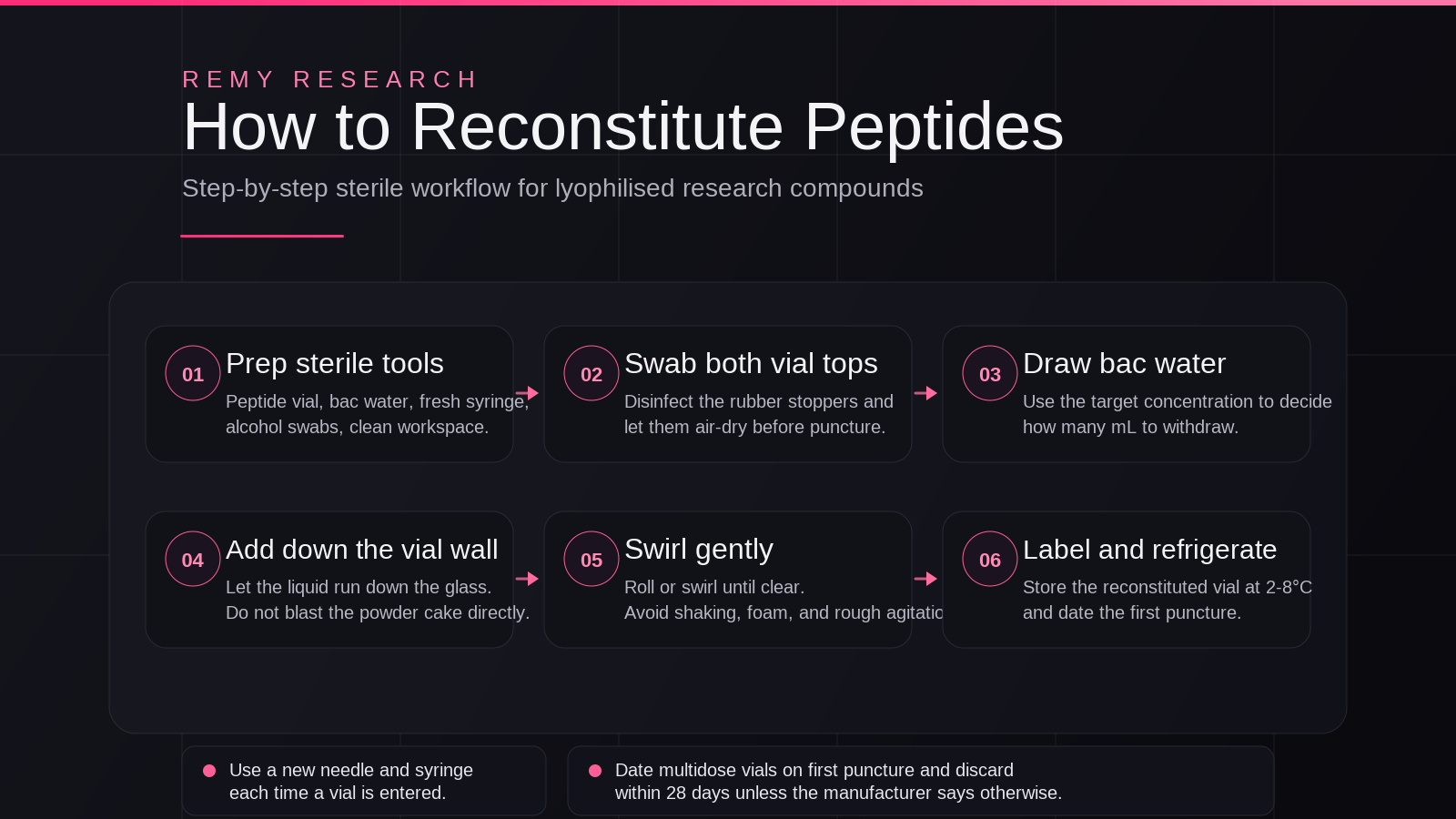
Start with the workflow before you touch the vial. The first diagram shows the sterile sequence. The second turns the concentration math into a fast visual reference so you can decide the right water volume before you draw anything.
Evidence and context
To reconstitute peptides, use a sterile technique, add the correct volume of bacteriostatic water slowly down the vial wall, and swirl gently until the powder fully dissolves. Bacteriostatic water contains 0.9% benzyl alcohol, which is why it is usually preferred for multi-dose peptide vials. Do not shake the vial, keep the finished solution refrigerated at 2–8°C, and date any multidose diluent vial when first punctured. For concentration math, use our peptide reconstitution calculator.
What Do You Use to Reconstitute Peptides?
Bacteriostatic water (often shortened to “bac water”) is sterile water for injection that contains 0.9% benzyl alcohol (9 mg/mL) as a bacteriostatic preservative.[1] Benzyl alcohol disrupts the cell membranes of microorganisms, which prevents bacteria from reproducing and causes cellular contents to leak out. It does not kill bacteria already present—it inhibits their multiplication—which is why the water must start sterile. This is what extends the usable life of a punctured multidose vial up to 28 days when handled properly.
For a plain summary of what published studies report, see whether bacteriostatic water needs refrigeration, and its shelf life.
This preservative action is what separates bacteriostatic water from plain sterile water for injection. Once a sterile water vial is punctured, there is no preservative present to suppress bacterial colonisation, so contamination risk rises with every draw. A bacteriostatic water vial, by contrast, can be punctured multiple times over a defined period because the benzyl alcohol continuously suppresses microbial proliferation. In practice, multidose vial handling guidance commonly uses a 28-day dating rule unless the manufacturer specifies otherwise.[5]
Bacteriostatic water is manufactured to United States Pharmacopeia (USP) standards. The USP monograph specifies the benzyl alcohol concentration, sterility requirements, endotoxin limits, and pH range (4.5–7.0).[1] When purchasing bacteriostatic water for peptide research, USP-grade compliance is a non-negotiable baseline.
Key Properties
- Preservative: 0.9% benzyl alcohol (w/v)
- Sterility: Must pass USP sterility testing at manufacture
- pH range: 4.5–7.0
- Multi-use: Up to 28 days after first puncture
- Route: Suitable for subcutaneous and intramuscular research applications
- Packaging: Typically available in 10 mL, 20 mL, and 30 mL glass vials
Bacteriostatic Water vs Sterile Water — Comparison
The distinction between bacteriostatic water and sterile water for injection is one of the most common sources of confusion in peptide reconstitution. Both are sterile at manufacture, but their intended use cases differ significantly.
| Property | Bacteriostatic Water | Sterile Water for Injection |
|---|---|---|
| Preservative | 0.9% benzyl alcohol | None |
| Multi-dose use | Yes (up to 28 days) | No — single use only |
| Shelf life after opening | 28 days | Immediate use, then discard |
| Bacterial inhibition | Active (benzyl alcohol) | None |
| Best for | Multi-dose peptide vials | Single-use preparations |
| Cost efficiency | Higher — one vial serves many doses | Lower — one vial per use |
| USP standard | USP Bacteriostatic Water | USP Sterile Water for Injection |
Normal saline (0.9% sodium chloride) is another solvent that appears in reconstitution protocols. It is isotonic, but solubility and compatibility differ by peptide and salt form, so check the compound's datasheet before using it. The same goes for the preservative: check the datasheet for benzyl alcohol compatibility. FDA-labelled chorionic gonadotropin (hCG), for example, is supplied with Bacteriostatic Water for Injection as its diluent.[11] For broader solvent compatibility considerations across blends and stacks, see our peptide interactions and mixing guide.
Bottom line: If the reconstituted peptide solution will be drawn from more than once, bacteriostatic water is the correct choice. Sterile water for injection is appropriate only when the entire reconstituted volume will be used in a single session, or when the specific peptide is preservative-sensitive.
How to Reconstitute Peptides Step by Step
Reconstitution is the process of dissolving a lyophilised (freeze-dried) peptide powder into a liquid solution using bacteriostatic water. Proper technique is critical for preserving peptide integrity and ensuring accurate dosing. Aseptic, sterile technique throughout the workflow is what keeps the multidose vial usable across the full discard window. Follow this step-by-step protocol:
Step 1 — Prepare Your Materials
Gather the lyophilised peptide vial, a vial of USP-grade bacteriostatic water, alcohol swabs, and an appropriately sized syringe (typically an insulin syringe or a 1–3 mL syringe with a 25–29 gauge needle). Ensure a clean workspace.
Step 2 — Swab Both Vial Tops
Use an alcohol swab to clean the rubber stopper on both the bacteriostatic water vial and the peptide vial. Allow each to air-dry for 10–15 seconds. This step reduces the risk of introducing contaminants through the needle puncture.
Step 3 — Draw the Bacteriostatic Water
Insert the syringe into the bacteriostatic water vial and draw the desired volume. The volume depends on your target concentration—see our reconstitution calculator for exact amounts. Common example: adding 2 mL of bac water to a 10 mg peptide yields 5 mg/mL (5000 mcg/mL).
Step 4 — Inject Along the Vial Wall
Insert the needle into the peptide vial and slowly dispense the bacteriostatic water down the inside wall of the vial. Do not inject directly onto the lyophilised powder cake. Directing the stream against the glass wall prevents the force of the liquid from damaging the peptide structure.
Step 5 — Swirl, Do Not Shake
Once the water is added, gently swirl the vial in a circular motion. Never shake a peptide vial. Vigorous shaking introduces mechanical stress and foam, both of which can shear peptide chains and accelerate denaturation, reducing potency.[6] The powder should fully dissolve within 1–3 minutes of gentle swirling. If any particulates remain, let the vial sit at room temperature for 5–10 minutes, then swirl again until you reach complete dissolution.
Step 6 — Verify and Store
Visual inspection is essential. The reconstituted solution should be clear and free of visible particles. Cloudiness or particulates may indicate degradation or contamination—discard and start fresh. Once dissolved, store the reconstituted vial in a refrigerator at 2–8°C and protect it from light. For detailed storage guidelines, see our peptide stability and storage guide.
Concentration Calculator — Get the Right Ratio
The amount of bacteriostatic water you add determines the concentration of the reconstituted peptide solution, which in turn determines how much liquid you draw for each dose. Getting this calculation wrong means inaccurate dosing throughout the entire vial.
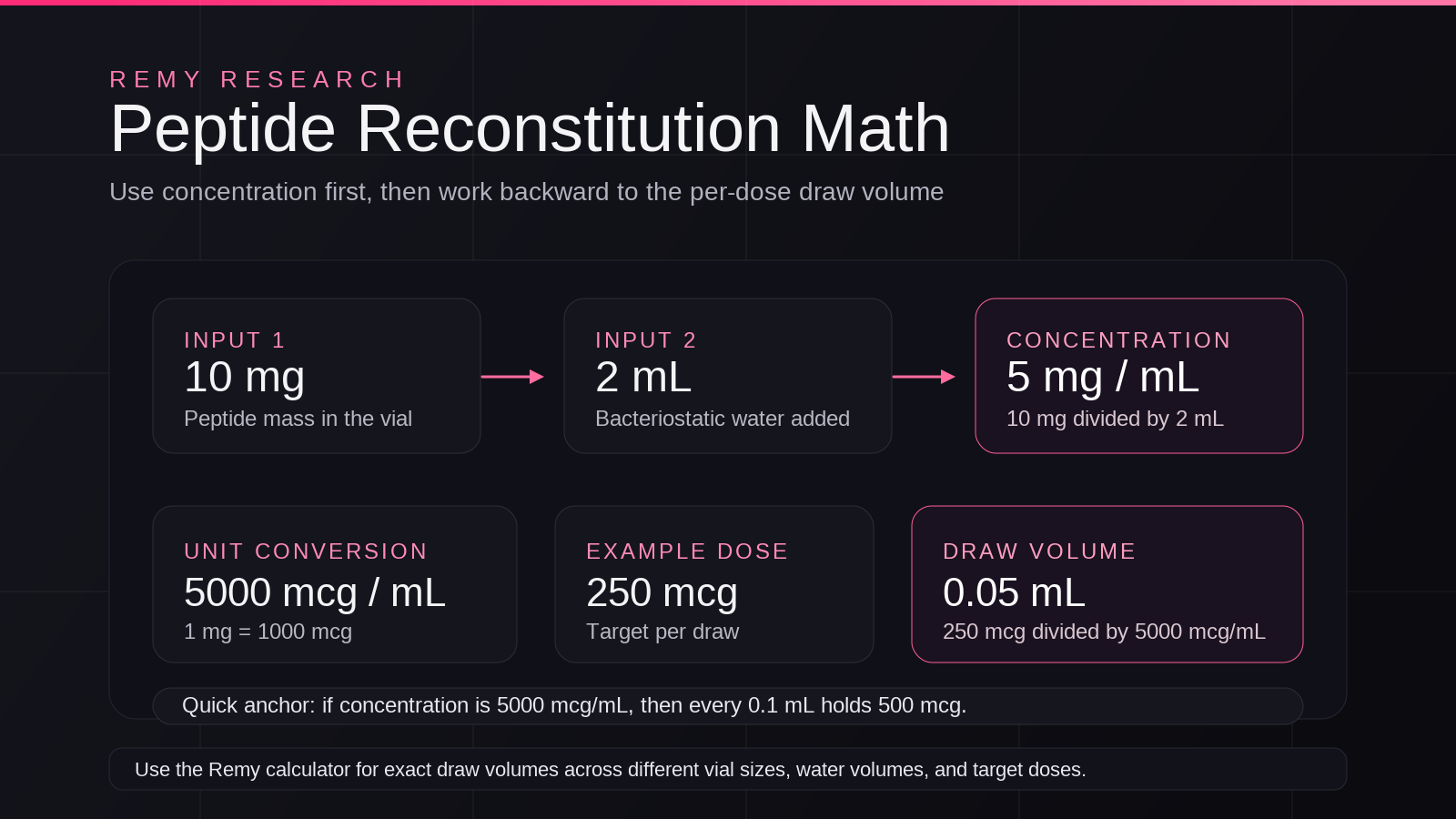
Our peptide reconstitution calculator handles this automatically. Enter the peptide mass (mg), the volume of bac water you plan to add (mL), and your target dose (mcg)—the calculator returns the exact syringe volume per dose. The optimal concentration varies by peptide; some compounds tolerate a wide range, others have a narrow stable window, so always check compound-specific guidance before locking in a dilution ratio. For lyophilised retatrutide vials, the retatrutide vial formats list the per-vial mass to plug into the math above.
Quick Reference Examples
| Peptide | Bac Water Added | Concentration | 0.5 mg Dose |
|---|---|---|---|
| 5 mg vial | 1 mL | 5 mg/mL | 10 units (0.10 mL) |
| 5 mg vial | 2 mL | 2.5 mg/mL | 20 units (0.20 mL) |
| 10 mg vial | 2 mL | 5 mg/mL | 10 units (0.10 mL) |
| 10 mg vial | 3 mL | 3.33 mg/mL | 15 units (0.15 mL) |
For precision across any peptide mass and water volume, always use the calculator rather than manual arithmetic.
Storage Requirements for Bacteriostatic Water
Proper storage of bacteriostatic water—both before and after opening—directly affects whether the preservative system functions as intended.
Unopened Vials
- Temperature: Store at controlled room temperature, 20–25°C (68–77°F)
- Light: Protect from direct light; store in original packaging or a dark cabinet
- Expiry: Follow the manufacturer’s printed expiration date
- Refrigeration: Not required for unopened vials
Opened (Punctured) Vials
- 28-day rule: Once the rubber stopper is punctured, date the vial and use within 28 days unless the manufacturer specifies a shorter or longer period[2]
- Temperature: Room temperature remains acceptable; refrigeration is optional for the diluent itself
- Label the date: Mark the vial with the date of first puncture and the reconstitution date—tracking both is essential for monitoring shelf life. Do not rely on memory.
- Discard after 28 days: Even if volume remains, the preservative system can no longer guarantee sterility beyond this window
Reconstituted Peptide Solutions
Once bacteriostatic water has been added to a lyophilised peptide, the resulting solution should be refrigerated at 2–8°C.
The storage rules shift from the bac water’s 28-day limit to the peptide’s own stability profile, which is much shorter: Sigma-Aldrich gives up to about a week at 4°C as the general figure for peptide solutions,[8] and Bachem advises keeping solutions as frozen aliquots rather than storing them long term.[9] The 28-day rule is a sterility limit for the opened diluent vial, not stability data for the peptide. See our peptide stability and storage guide for the sourced figures.
Quality Markers — What to Look For
Not all bacteriostatic water products are equivalent. When selecting a bac water source for peptide reconstitution, verify the following quality markers:
- USP-grade certification: The product should explicitly state compliance with the United States Pharmacopeia monograph for Bacteriostatic Water for Injection. This is the gold standard for pharmaceutical-grade diluents. For background on what a peptide COA actually verifies, see our peptide COA field guide.
- Benzyl alcohol concentration: Confirm the label states the benzyl alcohol content. USP bacteriostatic water labels specify 0.9% benzyl alcohol (9 mg/mL), with some presentations at 1.1% (11 mg/mL).[10] Lower concentrations may not adequately inhibit bacterial growth.
- Sterility testing: The manufacturer should perform and document sterility testing per USP <71>.[3] Ask for or verify that a Certificate of Analysis (COA) accompanies each lot.
- Endotoxin testing: USP <85> bacterial endotoxin testing should be performed. Endotoxins are heat-stable lipopolysaccharides from gram-negative bacteria that can remain even in sterile solutions.
- Lot tracking: Each vial should carry a visible lot number that maps to specific manufacturing and testing records. This enables traceability if any quality issue arises—the COA field guide above shows these checks applied to peptide lots.
- Packaging integrity: Glass vials with intact rubber stoppers and aluminium crimp seals. Avoid any product where the crimp seal shows signs of tampering or the stopper has been previously punctured.
Some products, such as bacteriostatic saline, contain both sodium chloride and benzyl alcohol. These are not interchangeable with bacteriostatic water for every peptide, so check compatibility against the compound's datasheet. For peptides that resist dissolving in water, dilute acetic acid is sometimes used as an alternative solvent, but compatibility should always be confirmed against the specific compound before use.
If a supplier cannot provide documentation for sterility testing and benzyl alcohol concentration, source elsewhere. The cost difference between certified and uncertified bac water is negligible; the risk difference is substantial.
Ordering bacteriostatic water from Remy Research for reconstitution
Bacteriostatic water is sold separately at Remy Research and is required to reconstitute lyophilised research vials. Order a ZPHC sterile bacteriostatic water vial (0.9% benzyl alcohol) alongside your research vials — the 11mL vial suits routine reconstitution and the 40mL bulk vial suits multi-vial workflows; each product page shows the current price. It ships in the same cold-chain box as your order.
Bacteriostatic water is stocked on remyresearch.com in ZPHC 11mL and 40mL vials. If a research workflow needs an even larger diluent volume, see the sourcing notes below.
Sourcing Bacteriostatic Water for Peptide Research
Bacteriostatic water availability has improved significantly as the peptide research market has grown. Researchers have several sourcing options:
Research Supply Channels
Specialised peptide and research chemical suppliers typically stock bacteriostatic water alongside their primary product lines. These suppliers are often the most reliable source because they understand the quality requirements for peptide reconstitution and can provide COAs on request.
Specialty Pharmacies
Certain compounding and specialty pharmacies carry USP-grade bacteriostatic water. Availability can be inconsistent, so call ahead. Pharmacies affiliated with research hospitals or clinics are more likely to stock it.
International Sourcing
Researchers can also order bacteriostatic water from international suppliers. When importing, verify that shipping conditions maintain appropriate temperatures, particularly during warm-weather months when ambient temperatures can exceed 45°C. Bacteriostatic water is relatively heat-stable compared to reconstituted peptides, but prolonged heat exposure can degrade the rubber stopper seal.
What About Remy Research?
Remy Research also stocks pre-filled retatrutide pens that need no reconstitution—no bacteriostatic water required (the ZPHC 60mg dual-chamber pen is the exception: it carries its own sterile water and is mixed at activation). Each pen is factory-sealed; the 30mg FlexiPen gives precise 0.1 mg-per-click dosing, and other pen strengths differ. Pens with an independent batch report are listed in our COA library; each product page states whether a pen has one. For lyophilised research vials in our catalogue, bacteriostatic water is sold separately as a ZPHC 11mL or 40mL vial—add one to your order to reconstitute them.
Our Research Standards
This article cites USP pharmacopeia standards, CDC multidose-vial dating guidance, sterility testing protocols, supplier peptide-handling guides, DailyMed drug labels, and established reconstitution best practices. All claims are cross-referenced against primary sources. We update articles when new guidance or regulatory decisions are published. Read our editorial policy →
Sources
- United States Pharmacopeia (USP). Bacteriostatic Water for Injection Monograph. USP–NF. usp.org ↩
- USP General Chapter <797> Pharmaceutical Compounding — Sterile Preparations. Beyond-use dating guidelines. usp.org/compounding ↩
- USP General Chapter <71> Sterility Tests. usp.org ↩
- USP General Chapter <85> Bacterial Endotoxins Test. usp.org
- Centers for Disease Control and Prevention. Standard Precautions: date multidose vials when first opened and discard within 28 days unless the manufacturer specifies otherwise. cdc.gov ↩
- Manning MC, Chou DK, Murphy BM, et al. Stability of Protein Pharmaceuticals: An Update. Pharm Res. 2010;27(4):544–575. PMID: 20143256. doi: 10.1007/s11095-009-0045-6. ↩
- Wang W. Instability, stabilization, and formulation of liquid protein pharmaceuticals. Int J Pharm. 1999;185(2):129–188.
- Sigma-Aldrich (Merck). Handling and Storage Guidelines for Peptides and Proteins. sigmaaldrich.com ↩
- Bachem. Handling and Storage Guidelines for Peptides. Bachem Knowledge Center. bachem.com ↩
- Bacteriostatic Water for Injection, USP (Hospira). Prescribing label. DailyMed, U.S. National Library of Medicine; label effective May 22, 2026. dailymed.nlm.nih.gov ↩
- Chorionic Gonadotropin for Injection, USP (Fresenius Kabi). Prescribing label: supplied with Bacteriostatic Water for Injection as diluent. DailyMed, U.S. National Library of Medicine. dailymed.nlm.nih.gov ↩