Oral GLP-1 for Weight Loss in 2026: Wegovy Pill vs Foundayo (Orforglipron) vs VK2735
A comparison of the three leading oral obesity drug candidates—Wegovy pill (oral semaglutide 25 mg), orforglipron, and oral VK2735—covering approval status, weight-loss data, and clinical trial timelines.
Update History ▾
October 22, 2026: Revised the page title and search description to match what readers search for: the two FDA-approved GLP-1 pills for weight loss and how their trial results compare.
October 20, 2026: Added the EMA CHMP positive opinion recommending EU marketing authorisation of Foundayo (October 15, 2026; European Commission decision still pending when checked October 20, 2026), Viking’s October 14, 2026 announcement that it had initiated the oral VK2735 SUNRISE Phase 3 programme (ClinicalTrials.gov still listed both trials as not yet recruiting at its October 16 update, with an estimated start in November 2026) and the peer-reviewed OUTSTAND-2 Phase 3 trial of investigational oral safiglipron (Nature Medicine, October 5, 2026). Updated the TL;DR, the status table, the Foundayo, VK2735 and “Which Oral Obesity Drug Matters Most?” sections and two FAQ answers; added four references; re-dated the table header and page stamp.
October 12, 2026: Corrected ATTAIN-1 — the trial never reported 14.3%; its top dose (36 mg in the trial, the same arm as the 17.2 mg Foundayo label dose) gave 12.4% vs 0.9% on the efficacy estimand and 11.2% vs 2.1% on the primary treatment-regimen estimand, superseding the May 17, 2026 note. Relabelled the Wegovy pill’s OASIS 4 figures (13.6% treatment-policy; 16.6% if adhered — the same figure Novo quoted to the CHMP, not a separate result). Fixed the decision framework (two approved oral GLP-1s, not one). Added the UAE approvals (Foundayo, announced April 3, 2026; Wegovy pill, June 1, 2026) with UAE pharmacy prices, the UK MHRA approval of the Wegovy pill (June 11, 2026), its Germany launch and Foundayo’s Saudi SFDA registration. Moved oral zenagamtide (amycretin) to Phase 3 (AMAZE 9). Added the VK2735 maintenance-study topline (September 22, 2026), the Part 2 start (October 6, 2026) and the oral Phase 3 SUNRISE trials (first posted October 9, 2026; not yet recruiting as of October 12). Corrected the VK2735 liver-fat line (it has no glucagon-receptor activity) and the cardiovascular-trial line (ACHIEVE-4). Table header re-dated.
October 11, 2026: Corrected the danuglipron section to Pfizer’s April 14, 2025 announcement (development ended after a potential drug-induced liver injury case, not in 2024 over tolerability) and replaced four broken or generic reference links: Lilly’s April 1, 2026 Foundayo approval release, Pfizer’s danuglipron update, Viking’s VANQUISH-2 enrollment release (March 26, 2026) and Novo Nordisk’s Q1 2026 report (Wegovy pill sales DKK 2,256 million).
October 10, 2026: Removed a stale "As of March 6, 2026" stamp from the first-approved oral GLP-1 answer.
October 7, 2026: Recorded the European Commission approval of the Wegovy pill and Wegovy 7.2 mg (July 15, 2026), the FDA approval of Wegovy HD 7.2 mg (March 19, 2026) and the UK MHRA authorisation of Foundayo (August 10, 2026); updated oral VK2735 Phase 3 timing to Q4 2026; added the Medicare GLP-1 Bridge (from July 1, 2026); corrected the outdated “orforglipron under review” line.
May 28, 2026: Updated VK2735 Phase 3 to "VANQUISH fully enrolled, readouts 2027" (VANQUISH-2 March 26; VANQUISH-1 April 29); corrected EMA CHMP opinion date to May 22, 2026; added Wegovy-pill DKK 2.26B first-launch-quarter commercial proof (Novo Q1 2026).
May 23, 2026: Reframed the article around the two FDA-approved oral GLP-1s for weight loss — Wegovy pill (oral semaglutide 25 mg, December 22, 2025) and Foundayo / orforglipron (April 1, 2026) — and added EMA CHMP positive opinion on the Wegovy pill (May 22, 2026, first oral GLP-1 recommended for EU weight management, 16.6% mean weight loss). FDA 503B bulks-list proposed exclusion of semaglutide / tirzepatide / liraglutide (April 30, 2026) added.
May 18, 2026: Added May 2026 research update on the Zaman & Amin Expert Opinion on Pharmacotherapy positioning review (PMID 42138103) framing orforglipron as a route-preference option rather than an efficacy leader.
May 17, 2026: Clarified ATTAIN-1 dose framing — FDA label caps at 17.2 mg (~12.4%); 36 mg trial dose reported ~14.3%.
March 6, 2026: Latest data review and formatting update
Initial publication
Research summary
OASIS 4 studied adults without diabetes who had obesity or overweight with a weight-related condition: oral semaglutide 25 mg produced 13.6% mean weight loss at 64 weeks under the treatment-policy estimand (trial report).
- ATTAIN-1 studied adults without diabetes who had obesity or overweight with a weight-related condition: orforglipron 36 mg produced 11.2% mean loss at 72 weeks under the treatment-regimen estimand (trial report).
- The article also compares oral VK2735 at its own trial stage; these separate results are not a direct ranking.
Summary revised November 1, 2026. This editorial update does not constitute a new literature review.
| Feature | Wegovy Pill | Orforglipron | Oral VK2735 |
|---|---|---|---|
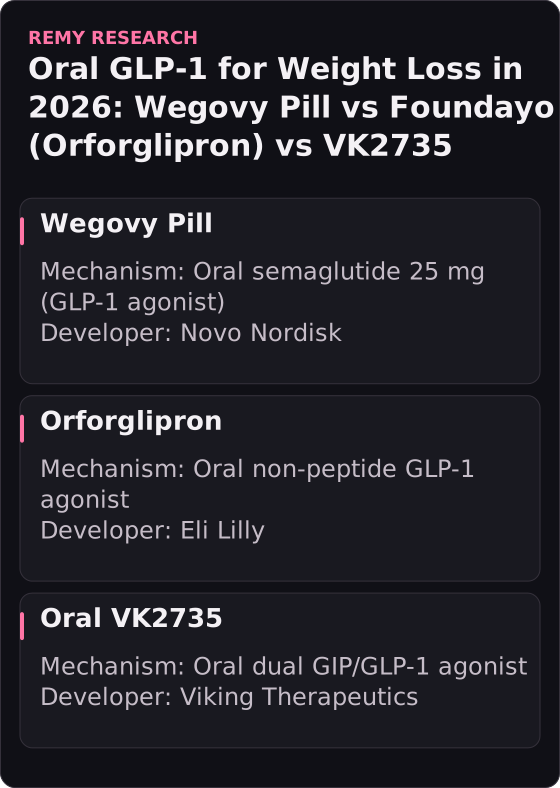
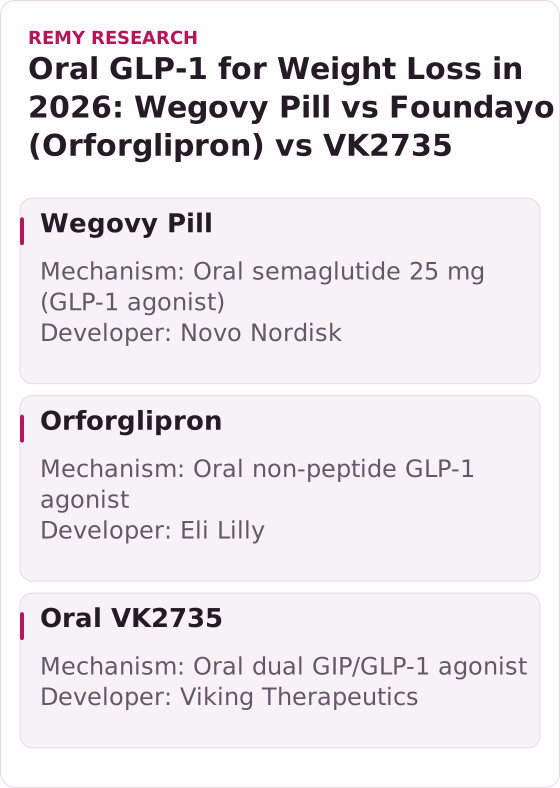
| Mechanism | Oral semaglutide 25 mg (GLP-1 agonist) | Oral non-peptide GLP-1 agonist | Oral dual GIP/GLP-1 agonist |
| Developer | Novo Nordisk | Eli Lilly | Viking Therapeutics |
| Status (October 20, 2026) | FDA approved Dec 22, 2025 (US launch Jan 2026); UAE June 1, 2026; UK MHRA June 11, 2026; EC July 15, 2026; launched in the US, UK, UAE and Germany | FDA approved April 1, 2026; UAE approval announced April 3, 2026; Saudi SFDA August 2, 2026; UK MHRA August 10, 2026; CHMP positive opinion October 15, 2026 (weight management and type 2 diabetes); European Commission decision pending | Positive Phase 2 data; oral Phase 3 SUNRISE 1/2 first posted October 9, 2026; Viking announced initiation October 14, 2026 (ClinicalTrials.gov: not yet recruiting, start est. November 2026); subcutaneous Phase 3 VANQUISH fully enrolled, readouts expected 2027 |
| Best Weight-Loss Figure | 13.6% (treatment-policy) / 16.6% (if adhered; trial-product), OASIS 4, 64 weeks | 11.2% (treatment-regimen) / 12.4% (efficacy) at 72 weeks (ATTAIN-1 top dose = Foundayo 17.2 mg) | Up to 12.2% at 13 weeks (VENTURE-Oral) |
| Study Duration | 64 weeks (Phase 3) | 72 weeks (Phase 3) | 13 weeks (Phase 2) |
| Key Differentiator | First approved oral GLP-1 for weight loss (Dec 22, 2025); EC approved July 15, 2026 | No food/water restrictions; non-peptide small molecule | Strongest short-duration data in class; dual GIP/GLP-1 |
What is the Wegovy Pill?
The Wegovy pill is a once-daily oral semaglutide 25 mg tablet for chronic weight management, building on the oral semaglutide platform first introduced with Rybelsus for type 2 diabetes. Novo Nordisk announced FDA approval on December 22, 2025. The company’s 2025 annual report and February 2026 investor materials confirm US launch in January 2026. In its first launch quarter the Wegovy pill booked DKK 2.26 billion in sales (Novo Nordisk Q1 2026, May 6, 2026) — the first hard commercial proof point that an oral GLP-1 can scale revenue, not just trial data.
Novo reports that oral semaglutide 25 mg delivered 16.6% mean weight loss in OASIS 4 when treatment was adhered to (trial-product estimand), which the company describes as on par with injectable semaglutide 2.4 mg; the primary treatment-policy result published in NEJM was 13.6% versus 2.2% with placebo, regardless of adherence. The Wegovy pill and Foundayo (orforglipron) are now the two FDA-approved benchmarks against which any investigational oral obesity drug is compared. The decision framework below provides a structured approach to evaluating these candidates.
Evidence and context
As of October 2026, two oral GLP-1s are FDA-approved for chronic weight management in the US: the Wegovy pill (oral semaglutide 25 mg, peptide + SNAC, approved December 22, 2025; 13.6% mean weight loss at 64 weeks in OASIS 4 regardless of adherence (treatment-policy estimand, vs 2.2% placebo), or 16.6% if treatment was adhered to (trial-product estimand)) and Foundayo / orforglipron (oral non-peptide GLP-1, Eli Lilly, approved April 1, 2026, 12.4% at 72 weeks on the efficacy estimand and 11.2% on the treatment-regimen estimand at the top dose — 36 mg in Phase 3 ATTAIN-1, sold as the 17.2 mg tablet). The European Commission approved the Wegovy pill on July 15, 2026, after a CHMP positive opinion on May 22, 2026. The UK MHRA authorised Foundayo for weight management and type 2 diabetes on August 10, 2026, its first authorisation in Europe; the MHRA had approved the Wegovy pill on June 11, 2026. On October 15, 2026, the European Medicines Agency’s human medicines committee (CHMP) adopted a positive opinion recommending EU marketing authorisation of Foundayo for weight management and type 2 diabetes in adults; the European Commission decision is pending. In the UAE, approval of Foundayo was announced on April 3, 2026 and of the Wegovy pill on June 1, 2026; both are sold on prescription in UAE pharmacies. Oral VK2735 (Viking Therapeutics) has positive Phase 2 data showing up to 12.2% weight loss at 13 weeks; its subcutaneous VK2735 Phase 3 VANQUISH programme is now fully enrolled (VANQUISH-2 completed March 26, 2026; VANQUISH-1 per the April 29, 2026 Q1 report), with both readouts expected in 2027. Two oral VK2735 Phase 3 trials were first posted October 9, 2026 — SUNRISE 1 (NCT07868835) and SUNRISE 2 in type 2 diabetes (NCT07868939). Viking announced on October 14, 2026 that it had initiated the SUNRISE Phase 3 programme; at its October 16, 2026 update, ClinicalTrials.gov still listed both trials as not yet recruiting, with an estimated start in November 2026; Viking’s October 28 quarterly report said both trials were underway. Cross-trial comparisons need caution because of different study lengths, populations, and estimands. Separately, the FDA proposed (April 30, 2026) excluding semaglutide, tirzepatide, and liraglutide from the 503B compounding bulks list — once finalised, this would block bulks-list compounding for these molecules.
What is Foundayo (Orforglipron)?
Foundayo (orforglipron) is Eli Lilly’s once-daily oral non-peptide GLP-1 receptor agonist — the first non-peptide small-molecule GLP-1 in pill form on the U.S. market. The non-peptide structure is what enables the dosing-window difference: Foundayo can be taken any time of day, with or without food and water, while peptide-based oral semaglutide tablets (Rybelsus, the Wegovy pill) need the SNAC empty-stomach window. Our retatrutide vs orforglipron comparison examines how Lilly’s oral and injectable programmes relate.
In August 2025, Lilly reported ATTAIN-1: the top dose (36 mg in the trial; 17.2 mg in the approved Foundayo formulation) lowered body weight by 12.4% at 72 weeks vs 0.9% for placebo (efficacy estimand), or 11.2% vs 2.1% on the primary treatment-regimen estimand (N Engl J Med 2025).
Foundayo was FDA-approved on April 1, 2026, cleared under the Commissioner’s National Priority Voucher pilot program 50 days after filing — the fastest approval of a new molecular entity since 2002. UAE approval was announced on April 3, 2026 (the second country worldwide), Saudi Arabia’s SFDA approved its registration on August 2, 2026, and the UK MHRA authorised Foundayo for weight management and type 2 diabetes on August 10, 2026. On October 15, 2026, the European Medicines Agency’s human medicines committee (CHMP) adopted a positive opinion recommending EU marketing authorisation of Foundayo (orforglipron) for weight management and type 2 diabetes in adults. EMA announced the opinion on October 16, 2026; the final decision rests with the European Commission and was still pending when we checked on October 20, 2026. EMA said the weight-management recommendation rests on two studies in 4,740 adults, in which weight loss at 72 weeks was about 5% to 11% depending on dose, versus about 2% to 2.5% on placebo.
A key supporting readout: ATTAIN-MAINTAIN (Aronne et al, Nat Med, May 12, 2026) showed orforglipron preserved 74.7% of weight loss in patients previously on tirzepatide and 79.3% in patients previously on semaglutide, over 52 weeks after switching off injectable GLP-1s — the first Phase 3 evidence that an oral GLP-1 can hold the line after stopping injectables.
What is Oral VK2735?
Oral VK2735 is Viking Therapeutics’ oral dual GIP/GLP-1 receptor agonist. In August 2025, Viking reported positive Phase 2 top-line data from VENTURE-Oral: oral VK2735 produced up to 12.2% mean weight loss after only 13 weeks versus 1.3% for placebo. The subcutaneous VK2735 Phase 3 programme has since moved ahead: VANQUISH-2 completed enrollment on March 26, 2026, and VANQUISH-1 was fully enrolled per Viking’s Q1 2026 report (April 29, 2026). Both Phase 3 readouts are expected in 2027. For the oral tablet, two Viking Phase 3 trials were first posted on ClinicalTrials.gov on October 9, 2026 (submitted October 5): SUNRISE 1 in adults with obesity or overweight without type 2 diabetes (NCT07868835) and SUNRISE 2 in adults with type 2 diabetes (NCT07868939). Each placebo-controlled trial runs 68 weeks and targets about 560 adults. Viking announced on October 14, 2026 that it had initiated the SUNRISE Phase 3 programme for oral VK2735. At its October 16, 2026 update, ClinicalTrials.gov still listed both trials as not yet recruiting, with an estimated start in November 2026; Viking’s October 28 quarterly report said both trials were underway.
The clinical interest is straightforward: if a 13-week oral dataset already exceeds 12% mean weight loss, the question is what longer-duration data will show. The caveat is equally clear—this is a much shorter study than Wegovy pill or orforglipron datasets, making direct comparisons premature. For UAE supplier verification around retatrutide research procurement, see our retatrutide supplier checklist.
Viking also reported a subcutaneous maintenance study (VK2735-102, Part 1, about 180 adults) on September 22, 2026: after 21 weeks of weekly injections (about 16–19% weight loss vs about 0% on placebo), participants switched to monthly or every-other-week injections kept up to 90% and up to 97% of the lost weight over the next 12 weeks, versus 61% on placebo; a small exploratory group that stayed on weekly injections (n=13) reached 21.7% at week 33. On October 6, 2026, Viking started Part 2, which adds oral-tablet and further subcutaneous maintenance arms in about 195 adults, with results expected in 2027. These are sponsor toplines on exploratory endpoints, and Part 1 did not test the oral formulation.
Oral VK2735 is investigational and not approved. Track all upcoming regulatory milestones on our obesity drug approval tracker for 2026.
Which Oral Obesity Drug Matters Most Right Now?
The answer depends on the question. What can patients access today? Two approved oral GLP-1s for chronic weight management in the US: the Wegovy pill and Foundayo (orforglipron, approved April 1, 2026). In the UAE, both are approved and sold on prescription: Foundayo’s approval was announced on April 3, 2026 (available from May 2026) and the Wegovy pill’s on June 1, 2026; UAE pharmacies list Foundayo at about AED 773–1,599 and the Wegovy pill at about AED 779–1,610 per 30 tablets (myAster, checked October 12, 2026). Our orforglipron vs Wegovy pill comparison has the full UAE table. Which approval is most likely to reshape competition next? Foundayo’s expansion outside the US (UAE, April 2026; Saudi Arabia and the UK, August 2026; in the EU, a CHMP positive opinion on October 15, 2026, with the European Commission decision pending) and the Wegovy pill’s EU approval (July 15, 2026). Which earlier-stage asset has the biggest upside-watch factor? Oral VK2735—striking short-duration data, with the Phase 3 SUNRISE trials first posted on ClinicalTrials.gov on October 9, 2026. For injectable context, our retatrutide vs tirzepatide vs CagriSema comparison shows how far ahead injectables remain.
If you need an approved oral GLP-1 for weight loss now → There are two: the Wegovy pill (oral semaglutide 25 mg; taken on an empty stomach; 13.6% treatment-policy / 16.6% if adhered in OASIS 4) and Foundayo (orforglipron; no food or water restrictions; 11.2% treatment-regimen / 12.4% efficacy estimand in ATTAIN-1). Both are FDA-approved, and both are approved in the UAE (Foundayo April 3, 2026; Wegovy pill June 1, 2026).
If no-fasting convenience matters most → Of the two approved pills, Foundayo (orforglipron) is the one without the empty-stomach and water restrictions, because its non-peptide structure does not need an absorption enhancer; the Wegovy pill has the larger weight-loss figure.
If maximum weight loss is the priority → Injectable drugs still far outperform oral options. Retatrutide (28.7%), tirzepatide (22.5%), and CagriSema (22.7%) all exceed the best oral result by a wide margin.
If you are tracking early-stage potential → Oral VK2735’s 12.2% at 13 weeks is an interesting signal, but the high dropout rate and the lack of Phase 3 results (the SUNRISE trials were only first posted in October 2026) make it speculative.
On May 22, 2026 the EMA Committee for Medicinal Products for Human Use (CHMP) issued a positive opinion on the Wegovy pill (oral semaglutide 25 mg) for EU weight management — the first oral GLP-1 recommended for EU weight management, with 16.6% mean weight loss and cardiovascular risk reduction supported in the dossier. On the same day, CHMP also issued a positive opinion on the Wegovy 7.2 mg single-dose pen (a higher-dose injectable), reporting up to 20.7% mean weight loss. The European Commission approved both the Wegovy pill and Wegovy 7.2 mg on July 15, 2026. In the US, the FDA had already approved the 7.2 mg dose as Wegovy HD on March 19, 2026. The 7.2 mg dose reframes the injectable ceiling.
The FDA proposed on April 30, 2026 to permanently exclude semaglutide, tirzepatide, and liraglutide from the 503B compounding bulks list. Once finalised, the rule would block 503B outsourcing facilities from compounding these molecules off the bulks pathway — effectively tightening the compounded-GLP-1 supply that grew during the 2022–2024 shortage. Practical impact lands on the compounded copies of the molecules behind the oral and injectable GLP-1s discussed in this article.
The oral GLP-1 conversation now has a current academic anchor: a narrative review in Expert Opinion on Pharmacotherapy (Zaman & Amin, May 15, 2026) frames orforglipron as a meaningful expansion of obesity pharmacotherapy for patients who prefer oral routes, but with the explicit caveat that comparative efficacy may not exceed the leading injectable incretins. The authors flag four gating uncertainties — long-term durability, persistence, affordability, and real-world safety — that will determine where orforglipron actually sits in routine care. An oral incretin’s value comes from route preference, tolerability, and access rather than beating injectables on weight loss.
What About Oral Zenagamtide (Amycretin)?
Oral zenagamtide (amycretin; zenagamtide is the generic name Novo Nordisk now uses) is Novo Nordisk’s unimolecular GLP-1/amylin receptor agonist in tablet form. Novo’s R&D pipeline lists it in Phase 3 for obesity, and the Phase 3 AMAZE 9 trial (NCT07720271) began recruiting on August 31, 2026, with primary completion estimated for mid-2028. No Phase 3 results have been reported (checked October 12, 2026).
The amycretin concept is noteworthy because it combines two distinct mechanisms — GLP-1 and amylin receptor agonism — in a single molecule. This is structurally different from orforglipron (GLP-1 only) and oral VK2735 (GLP-1/GIP). If the oral formulation delivers efficacy comparable to the injectable version, it could represent a meaningful advance. But it is too early to assess — the compound is years behind both the Wegovy pill and orforglipron in clinical development (no Phase 3 readout is expected before 2028).
Why Was Danuglipron Discontinued?
Pfizer discontinued development of danuglipron on April 14, 2025, after one asymptomatic participant in a once-daily dose-optimization study had potential drug-induced liver injury that resolved once the drug was stopped. Pfizer said the decision followed a review of all clinical data and recent input from regulators, and that liver-enzyme elevations across its safety database of more than 1,400 participants were in line with approved drugs in the class. Its discontinuation underscores that not every oral obesity drug candidate reaches the market — a reminder that positive Phase 2 efficacy data does not guarantee commercial viability.
Weight Loss Medications & Oral Obesity Drugs — The 2026 Landscape
Oral obesity drugs represent the next frontier in weight loss medications. For decades, obesity treatment relied on injectable GLP-1s, bariatric surgery, or older oral medications with modest efficacy. The arrival of oral formulations that rival injectable weight loss drugs in potency has reshaped the obesity market. Patients and clinicians now have multiple obesity medications under development that target GLP-1 receptors, GIP receptors, or both—all delivered as a daily pill or new pills in advanced clinical trials.
Why Oral Formulations Are Reshaping the Obesity Market
The obesity market has historically been dominated by weekly injection regimens. Many patients who need to lose weight prefer oral medications over injections, and the demand for oral obesity drugs is at an all-time high. Oral formulations remove barriers to adherence—no needles, no cold-chain storage, and integration into existing daily-pill routines. This shift is driving pharmaceutical companies to invest heavily in oral obesity medications, with several oral formulations now advancing through clinical trials simultaneously.
How GLP-1s Work as Weight Loss Medications
GLP-1s (glucagon-like peptide-1 receptor agonists) reduce appetite, slow gastric emptying, and enhance satiety signalling. As weight loss medications, GLP-1s help patients lose weight by acting on GLP-1 receptor pathways in the brain and gut. The GLP-1 receptor is the primary pharmacological target for both injectable and oral obesity drugs. Newer compounds like the retatrutide approval-status tracker add GIP receptor agonism and glucagon receptor engagement to produce greater weight loss than GLP-1-only obesity medications.
Clinical Trials & Trial Data for Oral Obesity Drugs
Clinical trials are the evidence backbone for every oral obesity drug seeking regulatory approval. As of 2026, the three leading candidates—Wegovy pill, orforglipron, and oral VK2735—have each produced clinical trial data from large, placebo-controlled studies. However, comparing clinical trial results across compounds is complicated by differences in study duration, patient populations, and statistical estimands. Patients enrolled in obesity clinical trials typically have a body mass index of 30 or above, or 27 with at least one weight-related comorbidity.
Key Clinical Trial Results Across Compounds
The OASIS programme (Wegovy pill) enrolled thousands of patients across multiple clinical trials evaluating oral semaglutide 25 mg for obesity. Eli Lilly’s ATTAIN programme generated clinical trial results for orforglipron across patients with obesity and type 2 diabetes. Viking Therapeutics’ VENTURE-Oral trial produced preliminary results in a shorter Phase 2 format. Each programme represents a different stage of clinical development, and clinical trial data from these studies collectively shapes the competitive landscape for oral obesity drugs in 2026.
Understanding Clinical Practice Implications
Clinical practice guidelines from major obesity medicine organisations increasingly recognise pharmacotherapy as a core pillar of obesity treatment. As clinical trial results translate into real-world clinical practice, clinicians must weigh efficacy, tolerability, cost, and patient preference when selecting among obesity medications. The availability of oral formulations expands the treatment toolkit for patients who previously declined injectable weight loss medications.
Obesity Treatment Beyond Weight Loss — Cardiovascular, Liver & Metabolic Benefits
Modern obesity treatment extends far beyond the scale. GLP-1-based obesity medications have demonstrated benefits for cardiovascular disease risk reduction, liver fat clearance, and metabolic health improvement. These broader health benefits are increasingly central to how clinicians and patients evaluate oral obesity drugs.
Major Adverse Cardiovascular Events (MACE) Data
Semaglutide (the active ingredient in Wegovy pill) demonstrated a 20% reduction in major adverse cardiovascular events in the SELECT trial—a landmark result for obesity medications. Major adverse cardiovascular events include heart attack, stroke, and cardiovascular death. This cardiovascular disease benefit is specific to semaglutide. Orforglipron’s cardiovascular-safety trial ACHIEVE-4 met non-inferiority against insulin glargine in type 2 diabetes (The Lancet, September 2026), but neither orforglipron nor oral VK2735 has an outcomes trial showing cardiovascular benefit. Heart failure outcomes are also under investigation, as obesity is a major risk factor for heart failure.
Liver Fat Reduction & MASH-Related Outcomes
Obesity is closely linked to non-alcoholic fatty liver disease (NAFLD) and metabolic dysfunction-associated steatohepatitis (MASH). GLP-1-based obesity medications have shown reductions in liver fat across clinical trials. Compounds that add glucagon-receptor activity, such as survodutide and retatrutide, are being studied for additional liver-fat reduction; VK2735 (a GLP-1/GIP dual agonist) does not act on the glucagon receptor, so any liver benefit would come through weight loss and its GLP-1/GIP arms.
Heart Failure, High Blood Pressure & Overall Health
Beyond major adverse cardiovascular events, oral obesity drugs may improve heart failure markers, reduce high blood pressure, and support overall health in patients with obesity. Weight loss of 10–15% is associated with clinically meaningful improvements in blood pressure, glycaemic control, and chronic disease burden. These benefits position oral obesity medications as treatments for the systemic consequences of obesity, not merely agents that help patients lose weight.
Obesity Care, Insurance Coverage & Patient Access
Obesity care in 2026 faces a fundamental access challenge. Even as highly effective obesity medications reach the market, insurance coverage remains inconsistent across countries and health systems. In the United States, Medicare coverage of obesity medications has been limited. Since July 1, 2026, the CMS Medicare GLP-1 Bridge gives eligible Part D enrollees certain GLP-1 medications for $50 a month, through December 31, 2027. Many private insurers still impose step therapy or prior authorisation requirements. High demand for GLP-1-based weight loss medications created supply constraints during 2022–2024, which limited patient access at the time.
Insurance Coverage for Oral Obesity Drugs
Insurance coverage is a critical barrier for patients seeking obesity medications. Without insurance coverage, the out-of-pocket cost of oral obesity drugs can exceed several hundred dollars per month. Policymakers and obesity medicine advocates argue that broader insurance coverage for obesity medications would reduce downstream costs from chronic diseases like type 2 diabetes, cardiovascular disease, and obstructive sleep apnea. As new oral obesity drugs enter the market, the insurance coverage landscape is expected to evolve.
Obesity Medicine & Clinical Practice Guidance
Obesity medicine is a rapidly growing specialty. Organisations such as the Obesity Medicine Association (OMA) and the European Association for the Study of Obesity (EASO) now publish clinical practice guidelines that incorporate oral obesity drugs. Obesity care increasingly emphasises a combined approach that pairs pharmacotherapy with lifestyle modification, psychological support, and long-term management. Harvard Medical School obesity researchers have published extensively on the evolving role of GLP-1s in obesity care and clinical practice.
Body Weight, Body Composition & Muscle Mass Considerations
Oral obesity drugs produce substantial reductions in body weight, but body composition changes matter as much as scale weight. Patients taking weight loss medications typically lose a combination of fat mass and lean mass. Preserving muscle mass during pharmacological obesity treatment is an active area of research and clinical concern.
Excess Weight, BMI & Waist Circumference
Clinical trials for oral obesity drugs measure efficacy using multiple endpoints: percentage body weight loss, absolute body weight reduction, proportion of patients achieving 5%, 10%, or 15% weight loss thresholds, and changes in body mass index and waist circumference. Patients with excess weight who lose 10% or more of body weight consistently show improvements in metabolic health markers. Waist circumference reduction is particularly meaningful because visceral fat drives much of the metabolic risk associated with obesity.
Muscle Mass, Muscle Loss & Strength Training
Muscle loss is a concern with all weight loss medications, including oral obesity drugs. Clinical trial data suggest that 20–40% of total weight lost during GLP-1 therapy may come from lean mass, though this varies across compounds and patient populations. Experts recommend strength training alongside obesity medications to preserve muscle mass and maintain metabolic rate. Strategies to preserve muscle mass—including adequate protein intake and resistance exercise—are increasingly incorporated into obesity treatment protocols.
GLP-1s & Substance Use Disorders — Emerging Research
One of the most unexpected findings in obesity research is the potential link between GLP-1s and substance use disorders. Preclinical and observational data suggest that GLP-1 receptor agonists may reduce addictive behaviours related to alcohol, nicotine, and other substance use disorders. Researchers at Harvard Medical School and other institutions have proposed that GLP-1s modulate reward systems in the brain, which may explain these broadly effective properties beyond obesity treatment.
Reward Systems & Broadly Effective Mechanisms
The GLP-1 receptor is expressed in brain regions involved in reward processing, including the nucleus accumbens and ventral tegmental area. GLP-1s appear to dampen reward systems that drive compulsive eating, substance use disorders, and other addictive behaviours. If ongoing clinical trials confirm these broadly effective mechanisms, GLP-1-based obesity medications could be repositioned for a much wider range of conditions—making them among the most broadly effective drug classes in modern medicine. Harvard Medical School researchers are leading several of these investigations.
Treating Diabetes, Chronic Kidney Disease & Comorbidities
Obesity frequently co-occurs with type 2 diabetes, chronic kidney disease, obstructive sleep apnea, and osteoarthritis. Oral obesity drugs that help patients lose weight also address these chronic diseases. Treating diabetes is a core indication for several GLP-1-based compounds, and the overlap between obesity medications and diabetes treatment has accelerated the development of oral formulations.
Oral Obesity Drugs for Treating Diabetes & Blood Sugar
Semaglutide was originally developed for treating diabetes before its obesity indication. Orforglipron has also shown blood sugar reduction in patients with type 2 diabetes. Another oral small-molecule GLP-1 receptor agonist, safiglipron (HRS-7535, developed by Hengrui and licensed outside Greater China to Kailera as KAI-7535), was non-inferior to dapagliflozin for HbA1c at 32 weeks in a Phase 3 trial of 810 adults with type 2 diabetes in China (OUTSTAND-2, NCT06589765, Nature Medicine, October 5, 2026). Mean weight change was −2.35% to −4.17% with safiglipron and −3.60% with dapagliflozin. Safiglipron is investigational. For patients with both obesity and diabetes, oral obesity drugs offer a dual benefit: clinically meaningful weight loss and improved glycaemic control. Treating diabetes with GLP-1-based obesity medications may reduce the need for insulin in some patients, simplifying overall chronic disease management.
Chronic Kidney Disease, Sleep Apnea & Osteoarthritis
Chronic kidney disease affects a substantial proportion of patients with obesity and diabetes. Clinical trials have begun evaluating GLP-1-based obesity medications for kidney-protective effects. Obstructive sleep apnea improves with weight loss, and tirzepatide recently received FDA approval for obesity-related obstructive sleep apnea—setting a precedent for oral obesity drugs. Osteoarthritis pain also improves with weight loss, as reduced body weight decreases mechanical load on weight-bearing joints. These other chronic diseases represent additional indications that could expand the market for oral obesity medications.
Daily Pill vs Weekly Injection — Dosing, Diet & Long-Term Management
The choice between a daily pill and a weekly injection involves trade-offs in convenience, efficacy, and adherence. Wegovy pill requires patients to take the tablet on an empty stomach with a small amount of water, then wait 30 minutes before eating—a constraint that orforglipron avoids as a non-peptide oral formulation. Weekly injection alternatives like injectable semaglutide or tirzepatide eliminate daily dosing but require self-injection. For patients seeking to improve weight loss outcomes, the choice depends on individual preferences, lifestyle, and clinical context.
Daily Pill vs Weekly Injection Convenience
A daily pill fits naturally into routines that already include other oral medications. However, the empty stomach requirement for peptide-based oral formulations like Wegovy pill can be inconvenient. New pills in development, such as orforglipron, eliminate food restrictions entirely. Weekly injection regimens require fewer doses but involve needle use. Patient surveys consistently show that many patients prefer oral obesity medications when efficacy is comparable—a preference that drives high demand for new oral formulations.
Reduced-Calorie Diet, Combined Strategy & Long-Term Management
All oral obesity drugs are indicated as adjuncts to a reduced-calorie diet and increased physical activity. Long-term management of obesity requires sustained treatment, as discontinuing obesity medications typically leads to weight regain. An approach that combines pharmacotherapy, behavioural counselling, strength training, and nutritional guidance offers the best prospect for durable weight loss. In early February 2026, several obesity medicine groups issued updated guidance emphasising long-term management strategies for patients on oral obesity medications and the importance of treating obesity as a chronic disease requiring ongoing other treatments beyond medication alone.
Further reading
Our Research Standards
This article cites peer-reviewed studies, FDA filings, and ClinicalTrials.gov data. All claims are cross-referenced against primary sources. We update articles when new trial data or regulatory decisions are published. Read our editorial policy →
- Novo Nordisk. FDA approves Wegovy pill and oral semaglutide 25 mg data. novonordisk.com
- Novo Nordisk. Annual Report 2025: Innovation and therapeutic focus. annualreport.novonordisk.com
- Novo Nordisk. Q4 2025 investor presentation, February 2026. novonordisk.com
- Eli Lilly. Orforglipron Phase 3 obesity results — ATTAIN-1. investor.lilly.com
- Eli Lilly. FDA approves Lilly's Foundayo (orforglipron), the only GLP-1 pill for weight loss that can be taken any time of day without food or water restrictions. April 1, 2026. investor.lilly.com
- Viking Therapeutics. Oral VK2735 Phase 2 results — VENTURE-Oral. ir.vikingtherapeutics.com
- Viking Therapeutics. February 11, 2026 corporate update. ir.vikingtherapeutics.com
- Pfizer. Pfizer Provides Update on Oral GLP-1 Receptor Agonist Danuglipron (development discontinued). April 14, 2025. pfizer.com
- Zaman W, Amin A. Orforglipron and the emergence of oral GLP-1 therapy for obesity: efficacy, safety, and clinical positioning. Expert Opin Pharmacother. 2026 May 15. PMID 42138103. pubmed.ncbi.nlm.nih.gov
- Novo Nordisk. FDA approves Novo Nordisk's Wegovy pill, the first and only oral GLP-1 for weight loss in adults. December 22, 2025. prnewswire.com
- Novo Nordisk. Wegovy pill (oral semaglutide) recommended by CHMP for approval in the EU as the first oral GLP-1. May 22, 2026. globenewswire.com
- Novo Nordisk. CHMP recommends EU approval of Wegovy 7.2 mg in a single-dose pen, up to 20.7% mean weight loss. May 22, 2026. finansavisen.no
- Reuters. US FDA proposes excluding semaglutide, tirzepatide, liraglutide from compounding bulks list. April 30, 2026. reuters.com
- Viking Therapeutics. Viking Therapeutics Announces Completion of Enrollment in Phase 3 VANQUISH-2 Trial of VK2735 (VANQUISH-1 enrollment completed in November 2025). March 26, 2026. ir.vikingtherapeutics.com
- Novo Nordisk. Financial report for the period 1 January 2026 to 31 March 2026 (Company announcement No 30/2026) — Wegovy pill Q1 2026 sales DKK 2,256 million. May 6, 2026. globenewswire.com
- Fierce Pharma. Novo gets head start on Lilly in Europe with EC approval of Wegovy pill (and Wegovy 7.2 mg). July 15, 2026. fiercepharma.com
- FDA. FDA approves fourth product under National Priority Voucher program, higher dose semaglutide (Wegovy HD 7.2 mg). March 19, 2026. fda.gov
- MHRA. UK first in Europe to authorise orforglipron for weight management and type 2 diabetes. August 10, 2026. gov.uk
- CMS. CMS to provide $50 monthly access to GLP-1 medications for Medicare beneficiaries (Medicare GLP-1 Bridge, July 1, 2026 – December 31, 2027). cms.gov
- Viking Therapeutics. Second quarter 2026 financial results and corporate update (oral VK2735 Phase 3 expected 4Q26). July 29, 2026. ir.vikingtherapeutics.com
- Wharton S, Aronne LJ, Stefanski A, et al. Orforglipron, an Oral Small-Molecule GLP-1 Receptor Agonist for Obesity Treatment (ATTAIN-1). N Engl J Med. 2025;393(18):1796–1806. PMID 40960239. pubmed.ncbi.nlm.nih.gov
- Wharton S, Lingvay I, Bogdanski P, et al. Oral Semaglutide at a Dose of 25 mg in Adults with Overweight or Obesity (OASIS 4). N Engl J Med. 2025;393(11):1077–1087. PMID 40934115. pubmed.ncbi.nlm.nih.gov
- Saudi Food and Drug Authority. SFDA approves registration of “Foundayo” for weight management. August 2, 2026. sfda.gov.sa
- MHRA. First GLP-1 tablet for weight loss approved in the UK. June 11, 2026. gov.uk
- Reuters. Novo Nordisk launches Wegovy weight-loss pill in Germany. September 1, 2026. reuters.com
- myAster (Aster DM Healthcare). Foundayo 30-tablet packs, UAE prices (checked October 12, 2026). myaster.com
- myAster (Aster DM Healthcare). Wegovy pill 30-tablet packs, UAE prices (checked October 12, 2026). myaster.com
- Viking Therapeutics. Positive topline results from maintenance study of GLP-1/GIP agonist VK2735 (Part 1). September 22, 2026. prnewswire.com
- Viking Therapeutics. Initiation of VK2735 oral maintenance dosing clinical trial in patients with obesity (Part 2). October 6, 2026. prnewswire.com
- ClinicalTrials.gov. Oral VK2735 for Weight Management Phase 3 (SUNRISE 1), NCT07868835; and in adults with type 2 diabetes (SUNRISE 2), NCT07868939. First posted October 9, 2026. clinicaltrials.gov
- ClinicalTrials.gov. AMAZE 9: zenagamtide tablets in people with excess body weight (Phase 3), NCT07720271. clinicaltrials.gov
- European Medicines Agency. New oral GLP-1 medicine for weight management and type 2 diabetes (CHMP positive opinion on Foundayo, orforglipron). October 16, 2026. ema.europa.eu
- European Medicines Agency. Foundayo (orforglipron): CHMP summary of positive opinion, EMA/CHMP/229918/2026 (EMEA/H/C/006632; opinion adopted October 15, 2026; checked October 20, 2026). ema.europa.eu
- Viking Therapeutics. Viking Therapeutics Announces Initiation of VK2735 Oral Phase 3 Clinical Program in Patients with Obesity (SUNRISE 1 and SUNRISE 2). October 14, 2026. ir.vikingtherapeutics.com
- Guo L, Yu D, Xu Y, et al. Oral small-molecule GLP-1RA safiglipron versus dapagliflozin in type 2 diabetes: a randomized, double-blind, active-comparator-controlled phase 3 trial (OUTSTAND-2, NCT06589765). Nat Med. 2026 Oct 5. doi:10.1038/s41591-026-04713-y. PMID 42834229. pubmed.ncbi.nlm.nih.gov